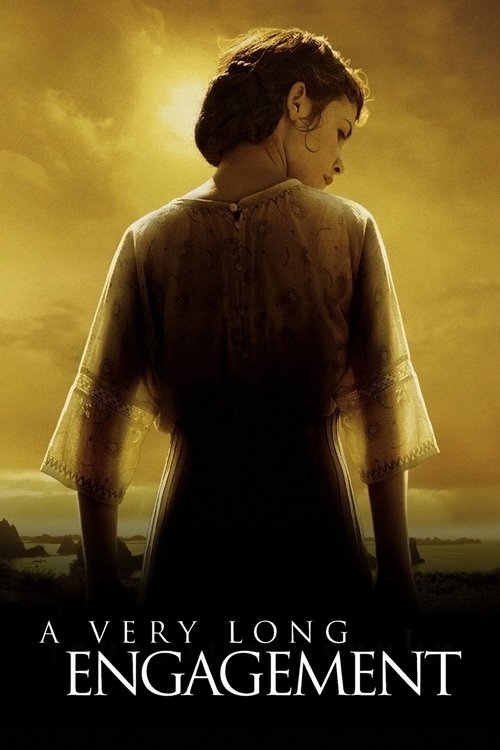
A Very Long Engagement (2004)
Directed by Jean-Pierre Jeunet
No — A Very Long Engagement is not woke, scoring 10 out of 100 on our wokeness meter.
There is a temptation, when confronted with a Jean-Pierre Jeunet film, to surrender to the whimsy and let the ledger go unexamined.
Consciousness Markers
Mathilde is a stubborn, resourceful woman who drives the entire investigation and refuses to accept the official account, but the film frames this as romantic devotion rather than any explicit feminist thesis.
The cast is almost entirely white French actors, but the film does center a disabled protagonist (Mathilde, a polio survivor who uses a cane and wheelchair) as its romantic lead, which is a genuine, story-integral element rather than a deliberate diversity push.
The film indicts the brutally corrupt French military justice system that condemned soldiers to die in no man's land, but this is anti-military-bureaucracy outrage rather than any critique of capitalism or wealth.
Mathilde's disability is presented matter-of-factly and she is portrayed as desirable and capable, but the film makes no modern body-positivity argument about it.
The film gestures at the cruelty of military tribunals, but it does so through narrative and character rather than any direct moralizing address to the audience.
No LGBTQ+ characters, themes, or subtext appear anywhere in the film.
The film engages no racial themes or commentary whatsoever; its concerns are entirely those of white French soldiers and civilians of the 1920s.
There is no environmental or climate-related content in the film.
Manech's amnesia is a plot device of war trauma, not a depiction of neurodivergence or neurodiversity.
The film is an explicitly fictional tale set against WWI, not a revisionist reframing of historical events or figures.
Why it received this score
There is a temptation, when confronted with a Jean-Pierre Jeunet film, to surrender to the whimsy and let the ledger go unexamined. We resist. A Very Long Engagement arrives from 2004, adapted from Sébastien Japrisot's 1991 novel, and concerns Mathilde, a polio survivor with a cane and a limp who refuses to accept the official account of her fiancé's death in the trenches. Audrey Tautou, working with the same director who made her a pixie of Montmartre, here spends most of the runtime limping through Brittany and Paris, interrogating survivors, hiring a private detective, and assembling a truth the French military would prefer remain buried. It is a handsomely mounted picture, all amber light and mud, and it takes the corruption of wartime tribunals seriously enough to hang a plot upon it.
On the matter of social consciousness, the film is a quiet specimen. Mathilde's disability is treated with a matter-of-factness that predates the current enthusiasm for such casting, and she is allowed to be desirable, stubborn, and sexually alive without a speech attached. The cast, however, is uniformly white and French, which reflects the demographics of 1920s rural France and not any deliberate exclusion. There is no racial consciousness here, no environmental sermon, no queer subtext, no examination of neurodiversity. Manech's amnesia is a wound of war, not a diagnosis. The film's anger is aimed squarely at military bureaucracy, which is not the same as an indictment of capital, and its feminist energy resides entirely in one woman's refusal to be told what happened to the man she loves. That is devotion, not a thesis.
The picture lectures no one. It shows a tribunal, a firing detail, a widow's grief, and lets the audience draw the conclusion unaided. This restraint is increasingly rare and should be noted with the gravity it deserves. A sommelier would call this vintage restrained, earthy, faintly romantic, and entirely untroubled by the anxieties of a later decade.
Analysis generated by our Consciousness Algorithm
Part of


Synopsis
Young Frenchwoman Mathilde searches for the truth about her missing fiancé, lost during World War I, and learns many unexpected things along the way. The love of her life is gone. But she refuses to believe he's gone forever — and she needs to know for sure.
Questions about A Very Long Engagement
Is A Very Long Engagement woke?
No — A Very Long Engagement is not woke, scoring 10 out of 100 on our wokeness meter. That earns it a verdict of Ultra Based.
Does A Very Long Engagement have any woke elements?
Very few. None of the 10 markers reaches 30, the level where a marker counts as present; the highest is Feminist Agenda at 20.
How does A Very Long Engagement compare to other 2004 movies?
It ranks #70 of the 178 films from 2004 we've scored; their average is 12. The wokest is Tropical Malady (62).
How is the Woke Score calculated?
An AI-assisted process researches the film and its reception, scores it 0–100 on ten markers, then combines those into one 0–100 Woke Score. It measures a specific set of 2020s cultural themes, not film quality.