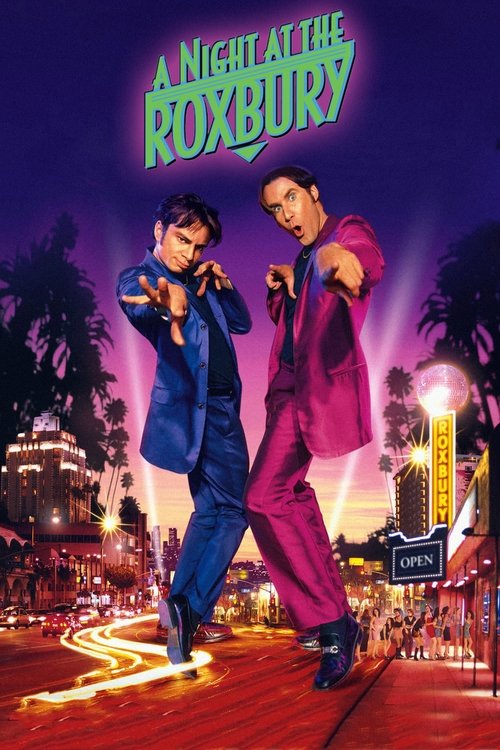
A Night at the Roxbury (1998)
Directed by John Fortenberry
No — A Night at the Roxbury is not woke, scoring 2 out of 100 on our wokeness meter.
A Night at the Roxbury arrives from 1998 with the quiet confidence of a film that has nothing on its mind and no intention of acquiring anything.
Consciousness Markers
A 1998 SNL sketch adaptation with a predominantly white cast; the few non-white or ethnic performers (e.g., Dan Hedaya) exist naturally in the story without any representational framing or comment.
No LGBTQ+ characters, themes, or subtext of any kind; the entire premise is two straight brothers pursuing women at nightclubs.
The film is built on the comedic objectification of women as club conquests and gold-diggers; it is if anything anti-feminist in its 1990s bro-comedy sensibility.
No engagement with race, racism, or racial identity whatsoever; the story is a white, affluent Los Angeles club scene.
No environmental or climate content of any kind.
The film is aspirational and pro-wealth: the brothers' goal is to be mistaken for rich, the women are attracted to money, and success means part-owning a hot club. No critique of capital.
No body-positivity themes; physical appearance is played for mockery rather than affirmation.
The brothers are portrayed as dim-witted and immature, but never framed through a neurodivergence lens.
No historical subject matter to revise; the film is a contemporary (1998) comedy.
The film has no didactic or preachy agenda; it is a one-joke sketch stretched to feature length with no message to deliver.
Why it received this score
A Night at the Roxbury arrives from 1998 with the quiet confidence of a film that has nothing on its mind and no intention of acquiring anything. Two brothers, well into adulthood, live at home, work in their father's artificial plant shop, and spend their evenings bobbing their heads in unison at Los Angeles nightclubs while being rejected by women. The source material was a recurring Saturday Night Live sketch, and the screenplay stretches a single visual gag across ninety minutes with the determination of a man inflating a balloon he knows will pop.
There is no social consciousness here to catalogue, and the exercise is a short one. The women exist as conquests or as gold-diggers who vanish once the money proves imaginary. The brothers want to be mistaken for rich, and the film agrees that this is a worthy ambition. Capital is not critiqued; it is aspired to. There is no racial reckoning, no environmental sermon, no neurodivergent framing, no historical revision, and no lecture delivered from any pulpit. The physical comedy mocks bodies instead of affirming them. The remainder is a comedy of aspiration in which the aspiration is a nightclub and the comedy is two grown men failing to enter it.
One modest observation belongs in the ledger. Dan Hedaya appears as the exasperated father, and a handful of ethnic performers populate the margins without the film ever commenting on their presence. They are simply there. That is the entire sum of the film's cultural awareness, and it is not awareness so much as casting. Roger Ebert noted that laughing at these characters felt cruel. The characters would not have minded. They are on the list now.
Analysis generated by our Consciousness Algorithm
Part of


Synopsis
Despite being well into adulthood, brothers Doug and Steve Butabi still live at home and work in the flower shop owned by their dad. They exist only to hit on women at discos, though they're routinely unsuccessful until a chance run-in with Richard Grieco gets them inside the swank Roxbury club. Mistaken for high rollers, they meet their dream women, Vivica and Cambi, and resolve to open a club of their own.
Questions about A Night at the Roxbury
Is A Night at the Roxbury woke?
No — A Night at the Roxbury is not woke, scoring 2 out of 100 on our wokeness meter. That earns it a verdict of Ultra Based.
Does A Night at the Roxbury have any woke elements?
Very few. None of the 10 markers reaches 30, the level where a marker counts as present; the highest is Representation Casting at 5.
How does A Night at the Roxbury compare to other 1998 movies?
It ranks #107 of the 118 films from 1998 we've scored; their average is 12. The wokest is Show Me Love (60).
How is the Woke Score calculated?
An AI-assisted process researches the film and its reception, scores it 0–100 on ten markers, then combines those into one 0–100 Woke Score. It measures a specific set of 2020s cultural themes, not film quality.