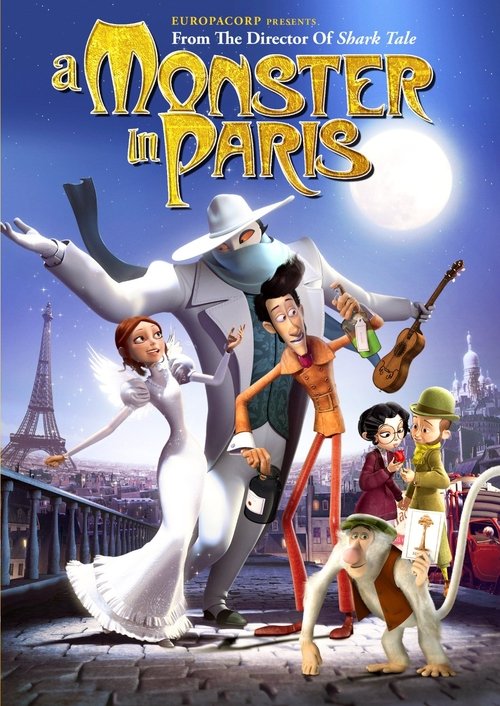
A Monster in Paris (2011)
Directed by Bibo Bergeron
No — A Monster in Paris is not woke, scoring 12 out of 100 on our wokeness meter.
A Monster in Paris arrives from 2011, a French animated musical set during the Great Flood of 1910, in which a shy projectionist, a clumsy inventor, and a cabaret singer named Lucille conspire to protect an oversized flea with an operatic voice from a police commissioner with mayoral ambitions.
Consciousness Markers
Lucille is an independent cabaret star who resists her aunt's pressure to marry the wealthy commissioner and drives the plot on her own terms, though the framing is romantic rather than ideological.
The central conceit of a gentle, misunderstood 'monster' accepted for his inner heart rather than his appearance offers a mild acceptance-of-the-different theme, though it plays as fairy-tale humanism rather than modern body-positivity messaging.
The film carries a gentle tolerance message for younger viewers, but it is delivered through song and story rather than preachy sermonizing.
The villainous Police Commissioner Maynott is a wealthy, power-hungry mayoral candidate whom Lucille is pressured to marry, giving a faint populist edge, but there is no systemic critique of capitalism.
The cast and characters are drawn from a thoroughly homogeneous French/European context with no deliberate diversity casting; the ensemble is white and unremarked upon.
No LGBTQ+ characters, themes, or subtext appear anywhere in the story.
There is no engagement with race, racism, or racial identity in the film.
The 1910 Great Flood of Paris is a period backdrop, not climate messaging; the sunflower-seed resolution is whimsy, not environmental advocacy.
No neurodivergent characters or themes are present or coded.
The Belle Époque Paris setting and flood are decorative period dressing with no revisionist reframing of historical events.
Why it received this score
A Monster in Paris arrives from 2011, a French animated musical set during the Great Flood of 1910, in which a shy projectionist, a clumsy inventor, and a cabaret singer named Lucille conspire to protect an oversized flea with an operatic voice from a police commissioner with mayoral ambitions. The film was directed by Bibo Bergeron, produced by Luc Besson, and it borrows its bones from The Phantom of the Opera while dressing them in Belle Époque watercolors. It is a pleasant thing. It is also, by the standards of our current cultural accounting, almost eerily quiet.
Lucille deserves a mention. She sings, she resists her aunt's matrimonial scheming, and she drives the plot on her own terms, which earns the film a modest credit on the feminist ledger. The villain is a wealthy office-seeker who weaponizes the monster hunt for votes, a faint populist tingle that stops well short of any structural complaint about capital. The central conceit, a gentle creature judged by his heart instead of his carapace, offers a mild acceptance-of-the-different theme, the sort of fairy-tale humanism that has soothed children since long before anyone thought to give it a label. The tolerance lesson arrives through song, which is the least objectionable delivery method available.
The rest of the ledger sits empty. The cast is uniformly European and unremarked upon. There is no engagement with race, no LGBTQ presence, no neurodivergent coding, no climate argument (the flood is scenery, and the sunflower seeds are whimsy), and no revisionist reframing of history. Paris here is postcard, not polemic. The result is a charming, well-mannered cartoon that predates the culture's appetite for instruction and shows no interest in acquiring one. It is a small mercy. Score it accordingly.
Analysis generated by our Consciousness Algorithm


Synopsis
Paris, 1910. Emile, a shy movie projectionist, and Raoul, a colourful inventor, find themselves embarked on the hunt for a monster terrorizing citizens. They join forces with Lucille, the big-hearted star of the Bird of Paradise cabaret, an eccentric scientist and his irascible monkey to save the monster, who turns out to be an oversized but harmless flea, from the city's ruthlessly ambitious police chief.
Questions about A Monster in Paris
Is A Monster in Paris woke?
No — A Monster in Paris is not woke, scoring 12 out of 100 on our wokeness meter. That earns it a verdict of Ultra Based.
Does A Monster in Paris have any woke elements?
Very few. None of the 10 markers reaches 30, the level where a marker counts as present; the highest is Feminist Agenda at 22.
How does A Monster in Paris compare to other 2011 movies?
It ranks #71 of the 245 films from 2011 we've scored; their average is 11. The wokest is Paul (68).
How is the Woke Score calculated?
An AI-assisted process researches the film and its reception, scores it 0–100 on ten markers, then combines those into one 0–100 Woke Score. It measures a specific set of 2020s cultural themes, not film quality.