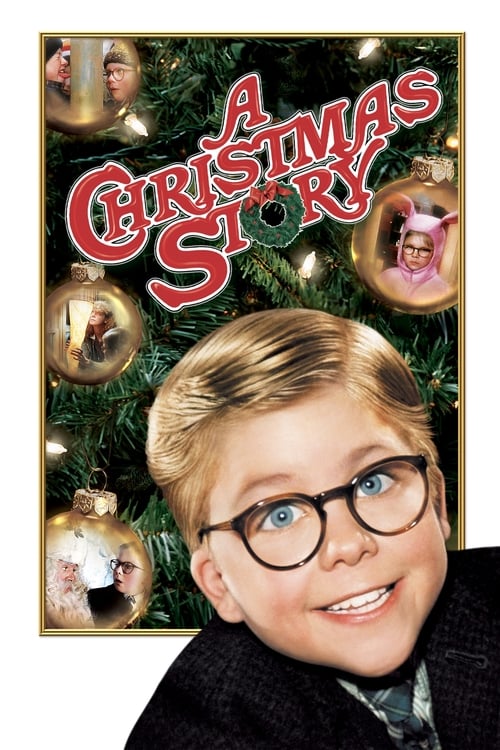
A Christmas Story (1983)
Directed by Bob Clark
No — A Christmas Story is not woke, scoring 0 out of 100 on our wokeness meter.
There is a school of critical thought that holds every cultural artifact must be audited against the moral ledger of the present moment.
Consciousness Markers
The cast is overwhelmingly white, with no deliberate modern diversity casting. The Chinese restaurant scene uses ethnic stereotypes rather than progressive representation.
There are no LGBTQ+ characters, themes, or subtext.
The mother has some agency in family matters, but the film does not advance a feminist agenda or critique patriarchy.
The Chinese restaurant sequence relies on broad ethnic humor, not racial consciousness or social critique.
There is no environmental or climate-related theme.
The film gently mocks holiday consumerism and a radio commercial, but it does not advocate anti-capitalist politics.
There is no body positivity theme or messaging.
There is no exploration of neurodivergence or neurodiverse characters.
The 1940s setting is nostalgic and personal, not a revisionist historical narrative.
The film is a light comic memoir and does not lecture the audience on social or political issues.
Why it received this score
There is a school of critical thought that holds every cultural artifact must be audited against the moral ledger of the present moment. A Christmas Story, released in 1983 and adapted from Jean Shepherd's semi-autobiographical short stories, presents the auditor with a nearly blank page. It concerns a nine-year-old boy in 1940s Indiana who wants a BB gun, and the various adults who tell him he will shoot his eye out. The film is nostalgic, episodic, and entirely preoccupied with the interior weather of one small family. It has no argument to make about the world beyond that family, and it makes none.
The cast is uniformly white, drawn from the ordinary demographics of mid-century northwest Indiana, and the film makes no effort to correct this. The one sequence involving characters of non-European descent, a Christmas dinner at a Chinese restaurant after the neighbors' dogs devour the turkey, plays the staff for broad ethnic comedy, with the proprietor mangling his Ls and a carol rendered in fractured English. This is not racial consciousness. It is a gag from 1983 that has aged into a liability, which is a different thing entirely.
The women in the film, chiefly Mrs. Parker, are granted a certain domestic cunning. She sabotages the leg lamp, deflects her husband's temper, and manages the household economy with quiet competence. The film observes this without commenting on it, and a feminist reading would have to be imported from outside. There is no environmental theme, no critique of capital beyond a mild joke at the expense of an Ovaltine commercial, no engagement with body image, neurodivergence, or the historical record. The film's ambition is to be funny about a furnace and a flagpole, and it succeeds. On the ledger, every column reads zero. A relic, and an honest one.
Analysis generated by our Consciousness Algorithm


Synopsis
The comic mishaps and adventures of a young boy named Ralph, trying to convince his parents, teachers, and Santa that a Red Ryder B.B. gun really is the perfect Christmas gift for the 1940s.
Questions about A Christmas Story
Is A Christmas Story woke?
No — A Christmas Story is not woke, scoring 0 out of 100 on our wokeness meter. That earns it a verdict of Ultra Based.
Does A Christmas Story have any woke elements?
No. All 10 markers score zero.
How does A Christmas Story compare to other 1983 movies?
It ranks #31 of the 38 films from 1983 we've scored; their average is 10. The wokest is Sans Soleil (68).
How is the Woke Score calculated?
An AI-assisted process researches the film and its reception, scores it 0–100 on ten markers, then combines those into one 0–100 Woke Score. It measures a specific set of 2020s cultural themes, not film quality.