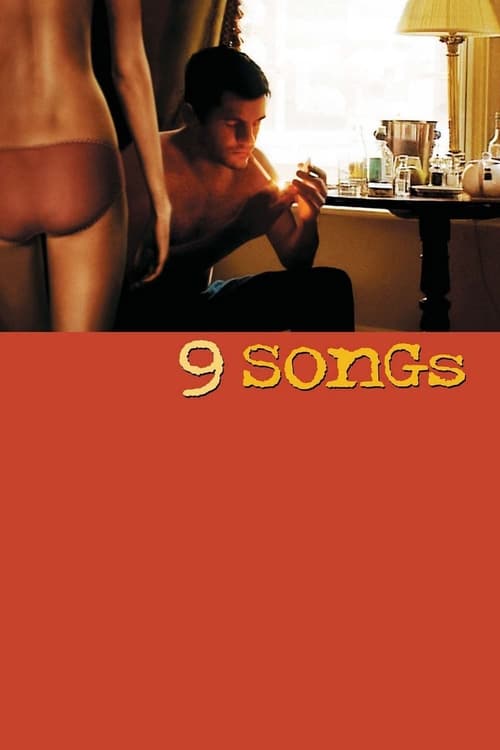
9 Songs (2004)
Directed by Michael Winterbottom
No — 9 Songs is not woke, scoring 0 out of 100 on our wokeness meter.
Michael Winterbottom's 9 Songs arrives from 2004, a year when a British art film could still generate controversy purely through the mechanics of unsimulated intercourse.
Consciousness Markers
The cast is predominantly white British and American musicians and actors, with no evident effort toward inclusive or diverse representation.
The film contains no LGBTQ+ themes, characters, or relationships; the strip-club scene is framed through a heterosexual male gaze rather than queer identity.
The film is an explicit erotic art piece often critiqued for its male-gaze perspective and lacks any discernible feminist agenda or critique of patriarchy.
Race is not a subject of the film, and no racial themes, commentary, or consciousness are present.
Although the protagonist is a glaciologist in Antarctica, the setting is a narrative backdrop for memory and romance, not a climate crusade or environmental message.
The film contains no critique of capitalism, wealth inequality, or economic systems.
The explicit nudity and sex are presented as erotic art rather than a body-positivity statement or challenge to conventional beauty standards.
No neurodivergent characters, themes, or narratives are present.
The film is a fictional contemporary love story and does not engage in historical revisionism.
The film is experiential and observational, with no didactic speeches or preachy messaging.
Why it received this score
Michael Winterbottom's 9 Songs arrives from 2004, a year when a British art film could still generate controversy purely through the mechanics of unsimulated intercourse. The premise is spare to the point of austerity: a glaciologist named Matt, stationed in Antarctica, recalls a months-long affair with an American exchange student named Lisa, the memory structured around nine live rock performances. Black Rebel Motorcycle Club opens and closes the proceedings. Between the gigs, the couple has sex, consumes cocaine, and has more sex.
The film was, by the standards of its moment, scandalous. Ann Widdecombe raised it in the House of Commons. Australia wrestled with its classification. And yet, viewed through the lens of contemporary cultural expectation, the film offers nothing in the way of a message. There is no critique of the male gaze, no reckoning with power, no argument about anything. The camera observes two attractive white people in various states of undress, and the film asks us to find meaning in the accumulation. The strip club sequence gestures toward something, then declines to pursue it. The nudity is erotic, not political. The bodies on display are conventional, and no effort is made to complicate that.
What remains is an exercise in style, and a modest one. Winterbottom's interest lies in texture: the blur of concert lights, the geography of a shared flat, the cold remove of the Antarctic frame. The film does not lecture, does not advocate, does not organize its images around any social thesis. It is, in the end, a document of a particular moment in British cinema, when transgression meant showing what had not been shown before. That the transgression now reads as merely quaint is perhaps the most interesting thing about it.
Analysis generated by our Consciousness Algorithm
Synopsis
Matt, a young glaciologist, soars across the vast, silent, icebound immensities of the South Pole as he recalls his love affair with Lisa. They meet at a mobbed rock concert in a vast music hall - London's Brixton Academy. They are in bed at night's end. Together, over a period of several months, they pursue a mutual sexual passion whose inevitable stages unfold in counterpoint to nine live-concert songs.
Questions about 9 Songs
Is 9 Songs woke?
No — 9 Songs is not woke, scoring 0 out of 100 on our wokeness meter. That earns it a verdict of Ultra Based.
Does 9 Songs have any woke elements?
No. All 10 markers score zero.
How does 9 Songs compare to other 2004 movies?
It ranks #151 of the 178 films from 2004 we've scored; their average is 12. The wokest is Tropical Malady (62).
How is the Woke Score calculated?
An AI-assisted process researches the film and its reception, scores it 0–100 on ten markers, then combines those into one 0–100 Woke Score. It measures a specific set of 2020s cultural themes, not film quality.