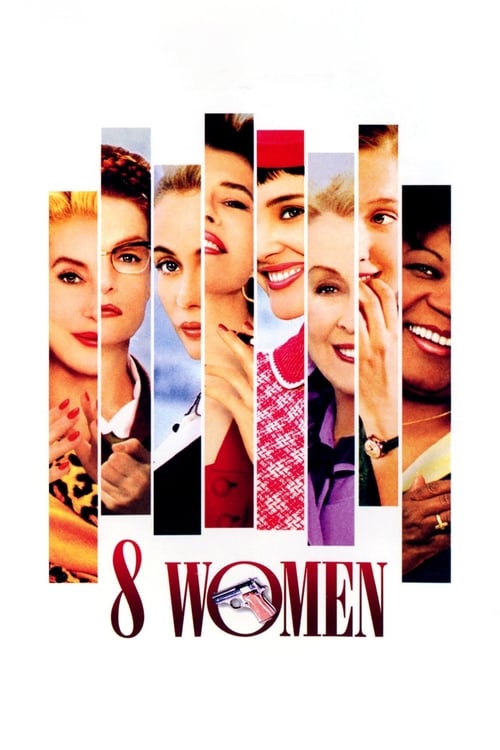
8 Women (2002)
Directed by François Ozon
No — 8 Women is not especially woke, scoring 37 out of 100 on our wokeness meter.
Eight women assemble in a snowbound manor for Christmas, discover the family patriarch stabbed in the back, and spend the next ninety minutes accusing each other while bursting into song.
Consciousness Markers
Explicit lesbian content: Madame Chanel is revealed to have had an affair with Pierrette, and Gaby and Pierrette passionately kiss on the living-room floor, with the household reacting to the revelation.
The film is entirely built around women's agency, secrets, and self-assertion (Louise discarding her maid's cap to claim equality), but it plays as campy pastiche rather than a feminist polemic.
An all-female ensemble of eight major French actresses, including Guadeloupean actress Firmine Richard as the cook, is a notable gender-skewed cast, though it is driven by star power and theatrical convention rather than a modern representation agenda.
Greed over stock shares and debts motivates several characters, but this is classic murder-mystery plotting rather than a systemic critique of wealth.
Firmine Richard is the sole Black performer, cast as the household cook, with no racial commentary or thematic engagement with race in the narrative.
The film is frothy, campy entertainment with no didactic or preachy messaging; any social content is subsumed into musical-comedy spectacle.
No environmental or climate themes whatsoever; the snowbound setting is purely a whodunit device.
No body-positivity themes; the film trades in glamorous 1950s star imagery and conventional beauty.
Augustine's melodramatic hypochondria and 'tachycardia' are played for farce, not as a depiction of neurodivergence.
The 1950s setting is an affectionate stylistic homage to Sirk and Hitchcock, not a revisionist re-reading of history.
Why it received this score
Eight women assemble in a snowbound manor for Christmas, discover the family patriarch stabbed in the back, and spend the next ninety minutes accusing each other while bursting into song. François Ozon has built a jukebox musical out of a 1958 stage mystery, and he stocks it with the entire French cinematic firmament: Deneuve, Huppert, Ardant, Béart, Darrieux. The result is a pastiche of Sirk and Hitchcock, all saturated color and theatrical confinement. This is a star vehicle in the oldest sense, and the stars happen to be women, which earns a modest nod from the casting ledger even if the motive was marquee value and not an agenda.
The social content is present and unembarrassed. Madame Chanel, the housekeeper, is revealed to have carried on an affair with Pierrette, the disreputable sister, and the household absorbs the news with a shrug and a scandalized gasp in roughly equal measure. Later, Gaby and Pierrette kiss on the living room floor while the others watch. Louise, the maid, removes her cap and apron and declares herself an equal. The film is organized around female agency, female secrets, female self-assertion, and it treats all of it as vaudeville. Nobody here delivers a sermon. The tone is froth.
What the film declines to do is instructive. Its snowbound setting carries no environmental freight. Its glamorous stars carry no body-positive message. Augustine's palpitations are a comic affliction, not a portrait of neurodivergence. The scramble over stock shares and debts is murder-mystery plumbing, not a critique of capital. Firmine Richard appears as the cook, and the film finds nothing to say about race, because it has nothing to say. The whole enterprise ends with the women clasping hands and facing the camera, having learned almost nothing and preached even less. A curious artifact: progressive in its casting and its romances, indifferent to nearly everything else. It is, in the end, a bonbon.
Analysis generated by our Consciousness Algorithm
Synopsis
Eight women gather to celebrate Christmas in a snowbound cottage, only to find the family patriarch dead with a knife in his back. Trapped in the house, every woman becomes a suspect, each having her own motive and secret.
Questions about 8 Women
Is 8 Women woke?
No — 8 Women is not especially woke, scoring 37 out of 100 on our wokeness meter. That earns it a verdict of Based.
Does 8 Women have any woke elements?
3 of the 10 markers register at 30 or above, led by LGBTQ+ Themes (60), Feminist Agenda (50) and Representation Casting (40). On LGBTQ+ Themes: Explicit lesbian content: Madame Chanel is revealed to have had an affair with Pierrette, and Gaby and Pierrette passionately kiss on the living-room floor, with the household reacting to the revelation.
How does 8 Women compare to other 2002 movies?
It ranks #12 of the 150 films from 2002 we've scored; their average is 12. The wokest is Far from Heaven (78).
How is the Woke Score calculated?
An AI-assisted process researches the film and its reception, scores it 0–100 on ten markers, then combines those into one 0–100 Woke Score. It measures a specific set of 2020s cultural themes, not film quality.