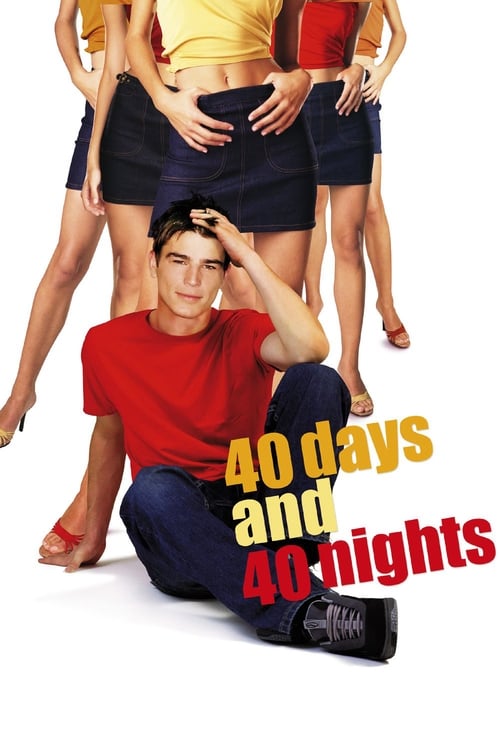
40 Days and 40 Nights (2002)
Directed by Michael Lehmann
No — 40 Days and 40 Nights is not woke, scoring 7 out of 100 on our wokeness meter.
In the spring of 2002, a San Francisco web designer named Matt Sullivan, nursing a breakup, vows to abstain from all sexual contact for the forty days of Lent.
Consciousness Markers
The cast is overwhelmingly white, with Shannyn Sossamon's mixed heritage being incidental rather than a deliberate inclusion. No conscious representation effort is present in this 2002 studio comedy.
No LGBTQ+ characters, themes, or subtext appear anywhere in the film.
The film was widely panned as 'sexist' and 'puerile,' with a male rape played for laughs and a female lead defined largely by her proximity to the protagonist's libido. This is the opposite of a feminist agenda.
No engagement with race, racism, or racial identity whatsoever.
No environmental or climate themes are present.
The dot-com office setting and betting pool carry no critique of capitalism or wealth inequality.
The film's entire comedic engine runs on bodies, arousal, and sexual desirability, with no body-positivity messaging.
No neurodivergent characters or themes are depicted.
No historical revisionism; the film is a contemporary sex farce with no historical subject matter.
The film makes no attempt to lecture or moralize; it is a broad, apolitical sex comedy.
Why it received this score
In the spring of 2002, a San Francisco web designer named Matt Sullivan, nursing a breakup, vows to abstain from all sexual contact for the forty days of Lent. That is the entirety of the premise, and Michael Lehmann, a director who once gave us Heathers, commits to it with a dedication bordering on the ascetic. The result is a comedy of mounting physical discomfort, staged across offices, laundromats, and one memorable city bus.
For those of us who keep ledgers on such matters, the returns are meager. Race never enters the frame. Neither does climate, class consciousness, or any reading of the dot-com economy that might double as an argument. The office betting pool that drives the second act is a betting pool, not a parable about greed. Neurodivergence, body acceptance, and historical revisionism are absent under any definition we can reasonably apply. The one faint signal worth recording is a casting decision that reads as incidental. Shannyn Sossamon, of Hawaiian, Filipino, Dutch, and German descent, plays Erica. Nothing in the script remarks on it. Nothing in the marketing did either. We log it and move along.
What the film does possess is a sexual politics so regressive it circles back around to instructive. The third act stages a male rape for laughs, and the critical consensus of the era, smutty, sexist, puerile, has aged into something closer to a diagnosis. Erica exists to measure Matt's resolve. Nicole exists to break it. Neither woman is granted an interior life that survives a single scene. Every remaining marker sits at zero, and those zeroes are earned. A work this indifferent to the cultural conversation of its own moment functions as a useful control sample. Forty days, it turns out, is ample time to learn nothing at all.
That the film grossed ninety-five million dollars suggests the appetite for this sort of thing was robust and unashamed. We record the data without judgment. The ledger is the ledger, and the ledger says: nothing here, and nothing on purpose, which is at least a kind of consistency. The patience required to appraise such a film exceeds the patience required to sit through it. Both, mercifully, are finite.
{"thematic_tags": ["box_office_number_one"]}
Analysis generated by our Consciousness Algorithm
Part of


Synopsis
Matt Sullivan's last big relationship ended in disaster and ever since his heart's been aching and his commitment's been lacking. Then came Lent, that time of year when everybody gives something up. That's when Matt decides to go where no man's gone before and make a vow: No sex. Whatsoever. For 40 straight days. At first he has everything under control. That is until the woman of his dreams, Erica, walks into his life.
Questions about 40 Days and 40 Nights
Is 40 Days and 40 Nights woke?
No — 40 Days and 40 Nights is not woke, scoring 7 out of 100 on our wokeness meter. That earns it a verdict of Ultra Based.
Does 40 Days and 40 Nights have any woke elements?
Very few. None of the 10 markers reaches 30, the level where a marker counts as present; the highest is Representation Casting at 12.
How does 40 Days and 40 Nights compare to other 2002 movies?
It ranks #92 of the 150 films from 2002 we've scored; their average is 12. The wokest is Far from Heaven (78).
How is the Woke Score calculated?
An AI-assisted process researches the film and its reception, scores it 0–100 on ten markers, then combines those into one 0–100 Woke Score. It measures a specific set of 2020s cultural themes, not film quality.