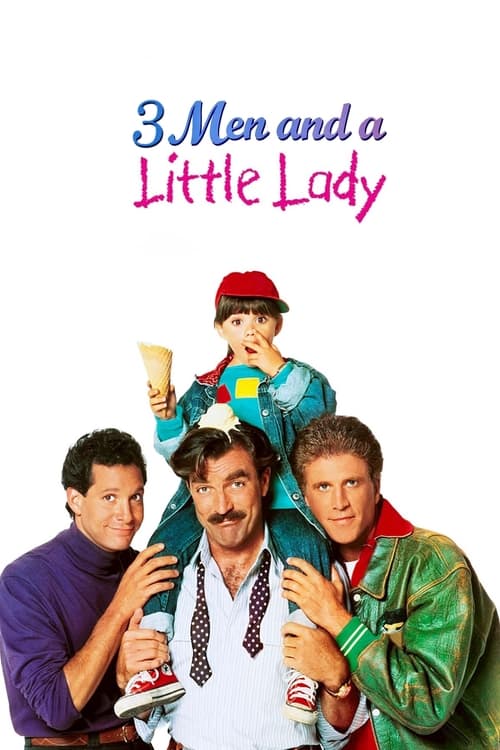
3 Men and a Little Lady (1990)
Directed by Emile Ardolino
No — 3 Men and a Little Lady is not woke, scoring 2 out of 100 on our wokeness meter.
Three Men and a Little Lady arrives as the 1990 continuation of a franchise that began with three bachelors and an infant, and it does not stray from the formula.
Consciousness Markers
The cast is uniformly white with no diverse representation of note; the film makes no comment on casting or identity.
There are no LGBTQ+ characters, themes, or subtext anywhere in this 1990 family comedy.
Sylvia's arc is a conventional romance-and-motherhood plot; the film offers no feminist critique of gender roles or patriarchy.
Race is entirely absent as a subject; the story is a white, upper-middle-class domestic farce.
No environmental or climate themes appear in the film.
The characters are affluent professionals (architect, cartoonist, actress, director) and the film celebrates rather than critiques wealth.
No body-positivity themes or messaging are present.
No neurodivergent characters or themes are depicted.
The film is a contemporary domestic comedy with no historical subject matter to revise.
The film is a lighthearted farce with no preachy or didactic messaging of any kind.
Why it received this score
Three Men and a Little Lady arrives as the 1990 continuation of a franchise that began with three bachelors and an infant, and it does not stray from the formula. Sylvia, now a famous actress, decamps to England with her daughter Mary to marry a scheming director, and the three men give chase. There is a wedding to stop, a headmistress to deflect, a vicar to kidnap, and a motorcycle borrowed from a sheepherder. The film is a domestic farce with a transatlantic accent, moving with the efficient, unbothered rhythm of a studio comedy that knows exactly what it is.
Subjecting this to a modern cultural audit is like running a metal detector over a bowl of pudding. The cast is uniformly white, the romance is conventional, and the resolution is a marriage. Wealth is not examined but enjoyed: an architect, a cartoonist, an actress, and a director occupy comfortable lofts and country houses, and nobody suggests the arrangement is unjust. There is no engagement with race, sexuality, climate, bodily autonomy, or neurological difference. The film does not lecture, does not scold, does not even glance at a cause. It wants the wedding stopped and the right couple married, and it achieves this with a punch to the jaw and a bouquet tossed into the air.
To be clear, this is not a moral failing. It is a genre film from 1990 doing genre work, and it does that work with modest competence. As a specimen of social consciousness, however, it is a null set. A sommelier presented with a glass of tap water can still note the temperature. This one is room temperature, and it is fine.
Analysis generated by our Consciousness Algorithm


Synopsis
Sylvia's work increasingly takes her away from the three men who help bring up Mary, her daughter. When she decides to move to England and take Mary with her, the three men are heartbroken at losing the two most important women in their lives.
Questions about 3 Men and a Little Lady
Is 3 Men and a Little Lady woke?
No — 3 Men and a Little Lady is not woke, scoring 2 out of 100 on our wokeness meter. That earns it a verdict of Ultra Based.
Does 3 Men and a Little Lady have any woke elements?
No. All 10 markers score zero.
How does 3 Men and a Little Lady compare to other 1990 movies?
It ranks #49 of the 68 films from 1990 we've scored; their average is 9. The wokest is Nightbreed (60).
How is the Woke Score calculated?
An AI-assisted process researches the film and its reception, scores it 0–100 on ten markers, then combines those into one 0–100 Woke Score. It measures a specific set of 2020s cultural themes, not film quality.