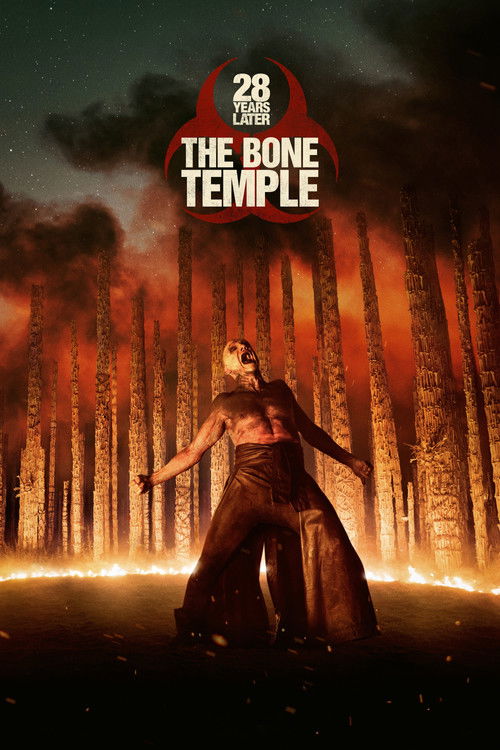
28 Years Later: The Bone Temple (2026)
Directed by Nia DaCosta
No — 28 Years Later: The Bone Temple is not especially woke, scoring 20 out of 100 on our wokeness meter.
The fourth instalment in a franchise that began with bicycle couriers and rage arrives in the hands of Nia DaCosta, who was handed the keys and told, apparently, to make something personal.
Consciousness Markers
A notably diverse ensemble for a British post-apocalyptic horror: Erin Kellyman is a co-lead as Jimmy Ink/Kellie, Chi Lewis-Parry carries the pivotal Alpha role of Samson, and Maiya Eastmond appears as Sam, though none of this is foregrounded as a statement.
Directed by Nia DaCosta, and the women in the cast (Cathy, Jimmima, Kellie) are given violent agency and narrative weight, but the film's concerns are evil and survival rather than gender politics.
One of the Fingers, Jimmy Jones, is explicitly described as a non-binary member of the gang, a small but deliberate inclusion in an otherwise grim ensemble.
Themes of evil and resurgent humanity are delivered through grotesque narrative rather than sermon; only the closing history-lesson framing gestures at thematic instruction.
The diverse cast exists naturally within the story with no commentary on race, racism, or racial identity anywhere in the plot.
The apocalypse here is a man-made virus, not ecological; no climate themes are present.
The antagonists are a satanic cult, not capitalists or corporations; no economic critique is offered.
No body-positivity themes; the film's physicality is prosthetic gore and infection horror.
Samson's condition is a viral infection treated with antipsychotics, not a portrayal of neurodivergence as identity; no neurodivergent representation is present.
The film is speculative post-apocalyptic fiction with no re-framing of real historical events.
Why it received this score
The fourth instalment in a franchise that began with bicycle couriers and rage arrives in the hands of Nia DaCosta, who was handed the keys and told, apparently, to make something personal. What she has made is a film about evil, satanic cults in Northumberland, and the slow re-humanisation of a large infected man through morphine and Duran Duran. Ralph Fiennes covers himself in iodine and builds an ossuary. Jack O'Connell styles his gang after Jimmy Savile, which is the sort of detail that lands with the weight of a falling cathedral. The gore is plentiful, the dread is thick, and the whole enterprise has the confidence of a film that knows its audience arrived voluntarily.
On the matter of social consciousness, the film is a curious specimen. The ensemble is notably diverse for a British apocalypse, and Erin Kellyman carries a co-lead with real conviction. One member of the Fingers is described as non-binary, a detail offered without ceremony. The women, Jimmima and Cathy among them, are granted violent agency and narrative consequence. None of this is staged as argument. The film has no interest in race as a subject, no ecological reading of its own catastrophe (the virus is man-made, the planet is merely the venue), and no economic critique to speak of. The antagonists are devil worshippers. There is no corporation to eat.
The film's sins are aesthetic and theological, not ideological. Evil is dramatised through skinning, crucifixion, and a pyrotechnic Iron Maiden number, which is a form of instruction, though delivered with a flamethrower instead of a lectern. Only the closing history lesson, delivered by Cillian Murphy's returning survivor to his daughter, gestures toward a thesis. It lasts a moment. The rest is a well-made, genuinely unnerving piece of work that resists the urge to tell us what to think, and for that we can be grateful.
Analysis generated by our Consciousness Algorithm
Part of


Synopsis
Dr. Kelson finds himself in a shocking new relationship - with consequences that could change the world as they know it - and Spike's encounter with Jimmy Crystal becomes a nightmare he can't escape.
Questions about 28 Years Later: The Bone Temple
Is 28 Years Later: The Bone Temple woke?
No — 28 Years Later: The Bone Temple is not especially woke, scoring 20 out of 100 on our wokeness meter. That earns it a verdict of Based.
Does 28 Years Later: The Bone Temple have any woke elements?
1 of the 10 markers register at 30 or above, led by Representation Casting (42). On Representation Casting: A notably diverse ensemble for a British post-apocalyptic horror: Erin Kellyman is a co-lead as Jimmy Ink/Kellie, Chi Lewis-Parry carries the pivotal Alpha role of Samson, and Maiya Eastmond appears as Sam, though none of this is foregrounded as a statement.
How does 28 Years Later: The Bone Temple compare to other 2026 movies?
It ranks #339 of the 800 films from 2026 we've scored; their average is 23. The wokest is Between Us (89).
Is 28 Years Later: The Bone Temple the most woke 28 Days/Weeks/Years Later movie?
No. It ranks #3 of the 4 28 Days/Weeks/Years Later films we've scored; the wokest is 28 Years Later (28).