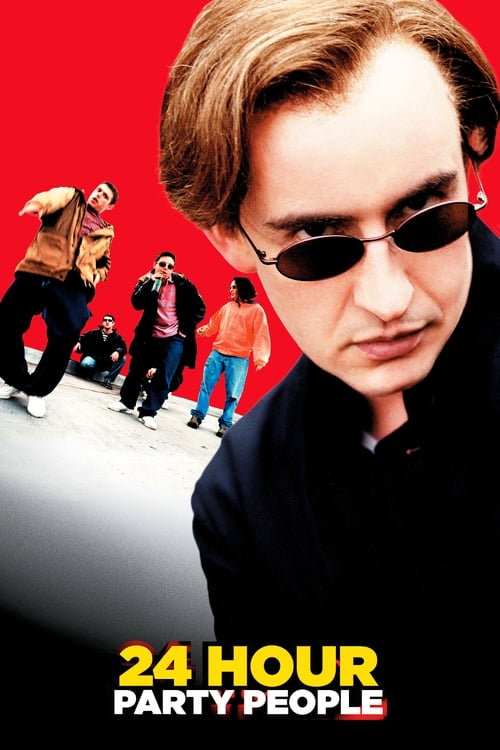
24 Hour Party People (2002)
Directed by Michael Winterbottom
No — 24 Hour Party People is not woke, scoring 10 out of 100 on our wokeness meter.
Michael Winterbottom's 24 Hour Party People concerns Tony Wilson, a Granada television presenter who attends a Sex Pistols gig in 1976 and spends the next sixteen years turning that evening into a record label, a nightclub, and a series of financial catastrophes.
Consciousness Markers
The film celebrates Factory Records' idealistic, artist-first ethos and critiques the commercial music industry, but not in a modern woke manner.
The film features a historically accurate black character, Alan Erasmus, played by Lennie James, but does not engage in modern diverse casting practices.
The film is a chaotic, comedic biopic that does not lecture the audience on social issues.
No LGBTQ+ themes or characters are present in this chronicle of the Manchester music scene.
The film focuses on a male-dominated music industry and does not advance a feminist agenda.
While black characters appear, the film does not explore racial issues or consciousness.
No environmental or climate-related themes.
No body positivity themes.
No neurodivergence themes are present; Ian Curtis's epilepsy is a medical condition, not a neurodivergent identity.
The film playfully mixes fact and fiction with an unreliable narrator, but does not revise history for ideological purposes.
Why it received this score
Michael Winterbottom's 24 Hour Party People concerns Tony Wilson, a Granada television presenter who attends a Sex Pistols gig in 1976 and spends the next sixteen years turning that evening into a record label, a nightclub, and a series of financial catastrophes. Steve Coogan plays him as a man narrating his own legend directly into the camera, correcting the record, then admitting the record was invented. Real concert footage sits beside staged scenes. A Buzzcocks member turns to the lens to deny an affair the film has just shown him having. The result is a biography that keeps winking at its own unreliability.
On the matter of social consciousness, the film is largely disinterested. Lennie James appears as Alan Erasmus, a genuine Factory co-founder, and the film treats his presence as simple fact, offering no commentary on race and no interest in racial politics. Factory's artist-first ethos gets a warm glow: contracts signed in blood, full creative control surrendered to the musicians, a hit single that loses five pence per copy because the sleeve costs more than the record. This is a critique of the commercial music business, though it amounts to nostalgia for a doomed business model, not a program for redistribution.
The absences are thorough. The Manchester scene was a boys' club, and the film depicts it as such without apology or correction. No environmental themes intrude on the ecstasy and the gang violence at the Haçienda. Ian Curtis's epilepsy is presented as a medical tragedy, not an identity. Nobody is lectured. Nobody is improved. The film's only sermon concerns the dignity of signing bad deals for good records, and even that arrives with a shrug and a vision of God on a rooftop.
Analysis generated by our Consciousness Algorithm


Synopsis
Manchester, 1976. Tony Wilson is an ambitious but frustrated local TV news reporter looking for a way to make his mark. After witnessing a life-changing concert by a band known as the Sex Pistols, he persuades his station to televise one of their performances, and soon Manchester's punk groups are clamoring for him to manage them. Riding the wave of a musical revolution, Wilson and his friends create the legendary Factory Records label and The Hacienda club.
Questions about 24 Hour Party People
Is 24 Hour Party People woke?
No — 24 Hour Party People is not woke, scoring 10 out of 100 on our wokeness meter. That earns it a verdict of Ultra Based.
Does 24 Hour Party People have any woke elements?
Very few. None of the 10 markers reaches 30, the level where a marker counts as present; the highest is Eat the Rich at 20.
How does 24 Hour Party People compare to other 2002 movies?
It ranks #59 of the 150 films from 2002 we've scored; their average is 12. The wokest is Far from Heaven (78).
How is the Woke Score calculated?
An AI-assisted process researches the film and its reception, scores it 0–100 on ten markers, then combines those into one 0–100 Woke Score. It measures a specific set of 2020s cultural themes, not film quality.