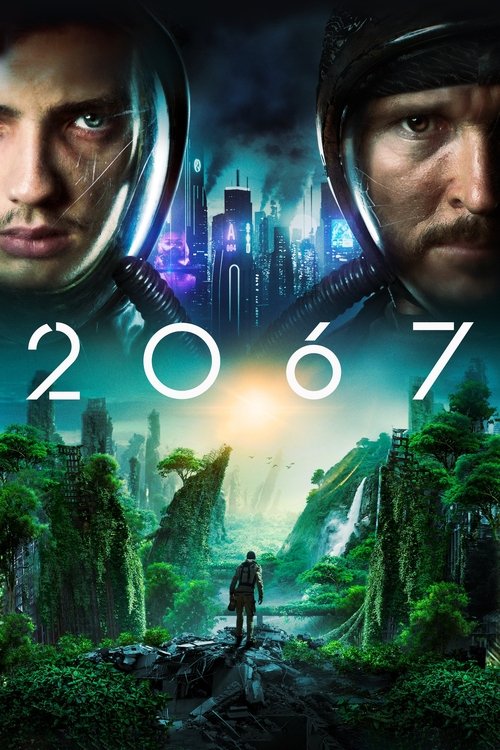
2067 (2020)
Directed by Seth Larney
Partly — 2067 is somewhat woke, scoring 46 out of 100 on our wokeness meter.
2067 is an Australian science fiction film about a poisoned planet, a synthetic oxygen supply, and a time machine that offers humanity one last bureaucratic chance.
Consciousness Markers
Climate change, deforestation, and oxygen depletion are the explicit premise and central crisis of the film, driving the entire plot and its resolution via reforestation.
The cast features notable diversity for an Australian production, including Indigenous Australian actors Deborah Mailman and Natasha Wanganeen and Sana'a Shaik as the wife, though the film makes no comment on this casting.
The villainous Chronicorp hoards a time machine to let a chosen elite flee a dying world while the masses perish, a clear corporate-greed critique, though it is subtext rather than thesis.
The climate message is embedded in the plot mechanics rather than delivered as direct moralizing, though the environmental moral is unmistakable and occasionally stated outright.
Regina Jackson is a female corporate CTO, but she is the villain, and Xanthe exists largely as a dying wife motivating the hero. No feminist thesis is advanced.
The film has a diverse cast but engages in no racial commentary or consciousness; race is simply not a subject of the story.
No LGBTQ+ characters, relationships, or themes appear anywhere in the narrative.
No body-positive themes or diverse body representation are present.
No neurodivergent characters or themes are depicted.
The film invents a fictional future history rather than revising any real historical record.
Why it received this score
2067 is an Australian science fiction film about a poisoned planet, a synthetic oxygen supply, and a time machine that offers humanity one last bureaucratic chance. The climate crisis is not a backdrop. It is the load-bearing wall. Deforestation, oxygen depletion, nuclear war, and a future rainforest that must be sent backward through time to revive the present. The film treats environmental collapse as both premise and solution, which makes it a climate crusade in narrative form. The sermon is mostly embedded in plot mechanics. Occasionally it states the moral outright. Mostly it lets the dying atmosphere do the talking.
The villainous Chronicorp hoards its time machine so a chosen elite can flee a ruined world while the masses choke. That is a corporate greed critique, though it remains subtext. Regina Jackson is a female chief technology officer, but she is the villain, and Xanthe exists largely as a dying wife whose function is to motivate the hero. No feminist thesis emerges. The cast is notably diverse for an Australian production, with Indigenous actors Deborah Mailman and Natasha Wanganeen and Sana'a Shaik in key roles, yet race is never a subject. Queer lives, body diversity, and neurodivergent experience are absent. The film invents a future history instead of revising a real one.
The result is somber, technically ambitious, and emotionally overwrought. It wants to be Kubrick by way of Gilliam and lands nearer to an expensive streaming pilot with a better score. The performances are earnest. The dialogue is banal. The message is unmistakable: save the trees, distrust the corporation, and perhaps do not send your son through time. As a specimen of modern social consciousness, the film is uneven. It cares deeply about the planet, gestures at representation, and has little interest in anything else. The apocalypse has rarely been so well intentioned and so tiring.
Analysis generated by our Consciousness Algorithm


Synopsis
A lowly utility worker is called to the future by a mysterious radio signal. He must leave his dying wife to embark on a journey that will force him to face his deepest fears in an attempt to change the fabric of reality and save humankind from its greatest environmental crisis yet.
Questions about 2067
Is 2067 woke?
Partly — 2067 is somewhat woke, scoring 46 out of 100 on our wokeness meter. That earns it a verdict of Woke-Adjacent.
What makes 2067 woke?
4 of the 10 markers register at 30 or above, led by Climate Crusade (85), Eat the Rich (45) and Representation Casting (45). On Climate Crusade: Climate change, deforestation, and oxygen depletion are the explicit premise and central crisis of the film, driving the entire plot and its resolution via reforestation.
How does 2067 compare to other 2020 movies?
It ranks #31 of the 227 films from 2020 we've scored; their average is 21. The wokest is One Night in Miami... (83).
How is the Woke Score calculated?
An AI-assisted process researches the film and its reception, scores it 0–100 on ten markers, then combines those into one 0–100 Woke Score. It measures a specific set of 2020s cultural themes, not film quality.