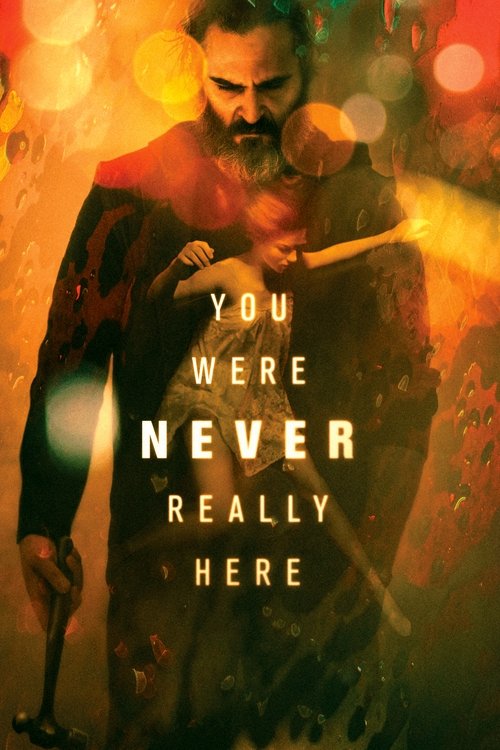
You Were Never Really Here (2017)
Directed by Lynne Ramsay
No — You Were Never Really Here is not woke, scoring 11 out of 100 on our wokeness meter.
Lynne Ramsay's adaptation of Jonathan Ames's 2013 novella arrives with the grim efficiency of a hired hand who does not much enjoy the work.
Consciousness Markers
Female director Lynne Ramsay subverts the standard damsel-rescue formula by having the trafficked girl Nina dispatch her abuser herself with a straight razor, denying the male savior his climactic redemption.
Joe's PTSD, flashbacks, and suicidal ideation are the film's psychological core, though the film treats trauma as lived experience rather than as an advocacy or identity framework.
The cast is overwhelmingly white, with only incidental supporting players of color (Frank Pando, Vinicius Damasceno) present without any commentary or deliberate diversity framing.
The villains are a cabal of elite politicians and governors covering up child trafficking, offering a faint anti-establishment critique of the powerful, though it is framed as moral corruption rather than an economic indictment of capitalism.
Ramsay's film is a moody, elliptical mood piece that shows rather than tells, offering no preachy moralizing or direct-address messaging.
No LGBTQ+ characters, relationships, or themes appear anywhere in the narrative.
The film engages no racial themes; the trafficking conspiracy is framed entirely around political and sexual corruption, not race.
No environmental or climate content whatsoever.
No body-positivity themes or messaging are present.
The film is a contemporary fictional thriller with no historical revisionism.
Why it received this score
Lynne Ramsay's adaptation of Jonathan Ames's 2013 novella arrives with the grim efficiency of a hired hand who does not much enjoy the work. Joaquin Phoenix plays Joe, a traumatized veteran who retrieves trafficked girls from the wealthy men who purchase them, and the film trails him through a New York of flickering hallways and unfinished thoughts. Ramsay has no interest in the standard machinery of the revenge thriller. The violence happens off screen, or in glimpses, and the camera would prefer to linger on a face. It is a mood piece wearing a genre coat, and it wears it well.
On the matter of social consciousness, the film is largely silent. The cast is white to a degree that suggests the audition room was booked in a very specific neighborhood, with supporting players of color drifting through without a line of thematic comment. There is no LGBTQ content, no environmental conscience, no racial argument, no body-positivity messaging. What the film does offer is a quiet rebuke to the damsel-rescue template: Nina, the kidnapped girl, ends her captor with a straight razor before Joe can arrive to do it for her, and the male savior is left standing in a dining room with nothing left to save. Ramsay, a woman directing a story about men who trade in girls, declines to hand the climax to the man.
The villains are governors and senators, a cabal of the powerful covering for their appetites, which reads as a faint grumble against the establishment and not an economic thesis. Joe's PTSD and suicidal ideation carry the film's psychological weight, though trauma here is lived, not lectured. Ramsay shows, withholds, and trusts the audience to keep up. In an era of cinema that explains itself twice and then checks for understanding, that restraint registers as nearly radical.
Analysis generated by our Consciousness Algorithm


Synopsis
A traumatized veteran, unafraid of violence, tracks down missing girls for a living. When a job spins out of control, Joe's nightmares overtake him as a conspiracy is uncovered—leading to what may be his death trip or his awakening.
Questions about You Were Never Really Here
Is You Were Never Really Here woke?
No — You Were Never Really Here is not woke, scoring 11 out of 100 on our wokeness meter. That earns it a verdict of Ultra Based.
Does You Were Never Really Here have any woke elements?
Very few. None of the 10 markers reaches 30, the level where a marker counts as present; the highest is Feminist Agenda at 25.
How does You Were Never Really Here compare to other 2017 movies?
It ranks #152 of the 309 films from 2017 we've scored; their average is 19. The wokest is I Am Not Your Negro (92).
How is the Woke Score calculated?
An AI-assisted process researches the film and its reception, scores it 0–100 on ten markers, then combines those into one 0–100 Woke Score. It measures a specific set of 2020s cultural themes, not film quality.