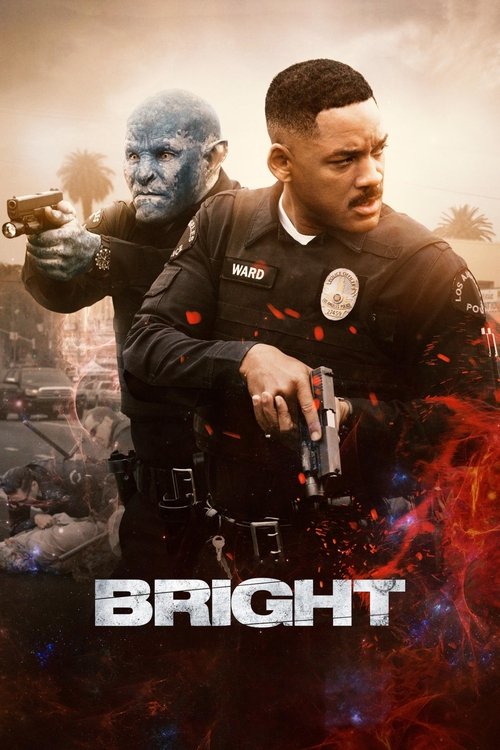
Bright (2017)
Directed by David Ayer
Yes · Woke
How we score movies →Consciousness Markers
The entire narrative framework is built on racial allegory, with orcs facing systemic discrimination, prejudice, and derogatory treatment mirroring real-world racism. The film explicitly confronts racism and police corruption as central themes, though the fantasy medium undermines the impact.
The film features Will Smith as the human officer and Joel Edgerton as an orc, centering the partnership between characters of different backgrounds. The cast includes diverse representation across multiple roles, though the fantasy framework complicates how we interpret this diversity.
The film demonstrates considerable lecture energy in its dialogue and thematic presentation, with characters frequently discussing racism, discrimination, and systemic inequality in ways that feel expository rather than organic to the narrative.
The film depicts class divisions through the contrast between marginalized orcs and privileged elves, suggesting systemic inequality, but does not develop explicit anti-capitalist critique or engage meaningfully with economic structures.
The film includes female characters such as Lucy Fry's elf character and Noomi Rapace, but they remain secondary to the male-centered buddy cop dynamic. There is minimal feminist consciousness or gender-focused thematic content.
No LGBTQ+ themes, representation, or subtext are present in the film. The narrative does not engage with sexual orientation or gender identity as meaningful elements.
No environmental or climate-related themes appear in the film. The narrative does not engage with ecological consciousness or climate advocacy.
Body positivity is not addressed in the film. The narrative does not engage with body image, disability representation, or related themes.
No neurodivergent representation or themes are present in the film. The narrative does not address autism, ADHD, mental health conditions, or neurodiversity.
The film does not engage in revisionist history. It is set in an alternate present-day fantasy world rather than attempting to reframe historical events or narratives.


Synopsis
In an alternate present-day where magical creatures live among us, two L.A. cops become embroiled in a prophesied turf battle.
Why it received this score
Bright arrives as a film so earnestly committed to its racial allegory that one might mistake it for a thesis defense conducted through the medium of an action movie. The premise is admirably straightforward: orcs serve as stand-ins for marginalized communities facing systemic discrimination and police brutality, while elves represent an entrenched privileged class. Will Smith's character and Joel Edgerton's orc partner navigate a world where speciesism functions as a proxy for racism, complete with derogatory slurs and institutional prejudice. The film does not shy away from its message, which is precisely the problem.
What undermines this enterprise is the heavy-handed execution that critics have rightly identified as clumsy and self-defeating. The allegory collapses under scrutiny because the fantasy framework invites us to treat these dynamics as fantastical rather than recognizing them as reflections of actual suffering. By filtering real-world racism through a lens of magical creatures and wands, the film paradoxically distances viewers from the genuine stakes of discrimination. The result is a film that wants desperately to say something important about systemic inequality and police culture but instead delivers a muddled action thriller that satisfies neither as entertainment nor as social commentary.
The film's progressive intentions are evident throughout, yet they remain largely unearned by the narrative execution. For this reason, the score reflects ambition that exceeds delivery, a monument to what happens when a filmmaker attempts to tackle urgent social questions through genre conventions that were never designed to bear such weight.
Analysis generated by our Consciousness Algorithm
Critic Reviews
“This ambitious, yet astonishingly well-executed Netflix tentpole directly benefits from the way Ayer’s gritty, streetwise sensibility grounds Landis’ gift for creating an elaborate comic-book mythology.”
“Bright could have been something truly special if it had slowed down the pace of its narrative to allow for a fuller exploration of its engaging world.”
“For all its flaws, Bright is still a headlong leap into a bracingly different new world. Cinema could do with more of that.”
“Bright tries to create a unique and dynamic world with the juxtaposition of harsh police life, crime and modern life contrasted with this imaginary magical realm, but it’s contrived, unconvincing and most of all calamitously preposterous.”