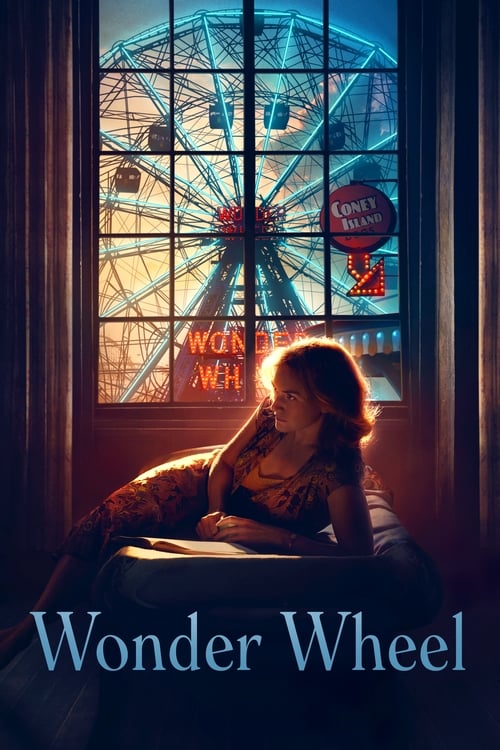
Wonder Wheel (2017)
Directed by Woody Allen
No — Wonder Wheel is not woke, scoring 6 out of 100 on our wokeness meter.
Wonder Wheel arrives as a period piece about a period piece, a 1950s Coney Island melodrama shot in the amber and teal that Vittorio Storaro can produce in his sleep.
Consciousness Markers
The film centers on two women and their romantic entanglements, but treats them through a traditional, somewhat misogynistic melodrama lens rather than any feminist critique. Female leads alone do not constitute a feminist agenda.
The film is a melodrama that aims to entertain and move rather than to preach or deliver social messaging. Minimal didacticism.
The cast is almost entirely white, with no evident effort to diversify the ensemble beyond the director's usual circle of collaborators. No representation casting markers present.
There are no LGBTQ+ characters, relationships, or themes anywhere in this 1950s-set melodrama.
No engagement with race, racial identity, or racial justice whatsoever in this all-white Coney Island period piece.
No environmental or climate themes appear in the film.
The film has no economic critique or anti-capitalist messaging; it is a personal romantic drama.
No body positivity themes or messaging present.
Richie is described as a troubled boy who sets fires, but this is framed as behavioral delinquency, not neurodivergence or a neurodiversity-affirming portrayal.
The film is a nostalgic period drama with no revisionist reframing of history.
Why it received this score
Wonder Wheel arrives as a period piece about a period piece, a 1950s Coney Island melodrama shot in the amber and teal that Vittorio Storaro can produce in his sleep. Kate Winslet plays Ginny, a former actress turned clam-house waitress, married to a carousel operator named Humpty and quietly conducting an affair with a lifeguard who narrates directly into the camera. The boardwalk glows. The Ferris wheel turns. Nobody in the frame is thinking about representation, structural injustice, or the carbon footprint of the amusement industry. It is a film content to be a film, which at this late date feels almost rude.
The two women at its center are defined entirely by the men they orbit, and the screenplay regards their jealousy and disappointment with the sympathy of an older, less interrogative tradition. A female lead is present. A feminist argument is not. The film pities Ginny without ever asking why the arrangement that traps her exists in the first place, and it treats Carolina's flight from mobsters as a plot engine, not a case study. There is a knife, a stolen watch, and a great deal of drinking. The moral weather is personal.
What the film asks of an audience is patience, and it does not always earn it. The sermon count is effectively nil. There is no lecture about the 1950s, no knowing wink at the present, no corrective narrator. It is a handsome, musty object, the cinematic equivalent of a souvenir postcard found in a drawer, and it offers the strange comfort of a movie that wants nothing from you but two hours.
Analysis generated by our Consciousness Algorithm


Synopsis
The story of four characters whose lives intertwine amid the hustle and bustle of the Coney Island amusement park in the 1950s: Ginny, an emotionally volatile former actress now working as a waitress in a clam house; Humpty, Ginny’s rough-hewn carousel operator husband; Mickey, a handsome young lifeguard who dreams of becoming a playwright; and Carolina, Humpty’s long-estranged daughter, who is now hiding out from gangsters at her father’s apartment.
Questions about Wonder Wheel
Is Wonder Wheel woke?
No — Wonder Wheel is not woke, scoring 6 out of 100 on our wokeness meter. That earns it a verdict of Ultra Based.
Does Wonder Wheel have any woke elements?
Very few. None of the 10 markers reaches 30, the level where a marker counts as present; the highest is Feminist Agenda at 10.
How does Wonder Wheel compare to other 2017 movies?
It ranks #224 of the 309 films from 2017 we've scored; their average is 19. The wokest is I Am Not Your Negro (92).
How is the Woke Score calculated?
An AI-assisted process researches the film and its reception, scores it 0–100 on ten markers, then combines those into one 0–100 Woke Score. It measures a specific set of 2020s cultural themes, not film quality.