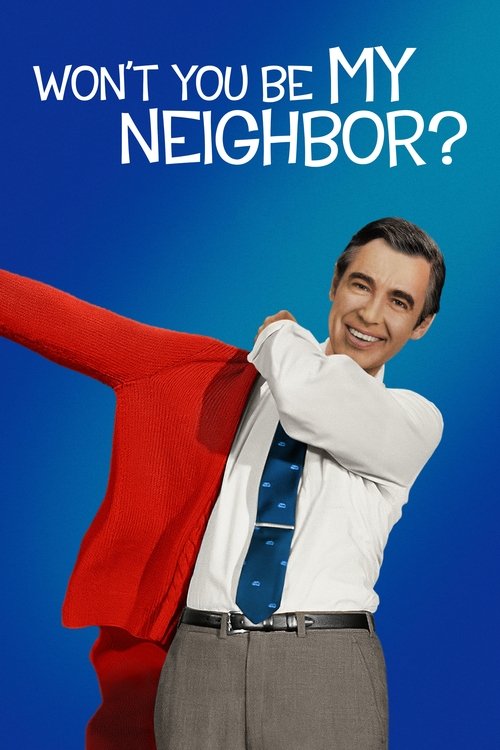
Won't You Be My Neighbor? (2018)
Directed by Morgan Neville
No — Won't You Be My Neighbor? is not especially woke, scoring 25 out of 100 on our wokeness meter.
Morgan Neville's documentary about Fred Rogers arrives with the confidence of a film that knows its audience has already forgiven it.
Consciousness Markers
The documentary foregrounds Rogers' integration of the neighborhood, most memorably the foot-bath scene with Officer Clemmons during segregation, making racial inclusion a central pillar of his legacy.
The documentary assembles a naturally diverse roster of interviewees—François Clemmons, Yo-Yo Ma, Junlei Li—and highlights Rogers' own casting of Black performers, though this reflects the subject's life rather than a modern casting mandate.
The film addresses François Clemmons' sexuality and Rogers' quiet, complicated support of him, including the pressure Clemmons faced to stay closeted—a genuine LGBTQ thread, though handled as biography rather than advocacy.
The film adopts Rogers' own gentle, moralizing cadence and closes on a note of earnest uplift, but it preaches kindness rather than a modern social-justice sermon.
Rogers' 'I like you just the way you are' ethos and his gentle address of children's feelings about their bodies gesture at self-acceptance, but it is framed as child development, not body-positivity activism.
Joanne Rogers and several female producers and collaborators are given voice, but the film's framework is a tribute to one man's philosophy rather than a feminist critique.
Rogers' outreach to children with disabilities, including Jeff Erlanger, touches on inclusion, but neurodivergence as a concept is not a focus.
Rogers' 1969 Senate testimony defending public broadcasting funding carries a faint anti-commercial undertone, but the film is not an economic polemic.
No environmental or climate themes appear in the film.
The film is a straightforward biographical documentary with no revisionist reframing of history.
Why it received this score
Morgan Neville's documentary about Fred Rogers arrives with the confidence of a film that knows its audience has already forgiven it. The archival footage is generous, the talking heads are loyal, and the whole enterprise moves at the pace of a cardigan being zipped. What the film offers is not so much an argument as a warm bath of a biography, content to let the subject's decency do the heavy lifting. The interviewees assembled here, from Francois Clemmons to Yo-Yo Ma to the producers who worked beside Rogers for decades, constitute a naturally varied group, though the diversity reads as the texture of a life instead of a casting directive.
The film does engage the more difficult corners of that life. Clemmons' sexuality, and Rogers' complicated, quiet support of a man pressured to remain closeted, supplies the documentary with its one genuine thread of contemporary social concern. The foot-bath scene, in which Rogers shares a basin with a Black officer during segregation, is presented as a cornerstone of his philosophy, and the film treats racial inclusion as central to his work. A 1969 Senate appearance defending public broadcasting funding carries a faint whiff of anti-commercial sentiment, though the film is no economic tract.
Where the documentary declines to push is everywhere else. There is nothing here of climate anxiety, nothing of historical reframing, and the body-acceptance ethos of "I like you just the way you are" is framed as child development, not a movement. Rogers' outreach to children with disabilities, including the young Jeff Erlanger, is touching without becoming a thesis on neurodivergence. The closing movement adopts Rogers' own gentle cadence, an earnest uplift that preaches kindness in general terms. This is moralizing of an old and unobjectionable sort, aimed at no political target. The result feels like a memorial service: warm, well attended, and careful not to upset anyone in the pews.
Analysis generated by our Consciousness Algorithm


Synopsis
For more than thirty years, and through his television program, Fred Rogers (1928-2003), host, producer, writer and pianist, accompanied by his puppets and his many friends, spoke directly to young children about some of life's most important issues.
Questions about Won't You Be My Neighbor?
Is Won't You Be My Neighbor? woke?
No — Won't You Be My Neighbor? is not especially woke, scoring 25 out of 100 on our wokeness meter. That earns it a verdict of Based.
Does Won't You Be My Neighbor? have any woke elements?
3 of the 10 markers register at 30 or above, led by Racial Consciousness (50), Representation Casting (35) and LGBTQ+ Themes (30). On Racial Consciousness: The documentary foregrounds Rogers' integration of the neighborhood, most memorably the foot-bath scene with Officer Clemmons during segregation, making racial inclusion a central pillar of his legacy.
How does Won't You Be My Neighbor? compare to other 2018 movies?
It ranks #83 of the 325 films from 2018 we've scored; their average is 20. The wokest is Return (92).
How is the Woke Score calculated?
An AI-assisted process researches the film and its reception, scores it 0–100 on ten markers, then combines those into one 0–100 Woke Score. It measures a specific set of 2020s cultural themes, not film quality.