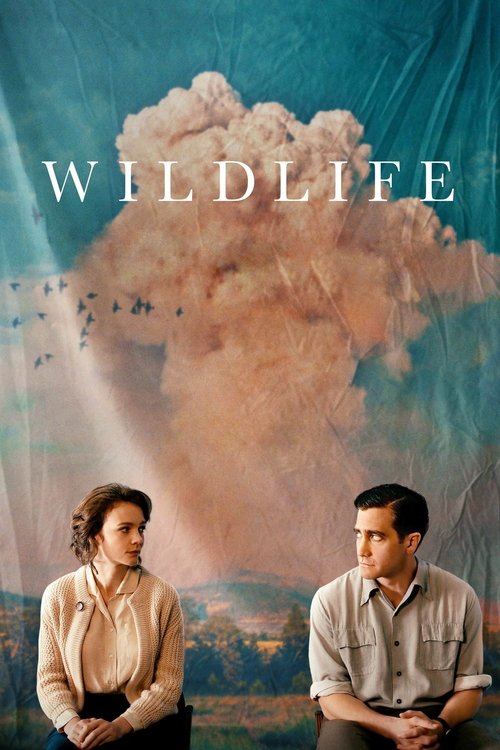
Wildlife (2018)
Directed by Paul Dano
No — Wildlife is not woke, scoring 9 out of 100 on our wokeness meter.
Paul Dano's directorial debut arrives with the patience of a filmmaker who has studied the domestic dramas of an earlier era and decided to make one of his own.
Consciousness Markers
Carey Mulligan's Jeannette chafes against her role as a housewife and asserts a desire for independence, but the film treats this as character psychology rather than a feminist thesis.
Jerry's job loss and the family's financial precarity are depicted, but the film offers no systemic critique of capitalism or wealth.
The cast is almost entirely white, with no deliberate diverse or inclusive casting choices; the film is a period domestic drama populated by the demographics of 1960s Montana.
There are no LGBTQ+ characters, relationships, or themes anywhere in the narrative.
Race is entirely absent from the film's concerns; no racial themes or commentary are present.
The forest fire functions as a symbolic backdrop to the family's unraveling, not as environmental advocacy or climate messaging.
No body positivity themes or body-diverse representation are present.
No neurodivergent characters or themes are depicted.
The film is a faithful period adaptation of a 1990 novel set in 1960 Montana, with no revisionist reframing of history.
Dano's direction is quiet, observational, and restrained, trusting the audience rather than delivering any message or moralizing.
Why it received this score
Paul Dano's directorial debut arrives with the patience of a filmmaker who has studied the domestic dramas of an earlier era and decided to make one of his own. It is 1960 in Great Falls, Montana, and the Brinson family is coming apart at a speed that feels geological. Jerry loses his job as a golf pro, then his sense of purpose, and wanders off to fight a forest fire near the Canadian border. Jeannette, played by Carey Mulligan with a coiled restlessness, takes work teaching swimming and begins an affair with a car dealer. Their son Joe watches all of it. The camera watches Joe watching. This is a film about a marriage dissolving, and it declines to make any larger argument about the institution of marriage itself.
The social consciousness here is faint and mostly incidental. Jeannette bristles at the role of housewife and speaks of wanting more, but the screenplay treats this as psychology, the private weather of a single unhappy woman, not as a thesis about women in general. Jerry's unemployment is rendered as personal humiliation, and the economy that produced it goes unexamined. No systemic critique is offered, and none is wanted. The raging fire could have carried an environmental charge. Instead it functions as a mood, a distant orange glow that mirrors the family's slow burn. Race, sexuality, body image, and neurodivergence are simply not part of this world, and the film does not pretend otherwise.
Dano's restraint is the whole point. He observes, he withholds, he lets silences do the talking. There is no lecture at the end, no moral delivered to the audience like a bill at a restaurant. We get a portrait, and portraits do not argue. The result is a well-made, emotionally precise film that has almost nothing to say about the culture that produced it. For our purposes, that is a low tally, and an honest one.
Analysis generated by our Consciousness Algorithm


Synopsis
14-year-old Joe is the only child of Jeanette and Jerry — a housewife and a golf pro — in a small town in 1960s Montana. Nearby, an uncontrolled forest fire rages close to the Canadian border, and when Jerry loses his job (and his sense of purpose) he decides to join the cause of fighting the fire, leaving his wife and son to fend for themselves.
Questions about Wildlife
Is Wildlife woke?
No — Wildlife is not woke, scoring 9 out of 100 on our wokeness meter. That earns it a verdict of Ultra Based.
Does Wildlife have any woke elements?
Very few. None of the 10 markers reaches 30, the level where a marker counts as present; the highest is Feminist Agenda at 20.
How does Wildlife compare to other 2018 movies?
It ranks #203 of the 325 films from 2018 we've scored; their average is 20. The wokest is Return (92).
How is the Woke Score calculated?
An AI-assisted process researches the film and its reception, scores it 0–100 on ten markers, then combines those into one 0–100 Woke Score. It measures a specific set of 2020s cultural themes, not film quality.