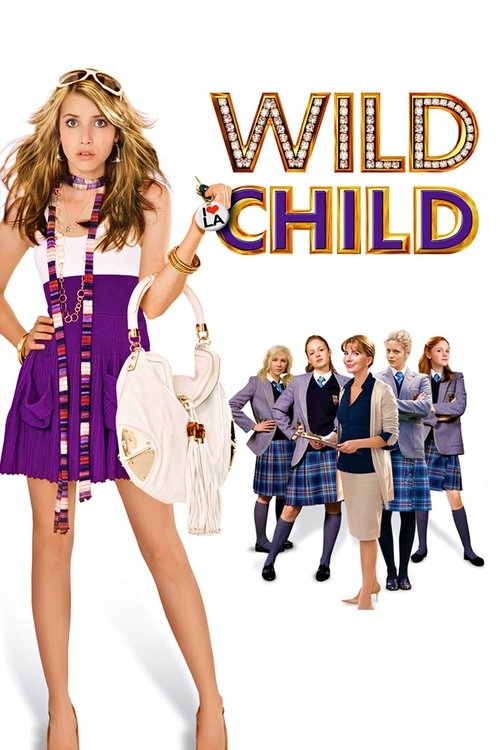
Wild Child (2008)
Directed by Nick Moore
No — Wild Child is not woke, scoring 11 out of 100 on our wokeness meter.
There is a particular vintage of tween comedy, roughly 2004 to 2010, that believed a spoiled American heiress could be cured of her moral deficiencies by being deposited among the damp stonework of an English boarding school.
Consciousness Markers
The film centers on a female protagonist, a female headmistress, and a girls' lacrosse team whose third-act solidarity is genuinely warm, but this is standard tween-comedy girl-power rather than a feminist thesis.
The ensemble is overwhelmingly white British and American, with Sophie Wu as the lone notable non-white cast member in a supporting role that carries no commentary. Diversity exists incidentally rather than as a stated aim.
Poppy's unlimited credit cards and Malibu materialism are framed as character flaws to be outgrown in favor of friendship, a mild 'money can't buy happiness' moral rather than any structural critique of wealth.
The film delivers a gentle moral about friendship, humility, and not judging others, but it is a light tween comedy that entertains rather than preaches.
No LGBTQ+ characters, subtext, or themes appear anywhere in the film.
Race is never addressed; the story is entirely about class and personality, not racial identity or consciousness.
No environmental themes or climate messaging of any kind.
No body-positivity themes; the film's humor leans on appearance-based insults like 'horse face.'
No neurodivergent characters or themes are present.
No historical revisionism; the film is a contemporary boarding-school comedy with no engagement with historical narrative.
Why it received this score
There is a particular vintage of tween comedy, roughly 2004 to 2010, that believed a spoiled American heiress could be cured of her moral deficiencies by being deposited among the damp stonework of an English boarding school. Wild Child is that vintage, decanted with efficiency. Emma Roberts plays Poppy Moore, whose unlimited credit cards and Malibu solipsism are presented as a character flaw to be outgrown, which the film accomplishes by trading her blonde hair for brunette and her materialism for a lacrosse stick. The moral is that money cannot purchase friendship. It is a modest moral, delivered without any structural objection to wealth itself, and it lands softly. The film is not angry about the rich. It merely wishes they would be nicer.
The ensemble is white British and American almost without exception, with Sophie Wu present in a supporting role that invites no comment, either from the film or from the viewer. Race never enters the conversation, because the conversation is about class and manners and the correct way to behave at a school dance. The girls' lacrosse team does build toward a third-act solidarity that is warmer than the material deserves, and there is genuine affection in the friendships that form over shared detention and confiscated phones. This is girl-power of the standard tween variety, not a thesis. The humor, meanwhile, leans on appearance-based insults, and the film's treatment of its own villain is unkind in ways it never pauses to examine.
What remains is a gentle sermon on humility and friendship, delivered by a cast who understand the assignment. The preaching is light. The cultural awareness is lighter still. Viewers seeking a boarding-school comedy will find one competently assembled, and those seeking ideological instruction will have to look elsewhere, ideally somewhere with more conviction and better jokes. The film has acquired a cult following in Britain, which tells us something about the British and rather less about the film. It is mild. It was always going to be mild.
Analysis generated by our Consciousness Algorithm
Part of


Synopsis
Sixteen-year-old Poppy has everything her unlimited credit cards can buy, and a spoiled attitude to match. After a final thoughtless prank, her exasperated father ships her off to boarding school in England. There, Poppy meets her match in a stern headmistress and a class full of girls who will not tolerate her selfishness.
Questions about Wild Child
Is Wild Child woke?
No — Wild Child is not woke, scoring 11 out of 100 on our wokeness meter. That earns it a verdict of Ultra Based.
Does Wild Child have any woke elements?
Very few. None of the 10 markers reaches 30, the level where a marker counts as present; the highest is Feminist Agenda at 20.
How does Wild Child compare to other 2008 movies?
It ranks #83 of the 212 films from 2008 we've scored; their average is 12. The wokest is Milk (68).
How is the Woke Score calculated?
An AI-assisted process researches the film and its reception, scores it 0–100 on ten markers, then combines those into one 0–100 Woke Score. It measures a specific set of 2020s cultural themes, not film quality.