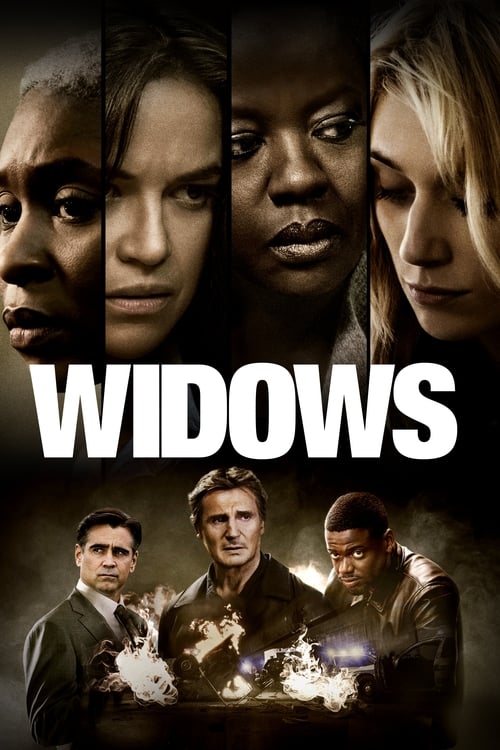
Widows (2018)
Directed by Steve McQueen
Yes — Widows is woke, scoring 63 out of 100 on our wokeness meter.
Steve McQueen's Widows opens with a getaway van detonating and rarely eases off.
Consciousness Markers
The ensemble is deliberately diverse, with Black, Latina, and white women leading a mainstream heist thriller, and the Chicago setting makes race and representation part of the texture.
The film centers on women reclaiming agency after their husbands' deaths, confronting abusive men, sexist exploitation, and male-dominated power structures.
Chicago's racialized political machine, police violence against a Black youth, and the South Side vs. dynastic white power dynamic are explicit concerns.
Social themes are present but folded into a genre thriller, with little direct preaching.
It critiques corrupt political dynasties, crime bosses, and wealthy elites, but the heist is driven by debt and survival rather than systemic anti-capitalist argument.
No LGBTQ+ characters, relationships, or themes are present.
No environmental or climate themes.
No body-positivity themes.
No neurodivergence themes.
Not a historical revision; it is a contemporary crime drama based on a TV series.
Why it received this score
Steve McQueen's Widows opens with a getaway van detonating and rarely eases off. Four thieves die in a Chicago shootout, leaving their wives a debt owed to a crime boss and a notebook of blueprints for a job that has not happened yet. The result is a heist picture assembled with unusual patience, and a cast that places Viola Davis, Michelle Rodriguez, Elizabeth Debicki and Cynthia Erivo at the center of a mainstream thriller. The ensemble is diverse by design. Black, Latina and white women share the frame and nobody pauses to announce the significance.
The story belongs to women who inherit nothing but obligations. Veronica grieves a husband and a son. Linda loses a store to her husband's hidden gambling. Alice endures an abusive mother and drifts into a transactional arrangement with a real estate developer. They reclaim agency because the alternative is ruin. The political backdrop sharpens the film's social attention. Jamal Manning runs for alderman on the South Side against Jack Mulligan, heir to a dynasty that has held the ward for decades and profits from a neighborhood it barely visits. Veronica's son was shot by police during a traffic stop, a wound the film keeps returning to without a speech attached.
The politics arrive folded into genre mechanics. Corrupt dynasties, mob enforcers and wealthy men who treat women as assets all take their lumps, though the heist itself is driven by debt and survival, not by an argument about the system. Little here preaches. McQueen trusts the audience to read the room, and the result is a thriller that carries its themes lightly and still lands hard. It ends with a school library named for a dead boy, a small monument bought with stolen money. The film declines to explain the irony. It does not need to.
Analysis generated by our Consciousness Algorithm


Synopsis
A police shootout leaves four thieves dead during an explosive armed robbery attempt in Chicago. Their widows have nothing in common except a debt left behind by their spouses' criminal activities. Hoping to forge a future on their own terms, they join forces to pull off a heist.
Questions about Widows
Is Widows woke?
Yes — Widows is woke, scoring 63 out of 100 on our wokeness meter. That earns it a verdict of Woke.
What makes Widows woke?
5 of the 10 markers register at 30 or above, led by Feminist Agenda (75), Representation Casting (75) and Racial Consciousness (65). On Feminist Agenda: The film centers on women reclaiming agency after their husbands' deaths, confronting abusive men, sexist exploitation, and male-dominated power structures.
How does Widows compare to other 2018 movies?
It ranks #16 of the 325 films from 2018 we've scored; their average is 20. The wokest is Return (92).
How is the Woke Score calculated?
An AI-assisted process researches the film and its reception, scores it 0–100 on ten markers, then combines those into one 0–100 Woke Score. It measures a specific set of 2020s cultural themes, not film quality.