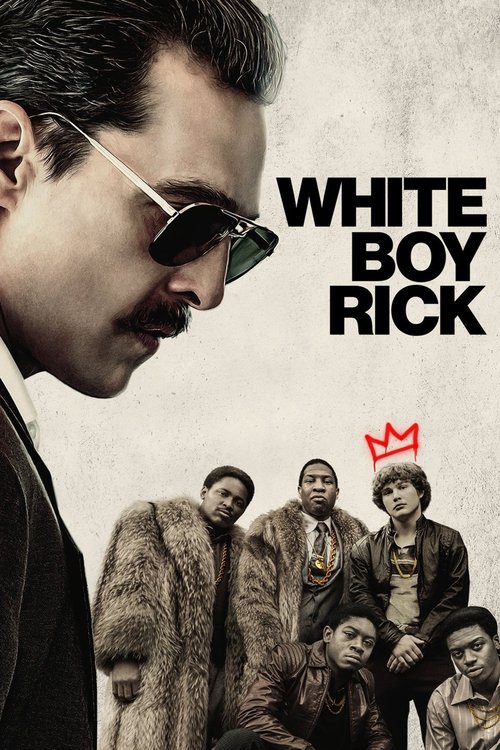
White Boy Rick (2018)
Directed by Yann Demange
No — White Boy Rick is not woke, scoring 11 out of 100 on our wokeness meter.
White Boy Rick arrives with the grim confidence of a film that knows exactly which true crime it has chosen.
Consciousness Markers
The film features a diverse supporting cast, including Black actors such as Brian Tyree Henry, RJ Cyler, Jonathan Majors, and Taylour Paige, but centers a white protagonist's story.
The epilogue about Wershe's long sentence for a non-violent offense carries a mild message about criminal justice reform, but the film remains a dramatization.
Set against the crack epidemic in Detroit, the film touches on racial dynamics of the drug war but does not explicitly critique systemic racism.
Female characters exist, such as Dawn, Cathy, and Agent Snyder, but the narrative does not advance a feminist agenda.
No LGBTQ+ characters or themes are present.
No environmental or climate-related themes are present.
The film depicts poverty and illegal economies but offers no anti-capitalist critique.
No body positivity themes are present.
No neurodivergent characters or themes are present.
Based on a true story but not a progressive revision of history.
Why it received this score
White Boy Rick arrives with the grim confidence of a film that knows exactly which true crime it has chosen. Yann Demange sets his camera in mid-1980s Detroit, a city being hollowed out by the crack trade and the federal response to it, and follows a fourteen-year-old who becomes the youngest informant the Bureau ever recruited. Matthew McConaughey plays the father with a weary, gun-selling charm. The supporting cast is notably integrated, with Brian Tyree Henry, RJ Cyler, Jonathan Majors and Taylour Paige doing serious work in the margins. The story they orbit belongs to a white teenager, and the film never pretends otherwise.
The picture is largely indifferent to the cultural preoccupations of its own release year. There is no romance outside heterosexual convention, no interest in the body as a site of affirmation, no environmental conscience, no anti-capitalist reading of the drug economy it depicts. Poverty and illegal commerce are rendered as weather, not as argument. The women in the cast, Dawn and Cathy among them, are given wounds and appetites but no thesis. Race sits in the frame constantly, since the war on drugs was waged unevenly, but the screenplay declines to name the disparity it keeps brushing against. The result is a crime drama that observes its own inequities without ever raising its voice about them.
What remains is the closing title card. Ricky Wershe served more than thirty years for a non-violent offense, a fact the film presents with a straight face and a mild nudge toward the injustice of it. That gesture is the film's only sermon, and it is brief. Everything before it is a well-acted, modestly assembled tragedy of a kid who was used by everyone who claimed to protect him. The film trusts the story to make its own case. For the most part, it does.
Analysis generated by our Consciousness Algorithm


Synopsis
The story of Richard Wershe Jr., a teenager who became an undercover informant for the police during the 1980s, and was ultimately arrested for drug trafficking and sentenced to life in prison.
Questions about White Boy Rick
Is White Boy Rick woke?
No — White Boy Rick is not woke, scoring 11 out of 100 on our wokeness meter. That earns it a verdict of Ultra Based.
Does White Boy Rick have any woke elements?
1 of the 10 markers register at 30 or above, led by Representation Casting (30). On Representation Casting: The film features a diverse supporting cast, including Black actors such as Brian Tyree Henry, RJ Cyler, Jonathan Majors, and Taylour Paige, but centers a white protagonist's story.
How does White Boy Rick compare to other 2018 movies?
It ranks #184 of the 325 films from 2018 we've scored; their average is 20. The wokest is Return (92).
How is the Woke Score calculated?
An AI-assisted process researches the film and its reception, scores it 0–100 on ten markers, then combines those into one 0–100 Woke Score. It measures a specific set of 2020s cultural themes, not film quality.