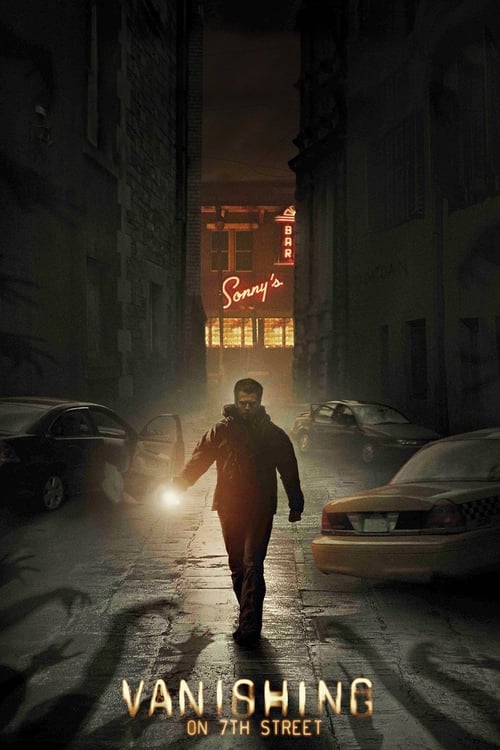
Vanishing on 7th Street (2010)
Directed by Brad Anderson
No — Vanishing on 7th Street is not woke, scoring 8 out of 100 on our wokeness meter.
Vanishing on 7th Street operates as a competent, if ultimately unremarkable, piece of survival horror.
Consciousness Markers
The cast includes Thandiwe Newton, John Leguizamo, and Jacob Latimore in prominent roles, but their presence is not framed as a statement about representation.
No LGBTQ+ characters, themes, or subtext are present.
The film has no feminist agenda or commentary on gender dynamics; Rosemary is a distressed mother figure rather than a vehicle for feminist themes.
Race is not addressed or thematized in the film.
The apocalyptic darkness is supernatural or unexplained, not an environmental or climate allegory.
There is no critique of capitalism or wealth inequality.
The film does not engage with body positivity or body-image themes.
No neurodivergent characters or themes are present.
The Roanoke Colony disappearance is referenced as a historical mystery, not revised or reinterpreted for ideological purposes.
The film is a straightforward horror-thriller and does not lecture the audience on social or political issues.
Why it received this score
Vanishing on 7th Street operates as a competent, if ultimately unremarkable, piece of survival horror. It presents a scenario of mass disappearance during a global power failure, a premise that relies more heavily on suspense than on any modern cultural commentary. The narrative functions as a straightforward thriller, focusing on the isolated struggle of a few survivors against an encroaching, undefined darkness. The film avoids the thematic complexity expected from modern prestige cinema, choosing instead to adhere to a practical, if somewhat claustrophobic, set of rules regarding light sources and survival within a decaying urban landscape. This restraint, while perhaps intended as a stylistic choice, results in a viewing experience that is entirely devoid of contemporary social urgency.
The cast, which includes several actors known for more prominent roles in socially conscious media, is utilized without any apparent intention to leverage their platform for any progressive messaging. Characters like Rosemary, who experiences distress over her missing child, serve as conventional dramatic anchors rather than vessels for any deeper sociological inquiry. The story remains firmly rooted in the mechanics of its apocalyptic mystery, referencing historical disappearances like the Roanoke Colony as mere plot devices. The inherent focus on the immediate threat and the logistical struggle for survival provides a stark contrast to the prevailing trend of overly didactic cinema.
Ultimately, the film is a serviceable example of the genre it inhabits. It does not attempt to lecture its audience on environmental ethics, gender dynamics, or systemic inequality. It simply offers a bleak, well-directed vision of societal collapse. This approach, while perhaps lacking in the kind of cultural gravitas many contemporary productions demand, allows the film to remain a purer, less burdened piece of speculative fiction. It is a story about the necessity of batteries, not the necessity of a statement.
Analysis generated by our Consciousness Algorithm


Synopsis
A mysterious global blackout yields countless populations to simply vanish, leaving only their clothes and possessions behind. A small handful of survivors band together in a dimly-lit tavern on 7th Street, struggling to combat the apocalyptic horror. Realizing they may in fact be the last people on earth, a dark shadow hones in on them alone.
Questions about Vanishing on 7th Street
Is Vanishing on 7th Street woke?
No — Vanishing on 7th Street is not woke, scoring 8 out of 100 on our wokeness meter. That earns it a verdict of Ultra Based.
Does Vanishing on 7th Street have any woke elements?
Very few. None of the 10 markers reaches 30, the level where a marker counts as present; the highest is Representation Casting at 20.
How does Vanishing on 7th Street compare to other 2010 movies?
It ranks #100 of the 238 films from 2010 we've scored; their average is 11. The wokest is My Name Is Khan (84).
How is the Woke Score calculated?
An AI-assisted process researches the film and its reception, scores it 0–100 on ten markers, then combines those into one 0–100 Woke Score. It measures a specific set of 2020s cultural themes, not film quality.