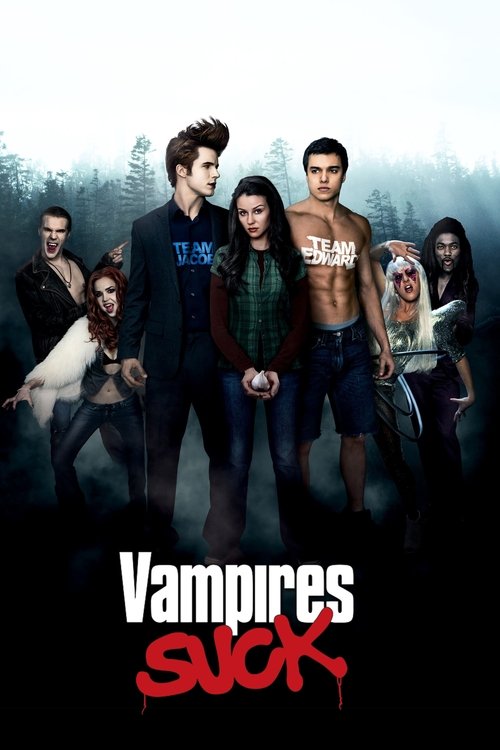
Vampires Suck (2010)
Directed by Aaron Seltzer
No — Vampires Suck is not woke, scoring 0 out of 100 on our wokeness meter.
Vampires Suck arrives in the historical record as a 2010 Friedberg and Seltzer production, which is to say it arrives as a business decision wearing the costume of a comedy.
Consciousness Markers
The cast is predominantly white with a few minority actors in comedic roles, but there is no apparent progressive intent behind the casting.
No LGBTQ+ characters, themes, or subtext are present in this Twilight spoof.
The film parodies Twilight's romance tropes without offering any feminist critique or agenda; female characters are largely objects of parody.
Any racial humor is incidental and not a consciousness-raising or progressive engagement with race.
There is no environmental or climate-related theme in the film.
The film contains no critique of capitalism or wealth inequality.
No body-positivity themes or messages are present.
The protagonist's anxiety is played for parody, not as a neurodivergence-affirming theme.
The film spoofs pop culture, not historical events or narratives.
It is a broad comedy with no didactic or preachy messaging.
Why it received this score
Vampires Suck arrives in the historical record as a 2010 Friedberg and Seltzer production, which is to say it arrives as a business decision wearing the costume of a comedy. Its target is the Twilight franchise, and its method is the blunt instrument: a joke about a name, a kick to the groin, a pop culture reference offered without comment. The film opened at number one domestically, grossed roughly eighty million dollars worldwide, and collected four Golden Raspberry nominations. Critics were unanimous in a way critics rarely are. Peter Travers gave it zero stars and four words. The ship, as Mark Kermode observed, had not merely sailed but struck an iceberg and been retrofitted for 3D.
On the matter of social consciousness, the film is a clean slate, and not in the flattering sense. Its cast is predominantly white, with Ken Jeong and a handful of others deployed for incidental gags that carry no progressive intent. There are no queer characters, no engagement with race as a subject, no environmental theme, no critique of wealth, no body-positive message, no neurodivergence-affirming framework, and no revisionist reading of history, since the film has no interest in history at all. Becca's anxiety is a punchline, not a portrait. As for sermonizing, the film has nothing to preach. It is too busy falling down.
The film remains a curiosity for the archive. A comedy can be crude, stupid, and reviled without registering a single point on the cultural ledger, and this one manages the trick. Jenn Proske's mimicry of Kristen Stewart's hair-tugging agitation drew the only genuine praise the film received, and it is deserved. She is doing precise work inside a production that rewards nothing precise. The rest is noise. We file it under zero, not as a verdict on quality (that verdict is separately and thoroughly settled) but as a factual observation. The film aspires to offend nobody and succeeds at nothing. The meter stays dark.
Analysis generated by our Consciousness Algorithm


Synopsis
Becca, an anxious, non-vampire teen is torn between two boys. Before she can choose, Becca must get around her controlling father, who treats her like a child. Meanwhile, Becca's friends contend with their own romantic issues – all of which collide at the prom.
Questions about Vampires Suck
Is Vampires Suck woke?
No — Vampires Suck is not woke, scoring 0 out of 100 on our wokeness meter. That earns it a verdict of Ultra Based.
Does Vampires Suck have any woke elements?
No. All 10 markers score zero.
How does Vampires Suck compare to other 2010 movies?
It ranks #204 of the 238 films from 2010 we've scored; their average is 11. The wokest is My Name Is Khan (84).
How is the Woke Score calculated?
An AI-assisted process researches the film and its reception, scores it 0–100 on ten markers, then combines those into one 0–100 Woke Score. It measures a specific set of 2020s cultural themes, not film quality.