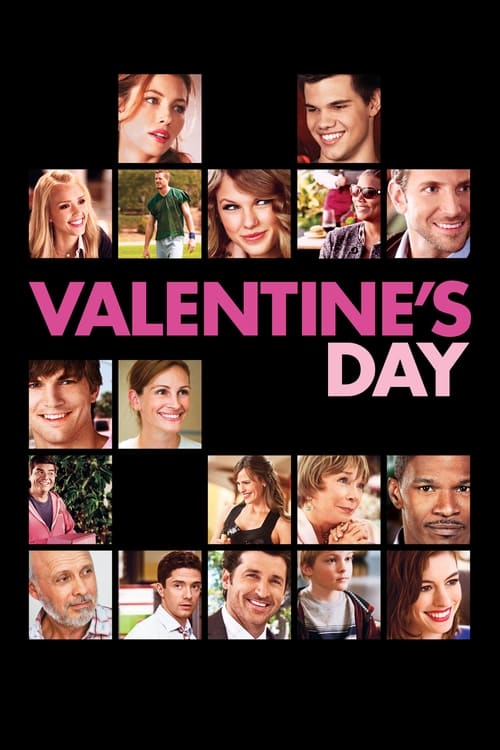
Valentine's Day (2010)
Directed by Garry Marshall
No — Valentine's Day is not woke, scoring 19 out of 100 on our wokeness meter.
Garry Marshall's Valentine's Day arrives as a greeting card with a payroll, a Los Angeles mosaic in which roughly two dozen recognizable faces rotate through eighteen hours of romantic misadventure.
Consciousness Markers
A genuine subplot follows closeted football player Sean Jackson coming out on national television and reconciling with his lover Holden, treated positively and sympathetically.
The ensemble cast is notably multiracial (Jamie Foxx, Queen Latifah, George Lopez, Hector Elizondo), but the diversity is treated as natural LA-set casting with no editorial comment.
Features several independent women (an army captain, a teacher, a woman throwing an 'I Hate Valentine's Day' party), but this is conventional romcom material rather than a feminist agenda.
A subplot references a $100,000 student loan driving a character into phone sex work, a mild economic-resentment note, but it is played for comedy, not as eat-the-rich polemic.
The film is featherweight escapism and preaches nothing, so lecture energy is minimal.
No racial commentary or racial themes are present; the diverse cast carries no racial consciousness message.
No environmental or climate content whatsoever.
No body positivity themes; characters are conventional and no body image commentary appears.
No neurodivergence themes or characters.
No historical revisionism; the film is a contemporary Valentine's Day vignette with no historical subject matter.
Why it received this score
Garry Marshall's Valentine's Day arrives as a greeting card with a payroll, a Los Angeles mosaic in which roughly two dozen recognizable faces rotate through eighteen hours of romantic misadventure. The structure owes an obvious debt to Love Actually, though the debt is settled in loose change. Critics were unkind, audiences eventually drifted away, and the film nonetheless opened at number one over the holiday that shares its name. Such is the marketplace, and such is the critic's burden, to sit with these things and count.
The cultural inventory here is modest and mostly incidental. A closeted football player, Sean Jackson, comes out on national television and is reunited with his lover, a subplot handled with sincerity and a fair share of screen time. The ensemble is thoroughly multiracial, though Los Angeles casting being what it is, nobody remarks on it. An Army captain crosses the country for a single day with her son. A woman takes a second job in phone sex to service a six-figure student loan, a detail played for laughs and never pursued as economic grievance. An "I Hate Valentine's Day" party signals a certain weariness with the holiday, and the weariness is itself the joke.
The absences are equally instructive. There is no environmental conscience, no engagement with history, no commentary on bodies, no neurological difference, no racial argument. It is a confection assembled by a director who understood that audiences want to leave the theater humming. It lectures no one. It means no harm. It also means very little else, and there is a strange integrity in that, a kind of honesty about its own weightlessness that more ambitious pictures could learn from and almost never do. The sommelier notes: thin, sweet, no finish. Pairs with nothing. Scores accordingly low, with one small pour for the football player who told the truth on camera and was rewarded for it, which in 2010 was still a mild act of nerve.
Analysis generated by our Consciousness Algorithm


Synopsis
Intertwining couples and singles in Los Angeles break-up and make-up based on the pressures and expectations of Valentine's Day.
Questions about Valentine's Day
Is Valentine's Day woke?
No — Valentine's Day is not woke, scoring 19 out of 100 on our wokeness meter. That earns it a verdict of Ultra Based.
Does Valentine's Day have any woke elements?
2 of the 10 markers register at 30 or above, led by LGBTQ+ Themes (50) and Representation Casting (30). On LGBTQ+ Themes: A genuine subplot follows closeted football player Sean Jackson coming out on national television and reconciling with his lover Holden, treated positively and sympathetically.
How does Valentine's Day compare to other 2010 movies?
It ranks #39 of the 238 films from 2010 we've scored; their average is 11. The wokest is My Name Is Khan (84).
How is the Woke Score calculated?
An AI-assisted process researches the film and its reception, scores it 0–100 on ten markers, then combines those into one 0–100 Woke Score. It measures a specific set of 2020s cultural themes, not film quality.