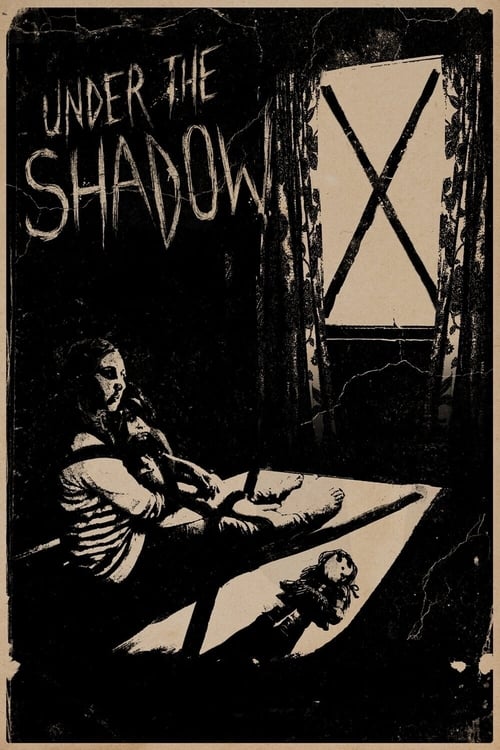
Under the Shadow (2016)
Directed by Babak Anvari
No — Under the Shadow is not especially woke, scoring 30 out of 100 on our wokeness meter.
The djinn, as a matter of professional record, do not care about your politics.
Consciousness Markers
Critics explicitly labeled this an 'Iranian feminist horror film,' with Shideh barred from medical studies and menaced by a chador apparition, functioning as an allegory for a society that oppresses women.
The cast is entirely Iranian/Middle Eastern, but this reflects an authentic Persian-language story rather than a performative diversity mandate; the representation is natural to the narrative.
The social and feminist commentary is embedded as subtext within a genre horror framework rather than delivered as direct moralizing.
The film concerns Iranian national and cultural identity during the war, but does not engage modern racial-consciousness discourse.
Shideh's past involvement with leftist groups is mentioned as backstory, but the film mounts no sustained anti-capitalist critique.
No LGBTQ+ characters or themes appear anywhere in the film.
No environmental or climate themes are present.
No body-positivity themes or messaging appear.
The mute neighbor boy is traumatized by his parents' death, not depicted as neurodivergent; no neurodivergence themes are present.
The film is a fictional horror story set against a real historical backdrop (the War of the Cities) without revising or reinterpreting historical events.
Why it received this score
The djinn, as a matter of professional record, do not care about your politics. They care about your beloved objects. In Babak Anvari's 2016 debut, a Tehran apartment block takes a missile during the War of the Cities, and something older than the Iran-Iraq conflict settles in behind the plaster. Shideh, a medical student barred from her studies over an old association with leftist groups, stays put with her daughter Dorsa while the neighbors evacuate. The film delivers a patient, dread-soaked haunting that honors its genre and its geography in equal measure.
Critics at the time reached for the phrase Iranian feminist horror, and the label holds. Shideh is denied a career by a committee of men, then menaced by a floating chador, which is about as on-the-nose as supernatural allegory gets. The casting is entirely Iranian and entirely correct for a Persian-language story, which is representation of the unforced variety. The leftist backstory registers as texture. It never hardens into a manifesto about capital.
The film declines to sermonize. The social critique lives inside the jump scares, the way a good ghost story keeps its thesis in the walls instead of the dialogue. There is no modern discourse bolted onto 1980s Tehran, no anachronistic vocabulary, no scene in which a character explains the theme to the audience. It simply lets a mother fight for her child against a society and a spirit that both want her diminished. Restraint, in this genre, is a rare vintage. This one is worth cellaring.
Analysis generated by our Consciousness Algorithm


Synopsis
After Shideh's building is hit by a missile during the Iran-Iraq War, a superstitious neighbor suggests that the missile was cursed and might be carrying malevolent Middle-Eastern spirits. She becomes convinced a supernatural force within the building is attempting to possess her daughter Dorsa, and she has no choice but to confront these forces if she is to save her daughter and herself.
Questions about Under the Shadow
Is Under the Shadow woke?
No — Under the Shadow is not especially woke, scoring 30 out of 100 on our wokeness meter. That earns it a verdict of Based.
Does Under the Shadow have any woke elements?
2 of the 10 markers register at 30 or above, led by Feminist Agenda (65) and Representation Casting (35). On Feminist Agenda: Critics explicitly labeled this an 'Iranian feminist horror film,' with Shideh barred from medical studies and menaced by a chador apparition, functioning as an allegory for a society that oppresses women.
How does Under the Shadow compare to other 2016 movies?
It ranks #40 of the 285 films from 2016 we've scored; their average is 16. The wokest is 13th (92).
How is the Woke Score calculated?
An AI-assisted process researches the film and its reception, scores it 0–100 on ten markers, then combines those into one 0–100 Woke Score. It measures a specific set of 2020s cultural themes, not film quality.