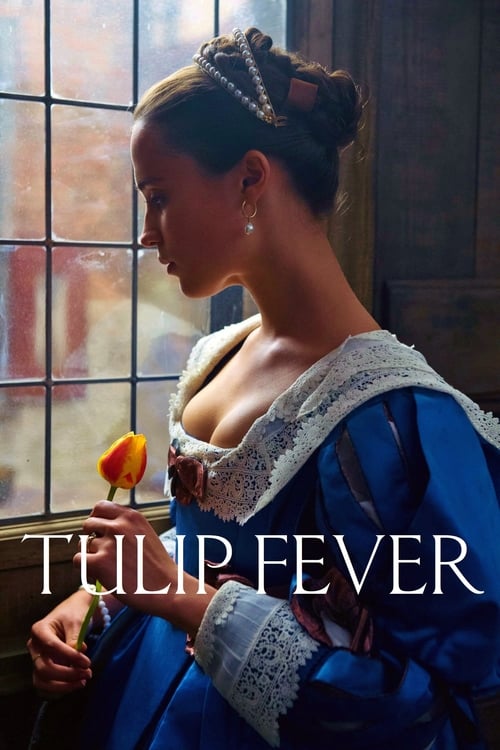
Tulip Fever (2017)
Directed by Justin Chadwick
No — Tulip Fever is not woke, scoring 7 out of 100 on our wokeness meter.
Tulip Fever arrives as a handsomely mounted period romance with a troubled production history and an air of exhaustion.
Consciousness Markers
Sophia is a woman chafing against a childless arranged marriage and exercising sexual and romantic agency, but the film frames this as period melodrama rather than a feminist statement.
The tulip mania speculative bubble and Willem's ruin gesture at the folly of financial speculation, but the film treats it as backdrop for romance rather than a critique of capital.
The ensemble is overwhelmingly white European and American actors, with David Harewood a rare non-white face in a 17th-century Amsterdam period piece; casting is traditional rather than consciously diverse.
No LGBTQ+ characters, relationships, or themes appear anywhere in the film.
Race is entirely absent as a subject; the film concerns Dutch merchants, painters, and nuns with no engagement with racial themes.
No environmental or climate content whatsoever.
No body-positivity themes; the film adheres to conventional period-drama beauty standards.
No neurodivergent characters or themes are present.
The film is a fictional romance set against a real historical backdrop (tulip mania) without reinterpreting or revising historical narratives.
The film is a lush, plot-heavy romance that makes no attempt to deliver moral or social instruction to the audience.
Why it received this score
Tulip Fever arrives as a handsomely mounted period romance with a troubled production history and an air of exhaustion. The film follows Sophia, an orphan married to a wealthy spice merchant, who falls for the painter commissioned to immortalize her. The tulip mania of 17th-century Amsterdam provides the backdrop, though it functions mostly as a decorative engine for plot. The result is a lush, overplotted melodrama that treats its historical setting as wallpaper. On the matter of modern social consciousness, the film is a sparse specimen. Its casting is traditional for a European period piece: a gallery of white faces, with David Harewood appearing in a minor role. That single inclusion registers as token presence, not a designed statement. The film has no interest in queer lives, racial argument, environmental anxiety, body politics, or neurodivergent perspective. Such concerns simply do not enter its frame.
Sophia does exercise romantic and sexual agency. She chafes against a childless arranged marriage and conspires to escape it. Yet the film frames her choices as period melodrama, not as a feminist argument. Her deception is punished by guilt, and the narrative resolves her into a convent, smiling at her painter from a distance. The tulip market offers a mild caution about speculation. Willem's ruin and the eventual crash suggest the folly of financial bubbles, but the film treats this as atmospheric irony. It does not mount a critique of capital. The wealthy merchant remains sympathetic. The nuns trade bulbs with pragmatic charm. Any economic lesson is incidental.
Tulip Fever makes no attempt to lecture its audience. It wants to be a swooning romance with sumptuous costumes and a complicated plot, and it succeeds only at the costumes. The film has no revisionist historical project. It invents private lives against a real backdrop and leaves the backdrop intact. Its progressive gestures are faint, inherited from the novel's interest in a woman's limited options and from the natural drama of a speculative bubble. The rest is silence, or perhaps the sound of a release date being pushed back one more time. As a cultural artifact, it is less a statement than a cautionary tale about studio mismanagement.
Analysis generated by our Consciousness Algorithm
Part of


Synopsis
An artist falls for a married young woman while he's commissioned to paint her portrait. The two invest in the risky tulip market in hopes to build a future together.
Questions about Tulip Fever
Is Tulip Fever woke?
No — Tulip Fever is not woke, scoring 7 out of 100 on our wokeness meter. That earns it a verdict of Ultra Based.
Does Tulip Fever have any woke elements?
Very few. None of the 10 markers reaches 30, the level where a marker counts as present; the highest is Eat the Rich at 15.
How does Tulip Fever compare to other 2017 movies?
It ranks #208 of the 309 films from 2017 we've scored; their average is 19. The wokest is I Am Not Your Negro (92).
How is the Woke Score calculated?
An AI-assisted process researches the film and its reception, scores it 0–100 on ten markers, then combines those into one 0–100 Woke Score. It measures a specific set of 2020s cultural themes, not film quality.