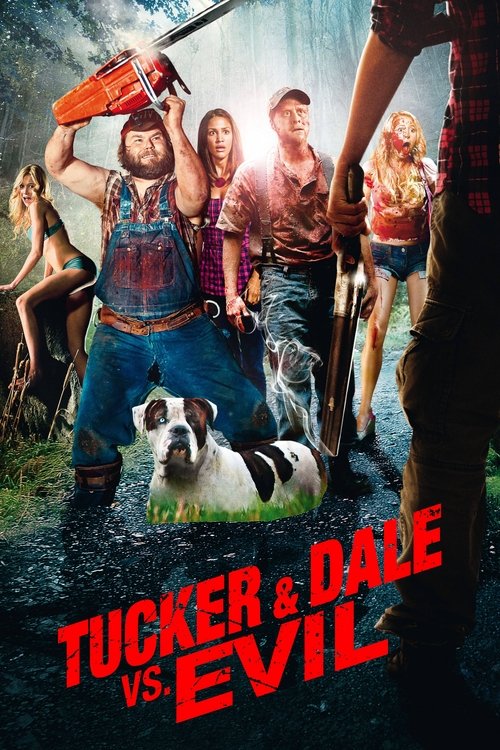
Tucker and Dale vs. Evil (2010)
Directed by Eli Craig
No — Tucker and Dale vs. Evil is not woke, scoring 0 out of 100 on our wokeness meter.
There is a particular strain of comedy that arrives with its thesis stapled to its forehead, and then there is Tucker and Dale vs. Evil, which arrives with a chainsaw and a misunderstanding and lets the audience do the thinking.
Consciousness Markers
The cast is predominantly white, with any minority presence incidental and unremarked upon. There is no deliberate representation casting agenda.
The film contains no LGBTQ+ characters, themes, or subtext.
Allison is a capable final girl, but the film does not advance a feminist agenda or critique patriarchy.
The central conflict is between college kids and rural hillbillies, a class and cultural clash rather than a racial one. No racial consciousness themes are present.
There is no environmental or climate-related messaging in the film.
The film does not critique capitalism, wealth inequality, or the rich.
There is no body positivity theme or celebration of diverse body types.
Chad's mental instability is played for horror and comedy, not as positive neurodivergent representation.
The film subverts horror tropes but does not revise or reinterpret historical events.
The film's moral about not judging by appearances is delivered through farce, not preachy lecturing.
Why it received this score
There is a particular strain of comedy that arrives with its thesis stapled to its forehead, and then there is Tucker and Dale vs. Evil, which arrives with a chainsaw and a misunderstanding and lets the audience do the thinking. Two well-meaning West Virginian hillbillies buy a lakefront cabin. A gaggle of terrified college students interpret every innocent act as attempted murder, and the resulting body count is almost entirely self-inflicted. The film's central joke is a sturdy one: the horror genre has spent decades treating rural poverty as a shorthand for menace, and Eli Craig simply reverses the polarity. The yokels are kind. The coeds are the danger. It is a clean, efficient piece of satire that neither scolds nor sermonizes, which places it in a category of genre filmmaking that has become alarmingly rare.
The cast is uniformly pale, and nobody in the screenplay pauses to reflect on this. Allison functions as a capable survivor, though the film has no interest in examining the gendered machinery of the slasher so much as in stepping over it. There is a class conflict at the center, college kids against country folk, but it is treated as a joke about assumptions, not a thesis about power. Chad's descent into unhinged vengeance is played for horror and eventual pathos, and the film never once suggests we should regard his instability as a misunderstood gift. No characters wrestle with identity, capital, climate, or the body. Nobody delivers a speech. When the moral finally surfaces, that we should not judge strangers by their overalls, it is delivered by a man throwing a box of chamomile tea at an asthmatic, which is as close to a lecture as this production is willing to get.
What remains is a well-oiled machine of escalating coincidence, and it holds up. The screenplay understands that a farce lives or dies on the precision of its timing, and the timing here is ruthless. It is a film with nothing to teach us and a great deal to show us, which, in the current climate of the multiplex, is a small mercy.
Analysis generated by our Consciousness Algorithm


Synopsis
Two hillbillies are suspected of being killers by a group of paranoid college kids camping near the duo's West Virginian cabin. As the body count climbs, so does the fear and confusion as the college kids try to seek revenge against the pair.
Questions about Tucker and Dale vs. Evil
Is Tucker and Dale vs. Evil woke?
No — Tucker and Dale vs. Evil is not woke, scoring 0 out of 100 on our wokeness meter. That earns it a verdict of Ultra Based.
Does Tucker and Dale vs. Evil have any woke elements?
No. All 10 markers score zero.
How does Tucker and Dale vs. Evil compare to other 2010 movies?
It ranks #204 of the 238 films from 2010 we've scored; their average is 11. The wokest is My Name Is Khan (84).
How is the Woke Score calculated?
An AI-assisted process researches the film and its reception, scores it 0–100 on ten markers, then combines those into one 0–100 Woke Score. It measures a specific set of 2020s cultural themes, not film quality.