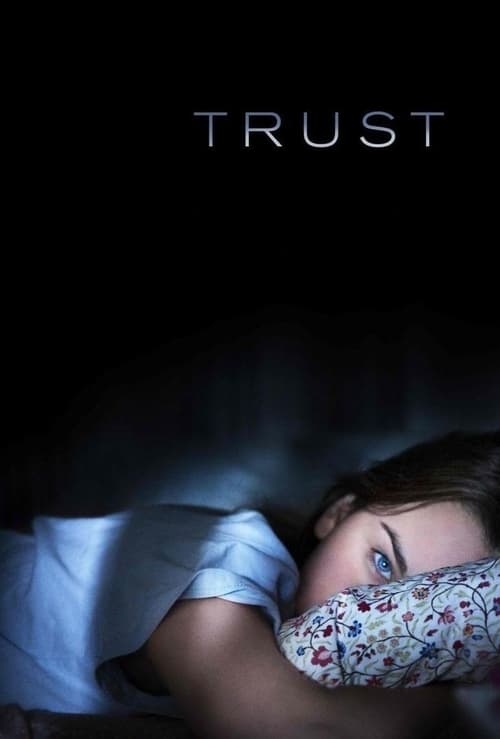
Trust (2010)
Directed by David Schwimmer
No — Trust is not woke, scoring 11 out of 100 on our wokeness meter.
David Schwimmer's Trust arrives with the gravity of a public service announcement that has been to film school.
Consciousness Markers
The film carries an awareness-raising mission rooted in Schwimmer's years of research and work with The Rape Foundation, and it aims to educate about online predation, though it delivers this through drama rather than explicit sermonizing.
The cast includes Viola Davis as a counselor and several actors of color in supporting roles, but their presence is natural to the story and never framed as a representational statement.
The film centers a teenage girl's trauma and recovery and gives her mother and a female counselor significant roles, but it is a victim-sympathy drama rather than a vehicle for a feminist agenda.
The father's advertising firm is briefly criticized for using provocative images of teenagers, a mild media-industry critique, but it is a minor subplot rather than an economic argument.
There are no LGBTQ+ characters, themes, or subtext anywhere in the film.
Race is never addressed or thematized; Viola Davis's casting is incidental and carries no racial commentary.
No environmental or climate themes appear in the film.
Body image and body positivity are not themes of the film.
No neurodivergent characters or themes are present.
The film is a fictional cautionary drama, not a reworking of historical events.
Why it received this score
David Schwimmer's Trust arrives with the gravity of a public service announcement that has been to film school. A fourteen-year-old girl named Annie is groomed in a chat room, meets a man she believes is a boy, and is raped in a motel while he films it. The film refuses to soften this. Schwimmer spent years with The Rape Foundation and roughly fifty drafts sharpening the thing, and the result is a sober, well-acted chamber piece that treats its subject with intelligence and sympathy. It is a serious film about a serious crime. That seriousness, however, is not the same as a program of social reform, and the picture mostly keeps its politics to itself.
There is a mild current of cultural awareness running beneath the surface. Annie's father works at an advertising firm that peddles provocative images of teenagers, a passing jab at the media machine that the film never develops into an argument. A hospital counselor, played by Viola Davis, offers the girl a patient ear, and Annie's mother carries her own quiet share of the anguish. These are humane gestures, not a thesis. Race is never raised. Neither is sexual identity, nor body image, nor the climate. The film has one subject and it stays on it.
Where the picture does lean forward is in its sense of mission. It wants us to understand how online predation works, how a child can be groomed into calling her abuser a boyfriend, how a family fractures in the aftermath. The lessons arrive through performance and consequence, not through speeches, which is the honorable way to do it. A post-credits revelation lands with a cold thud. The whole enterprise is earnest, well-meaning, and only occasionally preachy. It instructs us gently. It does not shout.
Analysis generated by our Consciousness Algorithm


Synopsis
A suburban family is torn apart when fourteen-year-old Annie meets her first boyfriend online. After months of communicating via online chat and phone, Annie discovers her friend is not who he originally claimed to be. Shocked into disbelief, her parents are shattered by their daughter's actions and struggle to support her as she comes to terms with what has happened to her once innocent life.
Questions about Trust
Is Trust woke?
No — Trust is not woke, scoring 11 out of 100 on our wokeness meter. That earns it a verdict of Ultra Based.
Does Trust have any woke elements?
Very few. None of the 10 markers reaches 30, the level where a marker counts as present; the highest is Lecture Energy at 25.
How does Trust compare to other 2010 movies?
It ranks #77 of the 238 films from 2010 we've scored; their average is 11. The wokest is My Name Is Khan (84).
How is the Woke Score calculated?
An AI-assisted process researches the film and its reception, scores it 0–100 on ten markers, then combines those into one 0–100 Woke Score. It measures a specific set of 2020s cultural themes, not film quality.