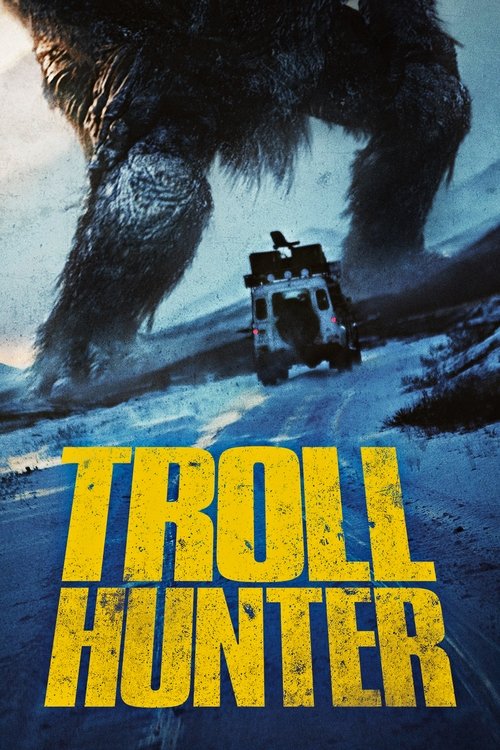
Troll Hunter (2010)
Directed by André Øvredal
No — Troll Hunter is not woke, scoring 5 out of 100 on our wokeness meter.
Trollhunter arrives from Norway in 2010 with a flash-gun, a Land Rover, and a profound disinterest in instructing anyone about anything.
Consciousness Markers
A Norwegian production with a naturally Nordic cast; a female documentarian and a replacement camerawoman appear, but casting reflects the film's national origin rather than any deliberate diversity agenda.
Hans grumbles about poor pay and the Troll Security Service satirizes secretive government bureaucracy, but there is no eat-the-rich economic critique.
Johanna and Malica are competent women in the crew, but the film makes no feminist argument and the camera is squarely on Hans.
The Polish bear-hunter scene toys with xenophobic stereotypes for comedy, but it is satire of Norwegian attitudes rather than a racial-consciousness statement.
A dry-witted found-footage creature feature with light social satire; it never stops to preach at the audience.
No LGBTQ+ characters, themes, or subtext of any kind.
Power lines and wildlife regulation appear as bureaucratic plot furniture, not as climate advocacy.
No body-positivity themes present.
No neurodivergence themes present.
The film draws on folklore and myth, not on reinterpreting real historical events.
Why it received this score
Trollhunter arrives from Norway in 2010 with a flash-gun, a Land Rover, and a profound disinterest in instructing anyone about anything. André Øvredal's found-footage mockumentary follows three Volda students as they tail Hans, a weary civil servant who kills trolls for a living and plants bear carcasses so the public stays calm. The Troll Security Service hovers in the background, confiscating tapes and filing paperwork. It is a creature feature with a bureaucratic pulse, and it treats its own mythology as a personnel problem.
Hans complains about his salary. That is the extent of the economic critique, and it lands as the grumbling of a man with a dangerous job and a modest pension, not a summons to redistribute anything. The power lines strung across the fjords function as an electric fence for trolls, and the wildlife regulations exist to keep farmers quiet. Nobody here stops to explain what any of it means for the planet. The women in the crew, Johanna and later Malica, handle their cameras with competence and receive no ceremony for it. The Polish bear hunter is a joke about Norwegian immigration attitudes, delivered with a straight face by Robert Stoltenberg, and the film lets the audience squirm without issuing a verdict. Folklore gets adapted. History does not. No one is redeemed, no one is educated, and the Prime Minister's cameo is a visual gag, not a confession.
What we have, then, is a film that satirizes secrecy and pays its respects to Peer Gynt. The trolls turn to stone in UV light because the old stories said so. The closing credits insist no trolls were harmed. Somewhere a studio executive once wanted to remake this, and the remake died, which feels correct. The film's cultural temperature is low, its humor dry, its agenda nonexistent. It is a documentary about a man with a very strange job, and it would prefer to remain one.
Analysis generated by our Consciousness Algorithm


Synopsis
A group of students investigates a series of mysterious bear killings, but learns that there are much more dangerous things going on. They start to follow a mysterious hunter, learning that he is actually a troll hunter.
Questions about Troll Hunter
Is Troll Hunter woke?
No — Troll Hunter is not woke, scoring 5 out of 100 on our wokeness meter. That earns it a verdict of Ultra Based.
Does Troll Hunter have any woke elements?
Very few. None of the 10 markers reaches 30, the level where a marker counts as present; the highest is Representation Casting at 12.
How does Troll Hunter compare to other 2010 movies?
It ranks #158 of the 238 films from 2010 we've scored; their average is 11. The wokest is My Name Is Khan (84).
How is the Woke Score calculated?
An AI-assisted process researches the film and its reception, scores it 0–100 on ten markers, then combines those into one 0–100 Woke Score. It measures a specific set of 2020s cultural themes, not film quality.