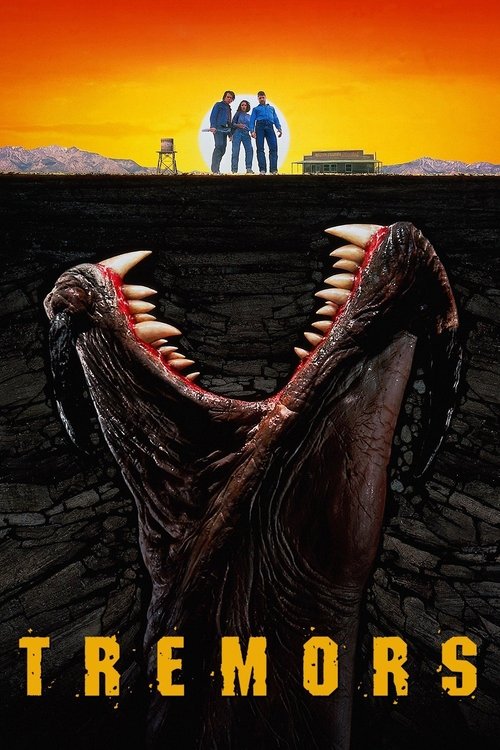
Tremors (1990)
Directed by Ron Underwood
No — Tremors is not woke, scoring 7 out of 100 on our wokeness meter.
Tremors arrives from 1990 with the tired courtesy of a movie that wants only to be a monster movie.
Consciousness Markers
The cast includes Victor Wong as store owner Walter Chang and Tony Genaro as Nestor, alongside a female lead, but these are natural small-town ensemble roles with no commentary on representation.
Rhonda LeBeck is a competent graduate-student seismologist and Heather Gummer a gun-toting survivalist, but the film treats them as genre characters rather than vehicles for a feminist message.
Minority characters exist naturally in the town without any racial commentary or consciousness; the Walter Chang role was simply shifted from Vietnamese to Chinese for casting.
No LGBTQ+ characters, themes, or subtext of any kind appear in the film.
No environmental or climate themes; the desert setting is purely a monster-movie backdrop.
No economic critique or anti-capitalist messaging; the handymen protagonists simply want to leave town.
No body-positivity themes or messaging present.
No neurodivergence themes or characters present.
No historical revisionism; the film is a contemporary creature feature with no historical subject matter.
The film is a lighthearted monster comedy with no preachy or didactic messaging; it deliberately avoids explaining its creatures' origins.
Why it received this score
Tremors arrives from 1990 with the tired courtesy of a movie that wants only to be a monster movie. Val McKee and Earl Bassett, two handymen in the fictional desert town of Perfection, Nevada, would like to leave. Something beneath the ground would prefer they did not. Ron Underwood's film was assembled as a contemporary variation on the 1950s creature feature, and it wears that inheritance without apology. Nothing in its construction suggests an interest in instructing anyone about anything.
The women fare better than the era required. Rhonda LeBeck is a graduate student in seismology who works out the creatures' hunting method, and Heather Gummer defends her basement armory with a rifle and admirable composure. Both are permitted competence. Neither serves as a thesis statement. Victor Wong's Walter Chang and Tony Genaro's Nestor populate the town without commentary, and the Walter Chang role was rewritten from Vietnamese to Chinese to accommodate Wong's casting, a production convenience carrying no thematic freight whatsoever. The film registers its own diversity the way it registers the weather: as a feature of the location.
The picture lacks a message, and it lacks that message proudly. The Graboids are never explained, because the writers found the usual science-fiction accounts too familiar and declined to bother. There is no moral at the close, no reckoning, no cause to which an audience might be recruited. Rhonda kisses Val at the end because preview audiences requested it, which remains the most ideological gesture in the entire production: a studio deferring to market research. The rest is rubble, pipe bombs, and canned pumpkin standing in for monster viscera. The film asks nothing of us except that we watch where we step, and that is a restful thing.
Analysis generated by our Consciousness Algorithm
Part of


Synopsis
Val McKee and Earl Bassett are in a fight for their lives when they discover that their desolate town has been infested with gigantic, man-eating creatures that live below the ground.
Questions about Tremors
Is Tremors woke?
No — Tremors is not woke, scoring 7 out of 100 on our wokeness meter. That earns it a verdict of Ultra Based.
Does Tremors have any woke elements?
Very few. None of the 10 markers reaches 30, the level where a marker counts as present; the highest is Representation Casting at 15.
How does Tremors compare to other 1990 movies?
It ranks #27 of the 68 films from 1990 we've scored; their average is 9. The wokest is Nightbreed (60).
Is Tremors the most woke Tremors movie?
Yes. It scores highest of the 4 Tremors films we've scored.