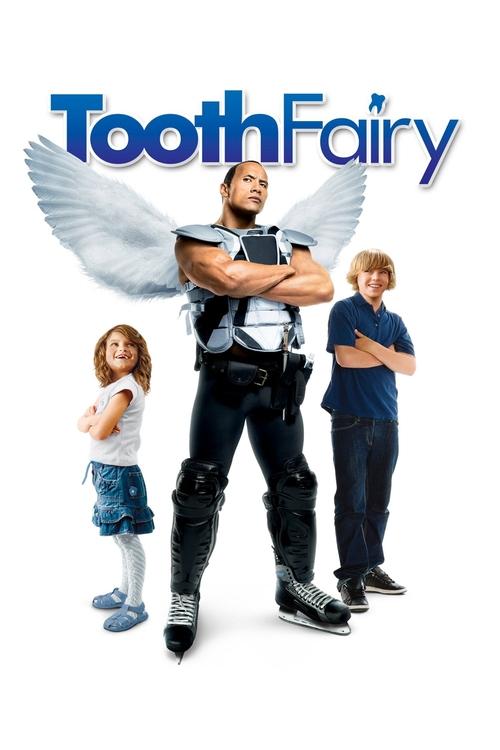
Tooth Fairy (2010)
Directed by Michael Lembeck
No — Tooth Fairy is not woke, scoring 8 out of 100 on our wokeness meter.
Dwayne Johnson plays Derek Thompson, a minor league hockey enforcer whose specialty is removing opponents' teeth, and who makes the tactical error of telling a six-year-old girl that the tooth fairy does not exist.
Consciousness Markers
Dwayne Johnson headlines as a Samoan/Black lead in a mainstream family comedy, but his casting is played entirely straight with no commentary on representation or identity.
The film delivers a mild, conventional 'believe in your dreams' moral, but it is gentle family-film sentiment rather than preachy social messaging.
No LGBTQ+ characters, themes, or subtext of any kind appear in the film.
Ashley Judd and Julie Andrews play women in authority, but the film advances no feminist thesis; the arc is Derek's redemption, not gender politics.
Race is never addressed, examined, or thematized; the story is a colorblind family fantasy.
No environmental or climate themes whatsoever.
No critique of wealth, capitalism, or class; the film is a mainstream studio family comedy.
No body-positivity messaging; the hockey premise revolves around knocking teeth out for laughs.
No neurodivergent characters or themes are present.
The film is a contemporary fantasy with no historical subject matter to revise.
Why it received this score
Dwayne Johnson plays Derek Thompson, a minor league hockey enforcer whose specialty is removing opponents' teeth, and who makes the tactical error of telling a six-year-old girl that the tooth fairy does not exist. For this he is conscripted into the fairy realm, issued wings and a tutu, and sentenced to two weeks of nocturnal collection duty under the supervision of Julie Andrews. The architecture is familiar to the point of comfort: a selfish man humbled by magic, a girlfriend with children to win over, a redemption arc with a proposal at the end. We have attended this film many times before, and this iteration does not improve on the recipe.
On the question of social consciousness, the ledger is thin. Johnson's presence as a Samoan and Black leading man in a mainstream family comedy of 2010 merits a modest notation, though the film never glances at the fact. His identity sits outside the text entirely. Race is not examined, queerness does not appear in any register, and gender politics, climate, class, body image and neurodivergence are all absent. The hockey sequences are built on the violent extraction of teeth, which is not a body-positive thesis so much as an occupational dental hazard played for slapstick. The fairy bureaucracy functions as a workplace comedy with wings, and it takes no interest in the labor conditions of its employees.
What remains is sentiment. The film's moral, that dreams deserve belief and children deserve indulgence, arrives with the soft pressure of a bedtime story. It lectures, but gently, and about nothing more divisive than the value of optimism. A picture can be amiable and empty at once, and this one manages the trick without apparent effort. The tooth is collected, the amnesia dust is spread, the audience is politely dismissed, and we are left with the curious sensation of having watched one hundred and one minutes of professional competence arranged carefully around a void.
Analysis generated by our Consciousness Algorithm
Part of


Synopsis
When minor-league hockey player Derek Thompson -- who has a penchant for knocking out his opponents' teeth every time he plays -- disillusions a fan, he is sentenced to a stint for one week as a bona fide, tutu-clad, real-life tooth fairy. Soon, Derek is inspired to rekindle his youthful dreams.
Questions about Tooth Fairy
Is Tooth Fairy woke?
No — Tooth Fairy is not woke, scoring 8 out of 100 on our wokeness meter. That earns it a verdict of Ultra Based.
Does Tooth Fairy have any woke elements?
Very few. None of the 10 markers reaches 30, the level where a marker counts as present; the highest is Representation Casting at 15.
How does Tooth Fairy compare to other 2010 movies?
It ranks #100 of the 238 films from 2010 we've scored; their average is 11. The wokest is My Name Is Khan (84).
How is the Woke Score calculated?
An AI-assisted process researches the film and its reception, scores it 0–100 on ten markers, then combines those into one 0–100 Woke Score. It measures a specific set of 2020s cultural themes, not film quality.