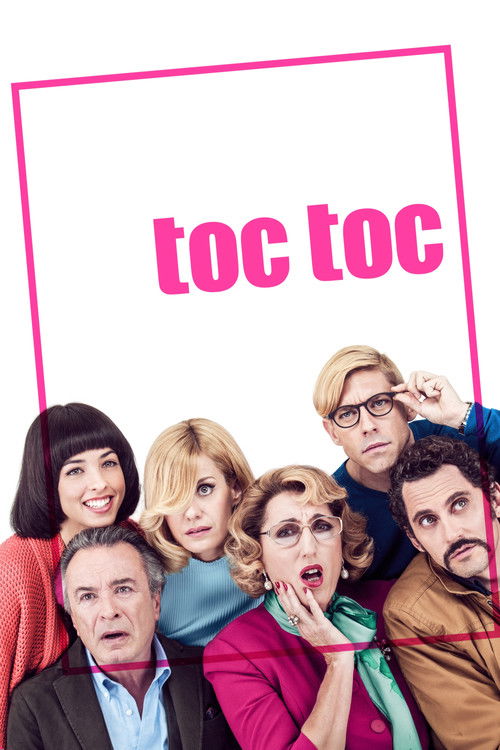
Toc Toc (2017)
Directed by Vicente Villanueva
Yes — Toc Toc is woke, scoring 61 out of 100 on our wokeness meter.
Toc Toc arrives from Spain in 2017, adapted from a French stage comedy by Laurent Baffie, and it wastes no time announcing its subject.
Consciousness Markers
The entire premise centers on characters with OCD and Tourette syndrome, depicting their compulsions and tics with empathy and showing them forming a peer support group.
The film carries a gentle therapeutic message about tolerance and mutual support, but it is delivered through comedy rather than preachy social-justice lecturing.
The cast is entirely Spanish with no evident racial or ethnic diversity casting, and no gender-swapped or inclusive casting choices are foregrounded.
No LGBTQ+ characters, relationships, or themes appear in the film.
Female characters exist but the film does not advance a feminist agenda or critique patriarchal structures.
Race and racial identity are not addressed or made thematically relevant.
No environmental or climate-change themes are present.
The film does not critique capitalism, wealth inequality, or class structures.
Body image, size acceptance, or related themes are absent.
The film is a contemporary fictional comedy and does not revise or reinterpret historical events.
Why it received this score
Toc Toc arrives from Spain in 2017, adapted from a French stage comedy by Laurent Baffie, and it wastes no time announcing its subject. Six strangers share an appointment time with a celebrated psychologist who never appears. Each carries a diagnosis: germ phobia, scrupulosity, arithmomania, symmetry obsession, echolalia, and one case of Tourette syndrome complete with coprolalia. The waiting room becomes the entire world of the picture. Doors open, nobody enters, and the clock advances with the patience of a Spanish summer.
This is, by any measure, a film built on neurodivergence. The compulsions are staged for laughs, but the laughter is affectionate and the diagnoses are specific. Blanca cannot touch a surface without reaching for a wipe. Otto will not step on a striped carpet. Federico shouts obscenities he cannot suppress. Over the running time the group stops merely enduring each other and starts offering small, practical kindnesses. A hand touches a shoulder and is not immediately washed. The film argues, quietly, that people living with these conditions understand each other better than any professional might. The closing twist, in which the loudest patient turns out to be the doctor running a covert support group, is a generous joke instead of a cruel one.
Elsewhere the ledger is bare. The cast is uniformly Spanish, the gender politics are those of a pleasant sitcom, and nobody mentions race, money, climate, or the body. The message of tolerance is genuine, but it arrives through farce rather than through sermonizing. A therapeutic comedy of manners, then, and a decent one, filed under a single heading and left there.
Analysis generated by our Consciousness Algorithm
Synopsis
A group of patients meet at a prestigious psychologist's office. Apart from the day and time of the appointment, something else unites them all: all six suffer from OCD. But the plane bringing the doctor is unexpectedly delayed, which forces them to spend an endless wait until the doctor shows up. Will they be able to keep their manias, impulses, convulsions, obsessions and rituals at bay during the wait?
Questions about Toc Toc
Is Toc Toc woke?
Yes — Toc Toc is woke, scoring 61 out of 100 on our wokeness meter. That earns it a verdict of Woke.
What makes Toc Toc woke?
1 of the 10 markers register at 30 or above, led by Neurodivergence (85). On Neurodivergence: The entire premise centers on characters with OCD and Tourette syndrome, depicting their compulsions and tics with empathy and showing them forming a peer support group.
How does Toc Toc compare to other 2017 movies?
It ranks #17 of the 309 films from 2017 we've scored; their average is 19. The wokest is I Am Not Your Negro (92).
How is the Woke Score calculated?
An AI-assisted process researches the film and its reception, scores it 0–100 on ten markers, then combines those into one 0–100 Woke Score. It measures a specific set of 2020s cultural themes, not film quality.