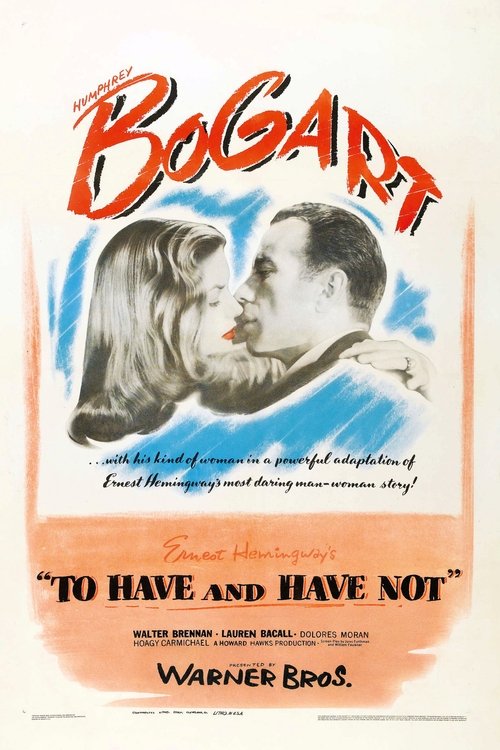
To Have and Have Not (1945)
Directed by Howard Hawks
No — To Have and Have Not is not woke, scoring 11 out of 100 on our wokeness meter.
Howard Hawks wagered that he could make a great film from Ernest Hemingway's worst book, and the resulting picture, assembled with uncredited toil from William Faulkner, stands as a monument to contractual obligation and fishing-trip bravado.
Consciousness Markers
Bacall's 'Slim' is notably self-possessed for 1944—she picks pockets, sings uninvited, and chooses to stay on her own terms—but this is star-vehicle charisma and Hawks's wife-inspired persona, not a feminist agenda.
The film gestures at the Free France/Vichy conflict but treats it as atmosphere and plot machinery rather than moral instruction; almost no didacticism.
The cast is uniformly white, drawn from Warner Bros. contract players of the era; the Martinique setting yields no non-white principal characters or casting commentary.
No LGBTQ+ characters, themes, or subtext are present; the central romance is a heterosexual Bogart-Bacall pairing.
Despite a Caribbean colonial setting under Vichy rule, the film engages no racial themes or commentary whatsoever.
No environmental or climate content of any kind.
Harry Morgan is a freelancing skipper motivated by getting paid; the film treats his mercenary pragmatism as hardboiled character, not a critique of capital.
The casting of Dolores Moran as a 'more voluptuous contrast' to the slender Bacall is pure 1940s Hollywood optics; no body-positive messaging.
Eddie's condition is depicted as alcoholism and comic rummy befuddlement, not neurodivergence, and is played for pathos and laughs rather than understanding.
The WWII-era Vichy Martinique setting and French Resistance backdrop are period-appropriate narrative scaffolding, not a revisionist re-reading of history.
Why it received this score
Howard Hawks wagered that he could make a great film from Ernest Hemingway's worst book, and the resulting picture, assembled with uncredited toil from William Faulkner, stands as a monument to contractual obligation and fishing-trip bravado. The setting is Vichy Martinique, a tinderbox of Free French sympathy, and the screenplay treats that political furnace the way a hotel treats a lobby: as a place characters pass through on the way to somewhere more interesting. The Resistance is plot machinery. The moral instruction is negligible. A viewer hoping for a sermon on collaboration or empire will leave hungry.
Humphrey Bogart's Harry Morgan charters his boat and wants only to be paid, which the film presents as hardboiled virtue, not an indictment of commerce. Lauren Bacall, in her first appearance, picks a pocket, sings without invitation, and decides on her own terms to remain. It is a magnetic performance and a star-making one, though its self-possession belongs to the persona Hawks borrowed from his wife and to the era's appetite for a certain kind of screen presence. Walter Brennan's Eddie drinks himself into comic befuddlement, and the film regards his ruin with a shrug and a chuckle.
The cast is uniformly white, the romance is heterosexual, and the Caribbean colony produces no racial thought whatsoever. Dolores Moran exists as a more voluptuous contrast to Bacall's slenderness, which is optics, not philosophy. The picture is a Casablanca rerun with better banter and less conscience, a wartime entertainment that asks nothing of its audience beyond a willingness to watch two beautiful people circle each other. It is agreeable. It is also, by the standards of our current cultural accounting, nearly inert.
Analysis generated by our Consciousness Algorithm
Part of


Synopsis
A Martinique charter boat skipper gets mixed up with the underground French resistance operatives during WWII.
Questions about To Have and Have Not
Is To Have and Have Not woke?
No — To Have and Have Not is not woke, scoring 11 out of 100 on our wokeness meter. That earns it a verdict of Ultra Based.
Does To Have and Have Not have any woke elements?
Very few. None of the 10 markers reaches 30, the level where a marker counts as present; the highest is Feminist Agenda at 18.
How does To Have and Have Not compare to other 1945 movies?
It is the wokest of the 7 films from 1945 we've scored; their average is 4.
How is the Woke Score calculated?
An AI-assisted process researches the film and its reception, scores it 0–100 on ten markers, then combines those into one 0–100 Woke Score. It measures a specific set of 2020s cultural themes, not film quality.