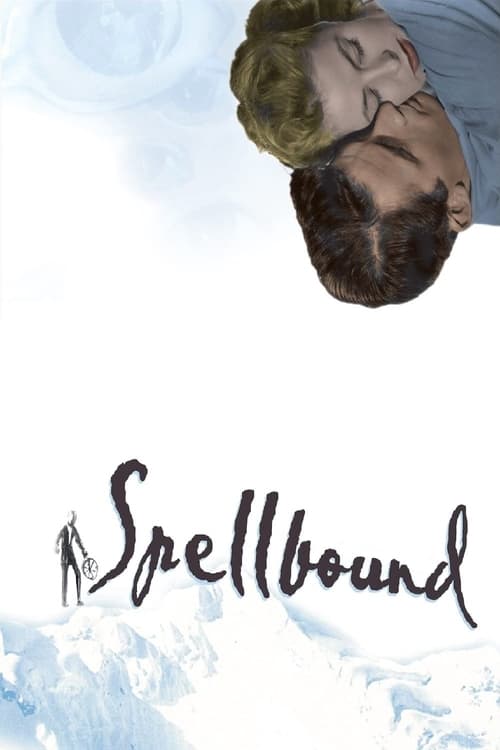
Spellbound (1945)
Directed by Alfred Hitchcock
No — Spellbound is not woke, scoring 0 out of 100 on our wokeness meter.
Alfred Hitchcock's Spellbound arrives from 1945 with a female protagonist who holds a medical degree, diagnoses her colleagues' neuroses, and solves a murder by reading a dream.
Consciousness Markers
The cast is entirely white, with no meaningful racial or ethnic diversity, and the film makes no attempt at inclusive representation casting.
There are no LGBTQ+ characters, themes, or subtext in the film.
Although the protagonist is a female psychoanalyst, the film does not advance a modern feminist agenda or critique patriarchal structures.
The film does not engage with racial consciousness, systemic racism, or racial identity as themes.
There is no environmental or climate-related messaging in the film.
The film contains no critique of capitalism, wealth inequality, or economic exploitation.
There is no body positivity theme or challenge to conventional beauty standards.
The film depicts psychoanalysis, amnesia, and guilt complexes, but not in the modern neurodivergence-affirming sense.
The film is not a historical revision or counter-narrative; it is a fictional psychological thriller.
The film explains psychoanalytic concepts as plot mechanics rather than delivering modern social or political lectures.
Why it received this score
Alfred Hitchcock's Spellbound arrives from 1945 with a female protagonist who holds a medical degree, diagnoses her colleagues' neuroses, and solves a murder by reading a dream. The film presents this without ceremony. Dr. Constance Petersen is permitted competence, and the screenplay never stops to applaud her for it. In the current taxonomy, this is a curiosity: a woman in authority whose authority is simply the premise. The cast surrounding Ingrid Bergman is uniformly white and uniformly Anglo-Saxon, a condition the film does not notice and therefore does not address. Gregory Peck spends much of the running time looking stricken in a manner that is meant to be psychological, and is.
The dream sequence, designed by Salvador Dali and then mostly cut by David O. Selznick, survives as two minutes of sloping roofs, masked card players, and a wheel that turns out to be a revolver. The film treats the unconscious as a mechanism, a lock to be picked, not as a territory of identity to be affirmed. Amnesia here is a plot device. Guilt is a symptom with a childhood cause. Nobody lectures. The nearest thing to an economic observation is that the murderer is a hospital administrator, and the film seems to regard this as a staffing matter, not a structural one.
Miklos Rozsa's score, with its theremin, won an Academy Award and has outlived most of the film's talking points. There are no talking points. The residue is craftsmanship, a phobia about parallel lines, and a gun fired into the camera in two frames of red. The picture asks for attention and offers suspense in return. By the standards of its own era it is a superior melodrama. By the standards of ours it registers almost nothing on the cultural instruments, and seems untroubled by the silence.
Analysis generated by our Consciousness Algorithm
Synopsis
When Dr. Anthony Edwardes arrives at a Vermont mental hospital to replace the outgoing hospital director, Dr. Constance Peterson, a psychoanalyst, discovers Edwardes is actually an impostor. The man confesses that the real Dr. Edwardes is dead and fears he may have killed him, but cannot recall anything. Dr. Peterson, however is convinced his impostor is innocent of the man's murder, and joins him on a quest to unravel his amnesia through psychoanalysis.
Questions about Spellbound
Is Spellbound woke?
No — Spellbound is not woke, scoring 0 out of 100 on our wokeness meter. That earns it a verdict of Ultra Based.
Does Spellbound have any woke elements?
No. All 10 markers score zero.
How does Spellbound compare to other 1945 movies?
It ranks #6 of the 7 films from 1945 we've scored; their average is 4. The wokest is To Have and Have Not (11).
How is the Woke Score calculated?
An AI-assisted process researches the film and its reception, scores it 0–100 on ten markers, then combines those into one 0–100 Woke Score. It measures a specific set of 2020s cultural themes, not film quality.