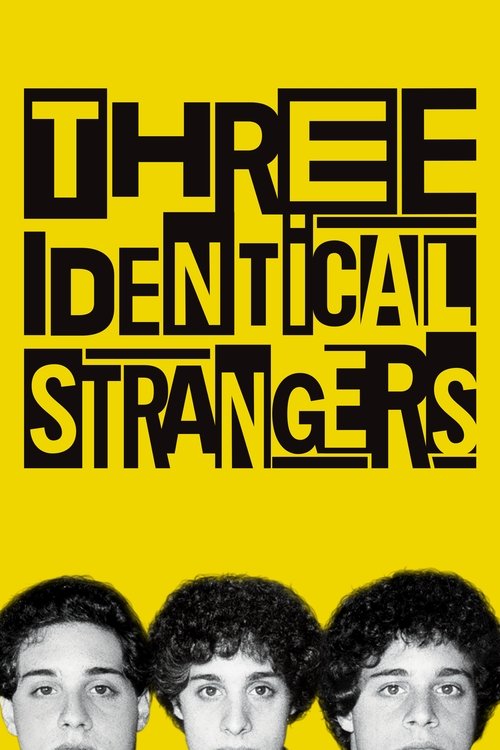
Three Identical Strangers (2018)
Directed by Tim Wardle
No — Three Identical Strangers is not woke, scoring 9 out of 100 on our wokeness meter.
Three Identical Strangers arrives with the polished sheen of a festival documentary and the moral weight of a suppressed file cabinet.
Consciousness Markers
The film carries a clear moral about scientific ethics and the harm of secrecy, delivered through its closing revelations, though it remains restrained and journalistic rather than preachy.
The film uncovers a suppressed historical episode — a secret twin study with sealed records — functioning as investigative revelation rather than a progressive reinterpretation of history.
Mental illness (manic depression, suicide) is depicted as a tragic consequence of the experiment, but it is not framed through a neurodivergence-affirming or advocacy lens.
The cast is overwhelmingly white, consisting of the three triplet subjects and mostly white researchers and journalists; no meaningful effort at diverse representation is present.
The film's content does not advance a feminist agenda; the only tangential note is a production-side anecdote about a female director being replaced, which is external to the film itself.
The experiment's variable was socioeconomic class, not race, and the film does not engage with racial consciousness as a theme.
The film critiques the ethics of a psychiatric study and an adoption agency, but frames this as institutional malpractice rather than a systemic anti-capitalist indictment.
The film contains no LGBTQ+ characters, themes, or subtext whatsoever.
There is no environmental or climate-related content in the film.
No body positivity themes or messaging appear in the film.
Why it received this score
Three Identical Strangers arrives with the polished sheen of a festival documentary and the moral weight of a suppressed file cabinet. Tim Wardle assembles archival footage, re-enactments, and interviews to recount how three young men discovered in 1980 that they were triplets, separated at birth by an adoption agency that had quietly enrolled them in a nature-versus-nurture study. The reunion is jubilant, the fallout is not. One brother is dead by his own hand. The records stay sealed until 2066. This is investigative journalism performed with a straight face and a mounting sense of dread, and it works.
The film's cultural consciousness is modest and mostly incidental. Its subjects are white, its researchers are white, and its adoptive families occupy three tiers of the American class ladder, which is the actual variable under examination. Race never enters the frame as a subject. Neither does climate, nor body image, nor any LGBTQ thread. Mental illness appears as tragedy and consequence, never as identity or advocacy. The institutional villain here is a psychiatric establishment and an adoption agency, indicted for malpractice and secrecy, not for the profit motive. A viewer hunting for contemporary sermonizing will find only the older, quieter sermon about scientific ethics. There is a moral, and the film delivers it, but it does so with a journalist's restraint and a closing title card.
There is one production-side footnote, in which the original director, a young woman, describes being replaced, and it lingers outside the film proper like a coat left in another room. What remains on screen is a story about brothers, grief, and the arrogance of researchers who never published their findings. It is gripping, humane, and entirely uninterested in the cultural battles of its own release year. We classify it accordingly.
Analysis generated by our Consciousness Algorithm


Synopsis
New York, 1980. Three complete strangers accidentally discover that they're identical triplets, separated at birth. The 19-year-olds' joyous reunion catapults them to international fame, but also unlocks an extraordinary and disturbing secret that goes beyond their own lives – and could transform our understanding of human nature forever.
Questions about Three Identical Strangers
Is Three Identical Strangers woke?
No — Three Identical Strangers is not woke, scoring 9 out of 100 on our wokeness meter. That earns it a verdict of Ultra Based.
Does Three Identical Strangers have any woke elements?
Very few. None of the 10 markers reaches 30, the level where a marker counts as present; the highest is Lecture Energy at 22.
How does Three Identical Strangers compare to other 2018 movies?
It ranks #203 of the 325 films from 2018 we've scored; their average is 20. The wokest is Return (92).
How is the Woke Score calculated?
An AI-assisted process researches the film and its reception, scores it 0–100 on ten markers, then combines those into one 0–100 Woke Score. It measures a specific set of 2020s cultural themes, not film quality.