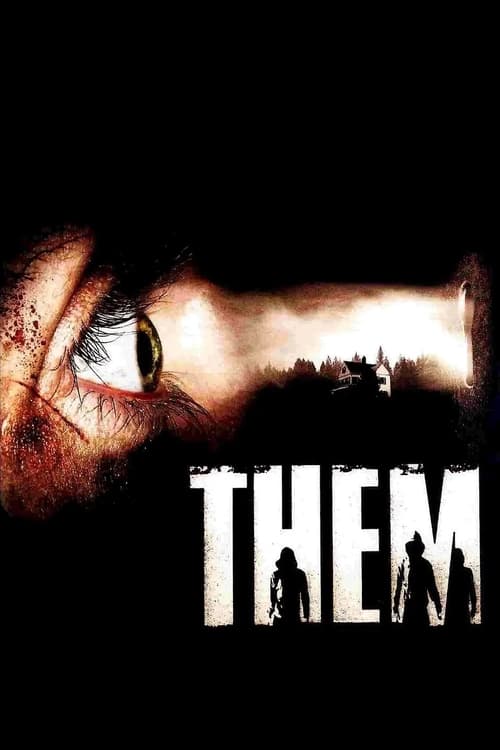
Them (2006)
Directed by Xavier Palud
No — Them is not woke, scoring 5 out of 100 on our wokeness meter.
Them, released in 2006 and known in its native France as Ils, opens with a title card promising that the following events actually happened.
Consciousness Markers
Clémentine is a capable female protagonist who fights back against her attackers, but this is standard survival-horror mechanics rather than any articulated feminist thesis.
The cast is entirely white French and Romanian actors playing characters with no stated ethnic identity; there is no deliberate diverse or inclusive casting agenda at work.
No LGBTQ+ characters, relationships, or themes appear anywhere in the film.
The film engages no racial themes whatsoever; the killers are anonymous hooded children with no racial framing.
No environmental or climate content of any kind.
The villains are children, not corporations or economic systems; there is no class or anti-capitalist commentary.
No body-image or body-positivity themes are present.
No neurodivergent characters or themes are depicted.
The film's 'based on real events' title card is a marketing embellishment with no verifiable basis, but it makes no attempt to revise or reinterpret history for ideological purposes.
The film is a lean, dialogue-sparse home-invasion thriller that never pauses to deliver a message or moral to the audience.
Why it received this score
Them, released in 2006 and known in its native France as Ils, opens with a title card promising that the following events actually happened. The claim is, by most accounts, decorative. A pair of French expatriates, Clémentine and Lucas, occupy a remote house near Bucharest, and across a single night a group of hooded figures terrorizes them through the attic, the woods, and finally the sewers. It runs eighty minutes. It wastes very few of them.
For those of us who catalog the cultural weather of a picture, this one is a clean read. The cast is white, French and Romanian, and nobody pauses to discuss it. No character announces an identity, corrects a prejudice, or explains an oppressive system to a captive audience. The killers are children, which rules out the usual corporate villainy, and the forest is not a metaphor for anything except forest. Clémentine fights back with a poker and a shard of glass, which is standard survival arithmetic and not a thesis. She endures on instinct, not on principle. There is no lesson in the ending, only a bus full of hooded boys and one girl, and a line of dialogue that explains nothing on purpose.
There is a temptation, when a film is this efficient, to credit it with hidden intelligence. Resist. Them is a machine for tightening the chest, and it does that job with a craftsman's indifference to meaning. It has no message to impart, no sermon to deliver, and no interest in being anything except frightening. In an era when even the slasher film stops to explain itself, that restraint reads almost as a period piece. We score it accordingly, file it under lean and unpersuaded, and move on to the next.
Analysis generated by our Consciousness Algorithm


Synopsis
Lucas and Clementine live peacefully in their isolated country house, but one night they wake up to strange noise. They're not alone... and a group of hooded assailants begin to terrorize them throughout the night.
Questions about Them
Is Them woke?
No — Them is not woke, scoring 5 out of 100 on our wokeness meter. That earns it a verdict of Ultra Based.
Does Them have any woke elements?
Very few. None of the 10 markers reaches 30, the level where a marker counts as present; the highest is Feminist Agenda at 8.
How does Them compare to other 2006 movies?
It ranks #132 of the 211 films from 2006 we've scored; their average is 11. The wokest is An Inconvenient Truth (92).
How is the Woke Score calculated?
An AI-assisted process researches the film and its reception, scores it 0–100 on ten markers, then combines those into one 0–100 Woke Score. It measures a specific set of 2020s cultural themes, not film quality.