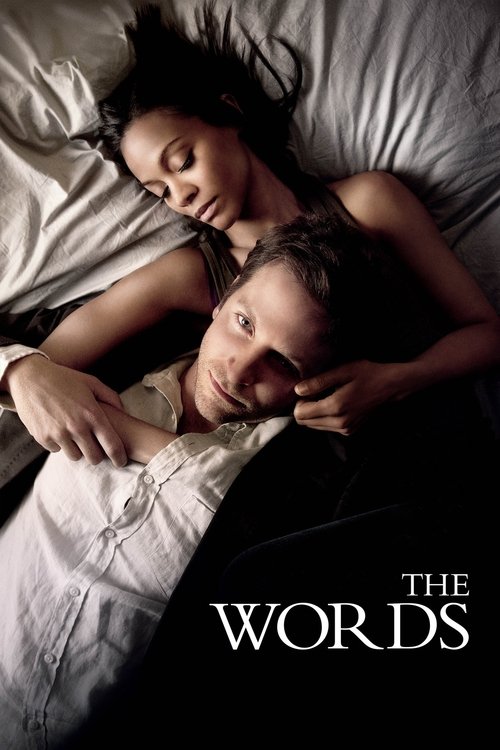
The Words (2012)
Directed by Lee Sternthal
No — The Words is not woke, scoring 6 out of 100 on our wokeness meter.
The Words is a 2012 literary mystery in which a young writer named Rory Jansen publishes a lost manuscript as his own.
Consciousness Markers
Zoe Saldaña headlines as the wife and the supporting cast includes J.K. Simmons and Željko Ivanek, but these are natural, unremarked-upon castings with no diversity-forward framing.
The film gestures toward a moral about the price of stolen success and the line between life and fiction, but delivers it as muted literary drama rather than explicit sermonizing.
Dora exists largely as the supportive wife who pushes Rory toward success; there is no feminist critique or agency-driven arc.
There is a faint critique of literary fame and the publishing industry's appetite for profit over truth, but it is a moral fable about plagiarism, not an eat-the-rich polemic.
No LGBTQ+ characters, relationships, or themes appear anywhere in the narrative.
The film engages no racial themes, commentary, or consciousness whatsoever.
No environmental or climate content of any kind.
No body-positivity themes or messaging present.
No neurodivergent characters or themes are depicted.
The WWII-era Paris flashbacks are period setting, not historical revisionism.
Why it received this score
The Words is a 2012 literary mystery in which a young writer named Rory Jansen publishes a lost manuscript as his own. The film is competently assembled and well acted. Bradley Cooper broods with appropriate handsomeness. Jeremy Irons supplies weathered gravitas. Zoe Saldana plays the supportive wife with professional warmth. The cast is varied in a way that feels incidental. A modern production can assemble such a group without making a statement, and this production does exactly that. No character pauses to explain the significance of anyone's background. The film has no interest in such matters.
The moral concerns plagiarism and the price of stolen success. There is a faint jab at the publishing industry's appetite for profit over truth. It is a fable about personal guilt, not a systemic critique. The Paris flashbacks are period setting, not historical revision. Dora exists to encourage Rory and then to forgive him. Her arc is domestic and reactive. The film does not examine gender. It does not examine race. It does not examine sexuality, climate, body image, or neurodivergence. It gestures toward a lesson about life and fiction, but the lesson arrives as muted literary drama. The sermon is barely audible.
This is a film that wants to be profound about authorship and identity. It is not. The ending is ambiguous in a way that feels less like mystery and more like indecision. The film is inoffensive, forgettable, and culturally quiet. It belongs to a vanished middle ground of star-driven dramas that premiere at Sundance and then evaporate. We have seen this before. We will see it again. The classification is straightforward: a mild artifact with almost no social consciousness to speak of.
Analysis generated by our Consciousness Algorithm


Synopsis
The Words follows young writer Rory Jansen who finally achieves long sought after literary success after publishing the next great American novel. There's only one catch - he didn't write it. As the past comes back to haunt him and his literary star continues to rise, Jansen is forced to confront the steep price that must be paid for stealing another man's work, and for placing ambition and success above life's most fundamental three words.
Questions about The Words
Is The Words woke?
No — The Words is not woke, scoring 6 out of 100 on our wokeness meter. That earns it a verdict of Ultra Based.
Does The Words have any woke elements?
Very few. None of the 10 markers reaches 30, the level where a marker counts as present; the highest is Representation Casting at 22.
How does The Words compare to other 2012 movies?
It ranks #128 of the 230 films from 2012 we've scored; their average is 12. The wokest is Killing Them Softly (92).
How is the Woke Score calculated?
An AI-assisted process researches the film and its reception, scores it 0–100 on ten markers, then combines those into one 0–100 Woke Score. It measures a specific set of 2020s cultural themes, not film quality.