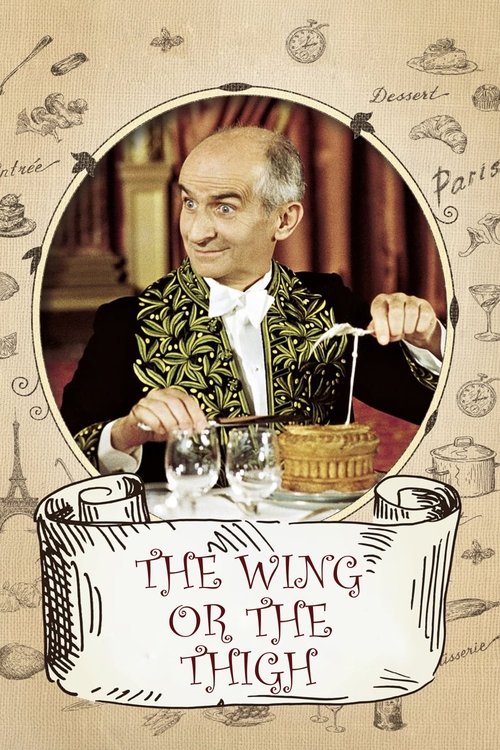
The Wing or the Thigh? (1976)
Directed by Claude Zidi
No — The Wing or the Thigh? is not woke, scoring 18 out of 100 on our wokeness meter.
Charles Duchemin, publisher of a restaurant guide of some repute, spends his days in false moustaches and prosthetics, slipping into dining rooms to judge them before the owners can identify him.
Consciousness Markers
The film pits traditional French cuisine against the industrial food magnate Tricatel, a critique of mass-production capitalism, though framed as culinary preservation rather than modern 'eat the rich' politics.
The talk-show confrontation and the factory exposé deliver a message about the dangers of industrial food, but it is played for comedy rather than preached.
The cast is entirely white French performers with no deliberate diversity casting; characters exist as written with no representational commentary.
No LGBTQ+ characters, themes, or subtext appear anywhere in the film.
The female lead Marguerite functions as a secretary and romantic interest; there is no feminist agenda or gender-power critique.
Race is entirely absent as a subject; the conflict is culinary and class-inflected, not racial.
No environmental or climate themes; the villain's sin is bad food, not ecological harm.
No body-positivity themes; the film's concerns are taste and gastronomy, not body image.
No neurodivergence is depicted or discussed; Gérard's clowning is a passion, not a condition.
The story is fictional and makes no attempt to revise or reinterpret historical events.
Why it received this score
Charles Duchemin, publisher of a restaurant guide of some repute, spends his days in false moustaches and prosthetics, slipping into dining rooms to judge them before the owners can identify him. It is 1976, and the film has no interest in who he is, only in what he eats. His son Gérard would rather be a clown. That is the entire crisis, and it is handled with a straight face by everyone involved, including the circus.
The antagonist, Tricatel, mass-produces food from petroleum and rubber and buys up starred restaurants to launder his reputation. A critique of industrial capitalism is present, though it arrives dressed as a defense of gastronomy and national pride. When the factory is exposed on live television, the audience boos. The film sides with the artisanal and the small, a position available to anyone with a palate and no political program attached. The sermonizing stays mild, mostly because the confrontation is staged as farce, with a blind tasting and a lost wristwatch as punchlines.
What the film does not have is a single moment of identity politics, gender critique, or environmental concern. Marguerite is a secretary and a love interest, and the film never suggests she should be otherwise. The cast is uniformly white and race never arises as a subject. Gérard's clowning is treated as a vocation, not a diagnosis. The villain's crime is bad food, not carbon emissions. This is a comedy about taste in both senses, made by people who assumed the audience shared their assumptions. It has aged into a period piece without ever having been asked to justify itself, which is its own quiet achievement.
Analysis generated by our Consciousness Algorithm

Synopsis
Charles Duchemin, a well-known gourmet and publisher of a famous restaurant guide, is waging a war against fast food entrepreneur Tri- catel to save the French art of cooking. After having agreed to appear on a talk show to show his skills in naming food and wine by taste, he is confronted with two disasters: his son wants to become a clown rather than a restaurant tester and he, the famous Charles Duchemin, has lost his taste!
Questions about The Wing or the Thigh?
Is The Wing or the Thigh? woke?
No — The Wing or the Thigh? is not woke, scoring 18 out of 100 on our wokeness meter. That earns it a verdict of Ultra Based.
Does The Wing or the Thigh? have any woke elements?
Very few. None of the 10 markers reaches 30, the level where a marker counts as present; the highest is Eat the Rich at 25.
How does The Wing or the Thigh? compare to other 1976 movies?
It ranks #6 of the 30 films from 1976 we've scored; their average is 13. The wokest is 1900 (77).
How is the Woke Score calculated?
An AI-assisted process researches the film and its reception, scores it 0–100 on ten markers, then combines those into one 0–100 Woke Score. It measures a specific set of 2020s cultural themes, not film quality.