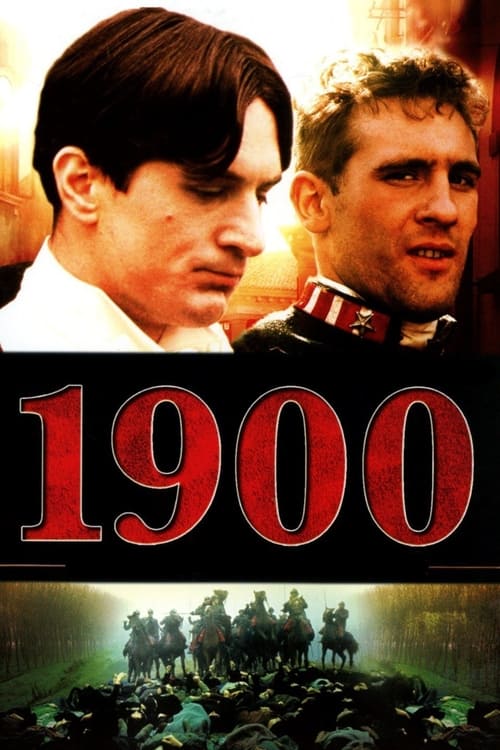
1900 (1976)
Directed by Bernardo Bertolucci
Yes — 1900 is woke, scoring 77 out of 100 on our wokeness meter.
Bernardo Bertolucci's 1900 runs five hours and seventeen minutes in its original form, a duration that functions as a kind of statement in itself.
Consciousness Markers
The film is an explicit Marxist epic of class struggle, depicting peasants rising against landowners and fascist enforcers, with communism as a central liberatory force.
The film is politically didactic about class struggle, but its epic narrative form and historical sweep keep it from feeling like a modern preachy lecture.
The cast is entirely white European, with no deliberate racial or ethnic diversity casting.
No LGBTQ+ characters, themes, or subtext are present.
Women appear as wives, peasants, and participants in revolt, but the film advances no feminist agenda or gender-conscious critique.
The film's central conflict is class-based, not racial; no racial consciousness or anti-racist themes are explored.
There is no environmental or climate-related content.
No body-positivity themes or body-diverse representation are present.
No neurodivergent characters or themes are depicted.
The film is a fictional historical drama set against real events, but it does not revise history in the modern ideological sense.
Why it received this score
Bernardo Bertolucci's 1900 runs five hours and seventeen minutes in its original form, a duration that functions as a kind of statement in itself. The film follows two men born on the same estate in 1901, the landowner's son Alfredo and the peasant's bastard Olmo, tracking them through two world wars, the rise of fascism, and the reckoning of 1945. It is an opera without the singing, scored by Ennio Morricone with generous borrowings from Verdi, and it moves at the pace of a glacier that has read Marx.
The film's commitments are unambiguous and entirely economic. Peasants strike, organizers agitate, and the padrone class is presented as a parasitic inheritance passed from father to weak-willed son. Donald Sutherland's Attila, a fascist foreman with a taste for cruelty, serves as the monstrous enforcer of capital, and his execution in a pigsty arrives as the narrative's genuine catharsis. Communism here is not a debate topic. It is the tide that eventually rises, and the film's sympathies never wander from the laborers who push it forward.
Contemporary cultural advocacy is entirely absent, and the film seems untroubled by the omission. The cast is uniformly white and European. Women appear as wives, mothers, and pitchfork-wielding participants in the revolt, but the film has no interest in gender as a category of analysis. There is no LGBTQ content, no environmental concern, no body-diverse casting, no neurodivergent characterization, and no effort to bend the historical record toward modern ideological ends. The politics are old, orthodox, and class-first. When the film lectures, it does so with a sweeping canvas and a Morricone score, which softens the sermon. Five hours of agrarian uprising is a long time. It is never a boring one.
Analysis generated by our Consciousness Algorithm


Synopsis
The epic tale of a class struggle in twentieth century Italy, as seen through the eyes of two childhood friends on opposing sides.
Questions about 1900
Is 1900 woke?
Yes — 1900 is woke, scoring 77 out of 100 on our wokeness meter. That earns it a verdict of Woke.
What makes 1900 woke?
1 of the 10 markers register at 30 or above, led by Eat the Rich (90). On Eat the Rich: The film is an explicit Marxist epic of class struggle, depicting peasants rising against landowners and fascist enforcers, with communism as a central liberatory force.
How does 1900 compare to other 1976 movies?
It is the wokest of the 30 films from 1976 we've scored; their average is 13.
How is the Woke Score calculated?
An AI-assisted process researches the film and its reception, scores it 0–100 on ten markers, then combines those into one 0–100 Woke Score. It measures a specific set of 2020s cultural themes, not film quality.