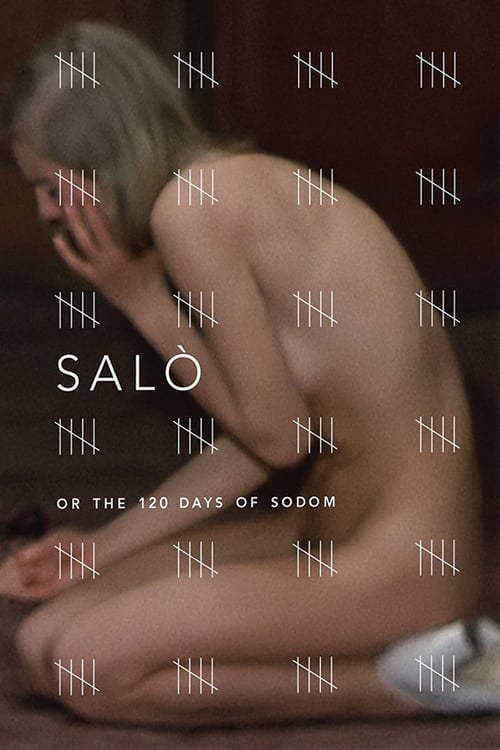
Salò, or the 120 Days of Sodom (1976)
Directed by Pier Paolo Pasolini
No — Salò, or the 120 Days of Sodom is not woke, scoring 18 out of 100 on our wokeness meter.
Salò, or the 120 Days of Sodom is Pasolini's final testament, a transposition of the Marquis de Sade's novel onto the fascist Republic of Salò in 1944.
Consciousness Markers
Pasolini's Marxist allegory frames the wealthy fascist libertines as ruling-class predators who reduce their victims' bodies to commodities, a genuine but oblique critique of power, consumerism, and class.
Same-sex acts, a drag Black Mass wedding, and a secret lesbian affair between two victims appear, but they are staged as instruments of sadistic fascist depravity rather than as affirming queer identity, so the marker registers only faintly.
Salò is a thesis-driven political art film with explicit philosophical scaffolding (Nietzsche, de Sade, Dante), but its nihilistic, transgressive posture is a provocation rather than the modern moralizing lecture the marker describes.
The film transposes de Sade's 18th-century text onto the fascist Republic of Salò as an allegorical reading of WWII-era Italy, though it is a literary adaptation rather than a revisionist reading of history.
The cast is entirely white European, drawn largely from non-professional Italian actors chosen for physical appearance; there is no deliberate representation casting of marginalized groups.
The film is a misanthropic allegory of power that brutalizes women and men alike with no feminist framework or critique of patriarchy; women are victims or collaborators, never agents.
A black maid is mentioned in passing as an object of a character's transgression, but the film has no racial consciousness or engagement with racial justice whatsoever.
There is no environmental or climate dimension to the film's concerns.
Bodies are tortured, commodified, and degraded; the film offers no body-positive or self-acceptance messaging.
No autistic, neurodivergent, or mental-health-identity themes are present.
Why it received this score
Salò, or the 120 Days of Sodom is Pasolini's final testament, a transposition of the Marquis de Sade's novel onto the fascist Republic of Salò in 1944. It concerns power, and what power does to the bodies it owns. Four libertines round up teenagers and spend four months reducing them to meat. The camera does not flinch. Neither has the film's reputation, which has only hardened in the half century since Pasolini was murdered three weeks before its release.
Assessed against the progressive markers of the current moment, the film is a wasteland. Its cast is uniformly white, assembled for physical attributes instead of any representational purpose. Women are brutalized alongside men with no feminist framework in sight; they are victims or collaborators, never agents. Race is essentially absent, surfacing only in a passing reference to a maid. There is no environmental conscience, no body-positive message, no neurodivergent interiority. The same-sex acts and the drag wedding of the final circle exist, but they are staged as instruments of fascist depravity, not as affirmation. Queerness here is a weapon of the torturer, not a banner.
Where the film does register is on the economic axis. Pasolini's Marxism frames the libertines as ruling-class predators who convert human beings into commodities, and the allegory bites. It also carries a thesis, with its Dante structure and its Nietzsche and Proust on the lips of monsters. But this is provocation, not sermon. The film does not lecture us toward virtue; it drags us toward the abyss and leaves us there. That distinction matters. A film can be radical and still refuse the modern catechism, and this one refuses it almost entirely. It is a monument to disgust, and disgust, it turns out, is not a social program.
Analysis generated by our Consciousness Algorithm
Synopsis
Four corrupted fascist libertines round up 9 teenage boys and girls and subject them to 120 days of sadistic physical, mental and sexual torture.
Questions about Salò, or the 120 Days of Sodom
Is Salò, or the 120 Days of Sodom woke?
No — Salò, or the 120 Days of Sodom is not woke, scoring 18 out of 100 on our wokeness meter. That earns it a verdict of Ultra Based.
Does Salò, or the 120 Days of Sodom have any woke elements?
1 of the 10 markers register at 30 or above, led by Eat the Rich (45). On Eat the Rich: Pasolini's Marxist allegory frames the wealthy fascist libertines as ruling-class predators who reduce their victims' bodies to commodities, a genuine but oblique critique of power, consumerism, and class.
How does Salò, or the 120 Days of Sodom compare to other 1976 movies?
It ranks #6 of the 30 films from 1976 we've scored; their average is 13. The wokest is 1900 (77).
How is the Woke Score calculated?
An AI-assisted process researches the film and its reception, scores it 0–100 on ten markers, then combines those into one 0–100 Woke Score. It measures a specific set of 2020s cultural themes, not film quality.