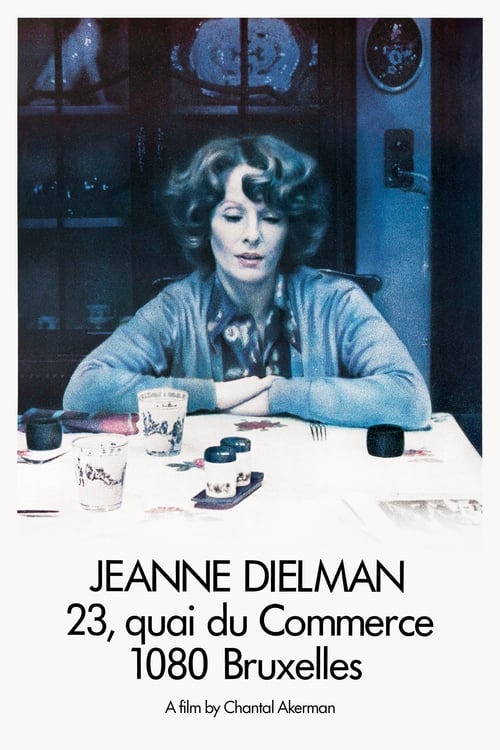
Jeanne Dielman, 23, quai du Commerce, 1080 Bruxelles (1976)
Directed by Chantal Akerman
Partly · Woke-Adjacent
How we score movies →Consciousness Markers
Explicitly feminist work examining women's unpaid domestic labor, sexual commodification, and bodily autonomy. Akerman is a canonical feminist filmmaker and this is her masterwork.
The entire film centers women's experience without male perspective or mediation. Female protagonist is the sole focus, engaged in authentic labor and bodily autonomy.
The film communicates its ideological content through formal and aesthetic choices rather than explicit dialogue. This is preachy cinema, but expressed through avant-garde form rather than direct argumentation.
While the film depicts economic precarity and the commodification of women's bodies, it does not frame this within explicit anti-capitalist ideology or class analysis.
No LGBTQ+ themes or representation present in the film. This was not a concern of second-wave feminist cinema of this era.
No racial consciousness or analysis present. The film's focus is on gender and class, not race. Set in Brussels with an entirely white cast.
Climate themes are entirely absent from the film. The work predates contemporary environmental consciousness in cinema.
Body positivity as a movement did not exist in 1976. The film's representation of the female body is neither celebratory nor body-positive in contemporary terms.
No neurodivergence representation or discussion. This was not part of the feminist discourse of the 1970s.
The film does not engage in historical revisionism. It is a contemporary portrait of its moment, not a reinterpretation of historical events.


Synopsis
A lonely young widow lives with her son following an immutable order: while the boy is in school, she cares for their apartment, does chores, and receives clients in the afternoon.
Why it received this score
Chantal Akerman's three-hour opus stands as a monument to second-wave feminist filmmaking, though we must distinguish between the specific consciousness it embodies and the contemporary progressive sensibilities of the 2020s. The film's refusal to glamorize or narrativize the daily existence of a widow engaged in both domestic labor and transactional sex constitutes a radical act of representation. Akerman holds her camera steady on the mundane, the repetitive, the unglamorous. She does not ask us to feel sympathy for her protagonist. She asks us to see.
The film's power derives from its formal choices as much as its thematic content. By rendering housework and sexual labor visible through an extended temporal form, Akerman exposes the invisible scaffolding upon which patriarchal domesticity rests. The deliberate pacing functions as a rebuke to conventional cinema's tendency to aestheticize and narrativize women's bodies. This is not entertainment in the service of male pleasure. This is documentation of what Akerman termed the "tyranny of the everyday."
Yet we must acknowledge that this work emerges from a particular historical moment and ideological framework. It exhibits the consciousness of 1970s feminism, not the identity-inflected progressivism of contemporary culture. The film contains no explicit racial analysis, no queer representation, no rhetoric of body positivity or neurodivergence. Its revolutionary character lies in its insistence on making visible what patriarchal cinema renders invisible, not in the specific markers we associate with modern cultural progressivism. It remains a necessary film, though perhaps not for the reasons contemporary critics often invoke.
Analysis generated by our Consciousness Algorithm
Critic Reviews
“Chantal Akerman’s radical 1975 masterpiece Jeanne Dielman, 23 Quai Du Commerce 1080 Bruxelles turns the term “realism” on its face, exploring the contours of a woman’s life through the mundane routines that never make it into movies. ”
“Not only is it a stunning piece of filmmaking that is as rich in detail as it is patient in its exploration, but it also makes the most of absolutely every single element of its slice-of-life portrait.”
“Ultimately, Jeanne Dielman registers not as a condemnation of domesticity, but a document of the exhaustion that comes from caring for others and never receiving care in return.”
“Being fascinating and unique, two qualities unquestionably in evidence here, don’t automatically deserve praise and, because of the film’s high quotient of tediousness, I find it impossible to recommend to any but the most devoted of experimental art film lovers. It works very well, however, as a cure for insomnia.”