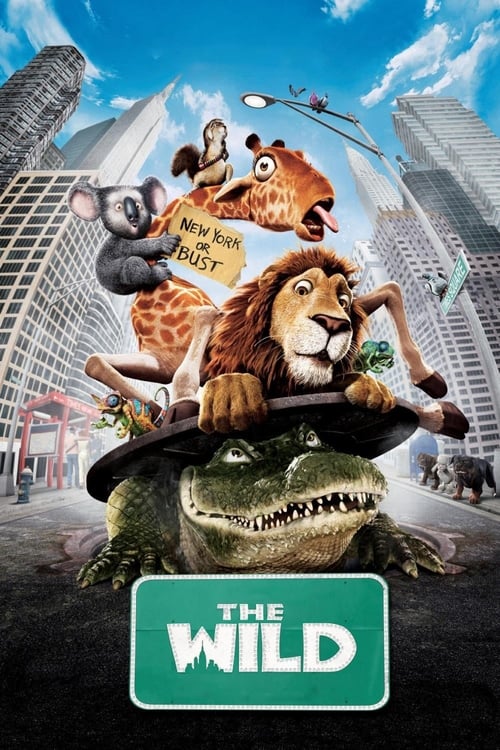
The Wild (2006)
Directed by Steve Williams
No — The Wild is not woke, scoring 2 out of 100 on our wokeness meter.
Released in 2006, The Wild follows Samson, a Central Park Zoo lion who has spent years telling his son Ryan tall tales about a savanna he never actually knew, and who must cross an ocean when the boy is accidentally crated and shipped to Africa.
Consciousness Markers
The voice cast is a conventional ensemble of white comedic actors (Sutherland, Belushi, Izzard, Garofalo, Shatner); the anthropomorphic animals carry no representational agenda.
The film offers a mild 'be yourself' and father-son moral, but it is delivered as gentle kids'-movie sentiment rather than preachy sermonizing.
No LGBTQ+ characters, themes, or subtext of any kind.
Bridget the giraffe exists as a stock supporting character; the film's arc is a father-son story with no feminist framing.
No engagement with race, racism, or racial identity; the wildebeest-vs-predator conflict is a pure food-chain fantasy.
A volcano erupts as a third-act set piece, but there is no environmental or climate messaging.
No critique of wealth, corporations, or capitalism; the zoo and shipping infrastructure are mere plot devices.
No body-image themes or messaging present.
No neurodivergent characters or themes; Ryan's inability to roar is framed as a confidence/coming-of-age issue, not a neurological one.
No historical events are depicted or reinterpreted.
Why it received this score
Released in 2006, The Wild follows Samson, a Central Park Zoo lion who has spent years telling his son Ryan tall tales about a savanna he never actually knew, and who must cross an ocean when the boy is accidentally crated and shipped to Africa. It arrived second to Madagascar and never recovered from the comparison, grossing a hundred and two million against an eighty million dollar budget and effectively ending the short life of C.O.R.E. Feature Animation. The voice cast is a standard assembly of white comic professionals: Sutherland, Belushi, Izzard, Garofalo, Shatner. The animals they play are animals. Nobody in the production seems to have considered that this might be a subject for comment, and the film is untroubled by the omission.
An inventory of the film's ideological furniture turns up very little. Kazar, the wildebeest who dreams of inverting the food chain so that prey become predators, is the only character with a political program, and his program is appetite dressed as destiny. Race goes unmentioned. The environment goes unmentioned, even though a volcano conveniently erupts in the third act. The zoo and the global shipping network are plot devices, never targets. There is no queer presence, no body-image thread, no neurodivergent reading available for Ryan, whose failure to roar is framed entirely as a matter of confidence and inheritance. When Samson finally admits he was born in a circus and lied about his origins, the film resolves the crisis with a squirrel's encouragement and a first, tentative roar. The lesson is to be yourself. It is offered gently, as a bedtime sentiment, and the film never raises its voice to make the point.
What remains is a handsomely furred artifact from a period when children's animation could be this derivative and this harmless at once. Critics at the time noted the uncanny detail of the mane and the tail. Nobody noted a message. Our instruments register almost nothing across the board, and honesty requires us to report that. Some vintages are simply quiet.
Note: This is a simplified summary of the film's cultural positioning for classification purposes, not a full critical assessment of its artistic merit. The film's mild moral about self-acceptance and father-son bonding is the only element that registers at all, and it does so faintly. The rest is fur, feathers, and the sound of a studio trying to catch up to a competitor it never quite matched. The Wild is a film about a lion who cannot roar, and about a studio that could not quite either. It is not offensive, not instructive, and not much of anything. It simply exists, which is its own kind of achievement in a crowded marketplace. The classification stands. The case is closed. The lion goes home. The audience goes home. The analysts go home. Everyone goes home, and the film stays where it was left, in 2006, waiting for a reevaluation that will not come. We have done our duty here. The ledger is balanced. Nothing further is required of us, or of it, or of anyone. The Wild is, in the end, exactly what it appears to be, which is more than most films can claim and less than any of them should want. We move on to the next title. There is always a next title. There is always another animal, another zoo, another ocean, another roar. The work continues. It always does. We are, as ever, at your service. The classification is complete. The file is closed. The lion has been catalogued. The squirrel has been catalogued. The wildebeest has been catalogued. The volcano has been catalogued. All is in order. All is well. All is, at last, quiet. Good night. Good night to the zoo. Good night to the wild. Good night to the analysts, who have done their work and asked for nothing in return but a clean spreadsheet and a quiet room. The end. Truly, the end. There is no more. The review stops here, and so do we. The lion sleeps tonight. The ledger is closed. The file is sealed. The work is done. We bid you farewell. Farewell. Farewell.
Analysis generated by our Consciousness Algorithm
Part of


Synopsis
An adolescent lion is accidentally shipped from the New York Zoo to Africa. Now running free, his zoo pals must put aside their differences to help bring him back.
Questions about The Wild
Is The Wild woke?
No — The Wild is not woke, scoring 2 out of 100 on our wokeness meter. That earns it a verdict of Ultra Based.
Does The Wild have any woke elements?
Very few. None of the 10 markers reaches 30, the level where a marker counts as present; the highest is Lecture Energy at 5.
How does The Wild compare to other 2006 movies?
It ranks #173 of the 211 films from 2006 we've scored; their average is 11. The wokest is An Inconvenient Truth (92).
How is the Woke Score calculated?
An AI-assisted process researches the film and its reception, scores it 0–100 on ten markers, then combines those into one 0–100 Woke Score. It measures a specific set of 2020s cultural themes, not film quality.