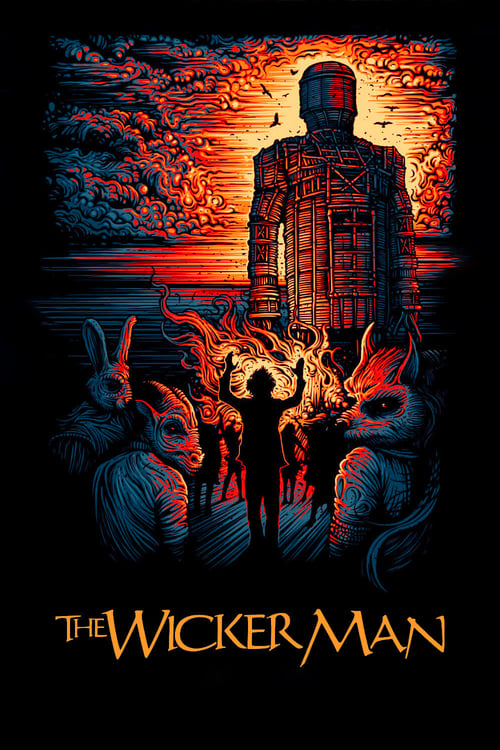
The Wicker Man (1973)
Directed by Robin Hardy
No — The Wicker Man is not woke, scoring 0 out of 100 on our wokeness meter.
Robin Hardy's 1973 folk horror film concerns a devout Christian police sergeant who flies to the Hebridean island of Summerisle to investigate a missing girl, and finds a community that has traded the kirk for Celtic paganism, maypoles, and open copulation in the fields.
Consciousness Markers
The film explores religious extremism thematically but presents it through horror and ambiguity rather than didactic moralizing.
The cast is entirely white British actors; no diversity-conscious casting choices are present in this 1973 production.
No LGBTQ+ characters or themes appear anywhere in the film.
Female characters exist largely as objects of pagan fertility ritual and male temptation; there is no feminist critique or agenda.
The film engages no racial themes or consciousness whatsoever.
Crop failure drives the plot, but it is a pagan-sacrifice mechanism, not an environmentalist or climate-crisis message.
Lord Summerisle's aristocratic manipulation of the islanders is a class dynamic, but the film offers no anti-capitalist or eat-the-rich thesis.
No body-positivity themes; the film's nudity is deployed as erotic spectacle rather than body acceptance.
No neurodivergent characters or themes are present.
The film dramatizes a clash between Christianity and Celtic paganism but makes no revisionist historical claim in the modern sense.
Why it received this score
Robin Hardy's 1973 folk horror film concerns a devout Christian police sergeant who flies to the Hebridean island of Summerisle to investigate a missing girl, and finds a community that has traded the kirk for Celtic paganism, maypoles, and open copulation in the fields. The film is a landmark of its subgenre and a monument to a cultural inventory that contemporary productions would struggle to assemble. The cast is uniformly white and British. Female characters serve as instruments of fertility ritual and male temptation; the innkeeper's daughter exists to press herself against a bedroom wall, her singing and speaking voices supplied by other women. None of this is interrogated. The film simply proceeds.
The remaining categories are similarly vacant. No same-sex themes appear. No racial consciousness is engaged. The failing harvest that motivates the plot is a pagan mechanism for human sacrifice, not an environmental parable, and the island's troubles are attributed to soil and weather in the most literal agronomic sense. Lord Summerisle's aristocratic management of his tenants supplies class texture without an anti-capitalist thesis. Nudity is deployed as spectacle, not as an argument about bodies. Neurodivergence does not appear. The collision between Christianity and paganism is dramatized as theology, not recast as a historical grievance.
What the film does possess is a sustained interest in religious extremism, delivered through horror and ambiguity instead of moral instruction. Neither the pagan islanders nor the fundamentalist sergeant emerges as the hero, and the closing image of a burning wicker man offers no lesson, only a sunset. This refusal to sermonize is exactly why the film registers so faintly on the modern instruments. It is a serious work about zealotry that declines to tell us how to feel, and we are left to admire the craftsmanship and mark the ledger accordingly. A restrained vintage, best cellared and revisited without commentary.
{"thematic_tags": ["book_adaptation"]}
Analysis generated by our Consciousness Algorithm


Synopsis
Police sergeant Neil Howie is called to an island village in search of a missing girl whom the locals claim never existed. The investigation is further complicated as Howie’s religious views clash with those of the island’s residents.
Questions about The Wicker Man
Is The Wicker Man woke?
No — The Wicker Man is not woke, scoring 0 out of 100 on our wokeness meter. That earns it a verdict of Ultra Based.
Does The Wicker Man have any woke elements?
Very few. None of the 10 markers reaches 30, the level where a marker counts as present; the highest is Lecture Energy at 5.
How does The Wicker Man compare to other 1973 movies?
It ranks #30 of the 32 films from 1973 we've scored; their average is 11. The wokest is Soylent Green (39).
How is the Woke Score calculated?
An AI-assisted process researches the film and its reception, scores it 0–100 on ten markers, then combines those into one 0–100 Woke Score. It measures a specific set of 2020s cultural themes, not film quality.