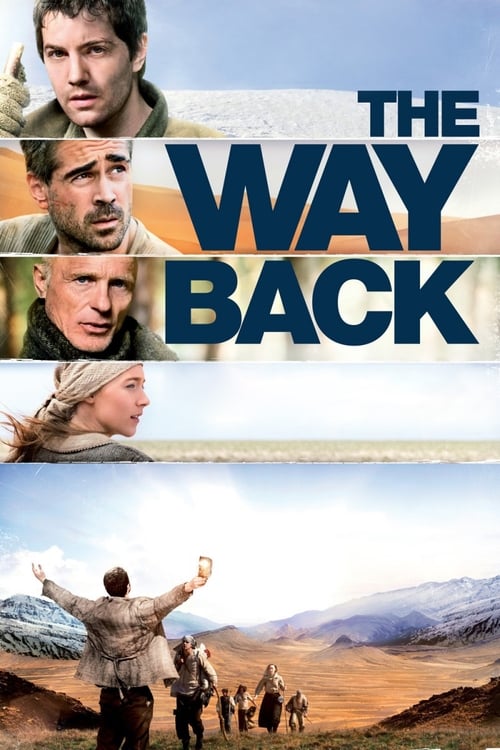
The Way Back (2010)
Directed by Peter Weir
No — The Way Back is not woke, scoring 0 out of 100 on our wokeness meter.
Peter Weir directed The Way Back in 2010 and then retired, which is a strange note to end on.
Consciousness Markers
The cast is composed of characters with various European nationalities as dictated by the historical survival story, with no modern inclusive-casting commentary or framing.
There are no LGBTQ+ themes, characters, or subtext in the film.
Saoirse Ronan's Irena is a narrative character in the survival group, but the film does not advance a feminist agenda or critique patriarchy.
The film deals with Soviet political repression and multinational prisoners, not racial identity or racial justice themes.
Harsh environments are survival obstacles, not a climate crusade or environmentalist message.
The film is anti-communist and anti-totalitarian in its depiction of the gulag, not anti-capitalist or focused on wealth inequality.
There is no body-positivity theme or body-image commentary.
A character's night blindness is a physical/medical condition used for survival drama, not a neurodivergence theme.
The film is based on a disputed memoir and presents a survival narrative, but it does not reinterpret history through a modern progressive ideological lens.
The film depicts political repression and survival without modern preachy lecture energy or direct audience moralizing.
Why it received this score
Peter Weir directed The Way Back in 2010 and then retired, which is a strange note to end on. The film follows a band of prisoners who walk out of a Siberian gulag and keep walking, across Mongolia, the Gobi, China, and the Himalayas, until they reach India. It is adapted from The Long Walk, a memoir whose author, it later turned out, was probably released by the Soviets in 1942 instead of escaping. Weir has conceded the film is essentially fiction. None of this makes the walking less arduous.
On the cultural index, the picture registers almost nothing. The cast is multinational because the gulag was multinational, and the film treats that as a fact of the setting instead of a statement. Saoirse Ronan arrives as Irena, a Polish girl with a fabricated past, and the film lets her be frightened and hungry without turning her into an argument about anything. The villains are the NKVD and the weather. The Soviet system is the antagonist, which places the film's politics somewhere well to the right of anything resembling a modern progressive critique of power. A character's night blindness is a survival liability, not a metaphor. The environment kills people. It is not making a point about the planet.
Grief, frostbite, and thirst carry the runtime. No character pauses to explain what the audience should feel, and no third act arrives to instruct us on the correct lesson. Peter Weir trusts a long walk to be interesting on its own, which it mostly is. The result is a serious film about suffering that asks for nothing but attention, and in this current climate of cinema as moral instruction, that restraint reads as almost antique. A sommelier of these matters would note the vintage: dry, austere, and entirely free of additives.
Scores: representation_casting 0, lgbtq 0, feminist 0, racial_consciousness 0, climate 0, anti_capitalist 0, body_positivity 0, neurodivergence 0, revisionist_history 0, lecture_energy 0. Overall cultural index: 0 out of 100. A clean, cold vintage with no fortification whatsoever. The category stands empty, and the film seems content to leave it that way. What the picture offers is snow, distance, and the sound of men dying of thirst, which is its own kind of purity. There is nothing here for the classifier to seize upon, and after a long day of seizing, that is a relief.
Thematic tags: book_adaptation, true_story. The film draws on Sławomir Rawicz's disputed memoir and the historical gulag system, though its director now describes it as essentially fictional. It won no Academy Awards, spawned no sequels, and reimagined nothing. It simply walked, and then it stopped walking, and then Peter Weir went home.
Analysis generated by our Consciousness Algorithm


Synopsis
A small band of multicultural convicts stages a daring escape from a WWII-era Siberian gulag, and embarks on a treacherous journey across five countries in a desperate race for freedom and survival.
Questions about The Way Back
Is The Way Back woke?
No — The Way Back is not woke, scoring 0 out of 100 on our wokeness meter. That earns it a verdict of Ultra Based.
Does The Way Back have any woke elements?
No. All 10 markers score zero.
How does The Way Back compare to other 2010 movies?
It ranks #204 of the 238 films from 2010 we've scored; their average is 11. The wokest is My Name Is Khan (84).
How is the Woke Score calculated?
An AI-assisted process researches the film and its reception, scores it 0–100 on ten markers, then combines those into one 0–100 Woke Score. It measures a specific set of 2020s cultural themes, not film quality.