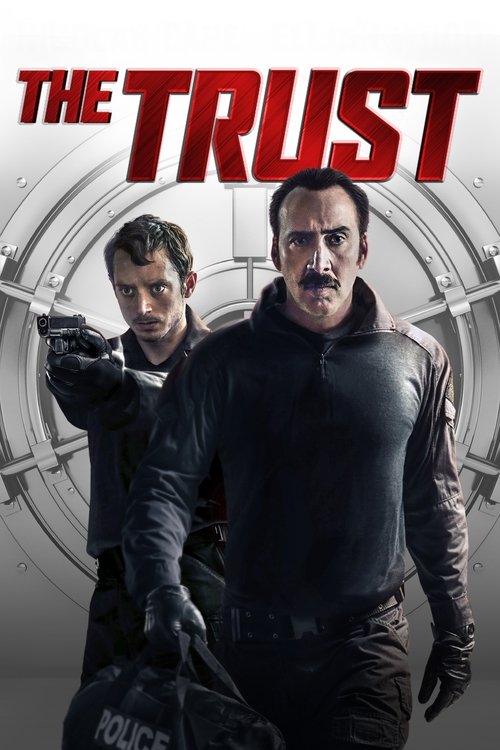
The Trust (2016)
Directed by Alex Brewer
No — The Trust is not woke, scoring 5 out of 100 on our wokeness meter.
The Trust is a 2016 crime drama about two Las Vegas evidence-room cops, Nicolas Cage as Lieutenant Jim Stone and Elijah Wood as Sergeant David Waters.
Consciousness Markers
The plot involves the theft of extreme wealth and the corruption of institutions, offering a minor, albeit criminal, critique of unchecked capital.
The casting is standard for a modern American crime thriller, offering no groundbreaking representation beyond basic genre requirements.
The female character is primarily a victim and a plot device, offering minimal agency or critique of gender dynamics.
The narrative is strictly focused on police corruption and high-stakes theft, with no discernible LGBTQ+ themes or characters.
The film operates within a standard, racially homogenous American crime setting with no specific commentary on race or systemic inequality.
The environmental impact of the heist or the setting is entirely ignored in favor of action and plot mechanics.
There is no focus on body image, diverse body types, or the celebration of physical forms.
No characters exhibit traits or conditions related to neurodivergence.
The film is a fictional crime drama and does not attempt to reinterpret any historical events.
The pacing is driven by action and plot, leaving no room for didactic social commentary.
Why it received this score
The Trust is a 2016 crime drama about two Las Vegas evidence-room cops, Nicolas Cage as Lieutenant Jim Stone and Elijah Wood as Sergeant David Waters. They stumble onto a mysterious vault, plan a drill-based heist, and find gems. The film is workmanlike, sweaty, and committed to genre mechanics. In terms of modern progressive markers, it is mostly a desert. No climate sermon. No neurodivergent arc. No body-image discourse. No historical revision. The camera cares about concrete, drill bits, and the specific indignity of being underpaid in a desert city.
The film's one faint brush with social consciousness is its attitude toward money. The villains are drug dealers with a high-tech safe. The heroes are public servants who steal from them. This creates a mild eat-the-rich vibration, though it is less a critique of capital than a critique of being bad at your job and needing cash. The female hostage exists to be restrained, to mention a child, and to trigger David's crisis of conscience. She is a plot device with a phone number. That yields a sliver of gender awareness, no more. Casting is standard for an American crime thriller: competent, familiar, not a statement.
The rest is silence. Race is not addressed. LGBTQ+ lives are absent. The environment does not enter the frame except as Las Vegas heat. The pacing is all action and plot, with no lecturing, no sermonizing, no classroom. It is a film that wants to be a heist picture and succeeds just enough. For the cultural sommelier, this is a lean vintage: drinkable, forgettable, and nearly free of the ideological additives that make modern classification such a chore. The Trust trusts in guns, drills, and Cage. That is its entire platform.
Analysis generated by our Consciousness Algorithm


Synopsis
A pair of cops investigating a drug invasion stumble upon a mysterious bank vault.
Questions about The Trust
Is The Trust woke?
No — The Trust is not woke, scoring 5 out of 100 on our wokeness meter. That earns it a verdict of Ultra Based.
Does The Trust have any woke elements?
Very few. None of the 10 markers reaches 30, the level where a marker counts as present; the highest is Eat the Rich at 15.
How does The Trust compare to other 2016 movies?
It ranks #221 of the 285 films from 2016 we've scored; their average is 16. The wokest is 13th (92).
How is the Woke Score calculated?
An AI-assisted process researches the film and its reception, scores it 0–100 on ten markers, then combines those into one 0–100 Woke Score. It measures a specific set of 2020s cultural themes, not film quality.