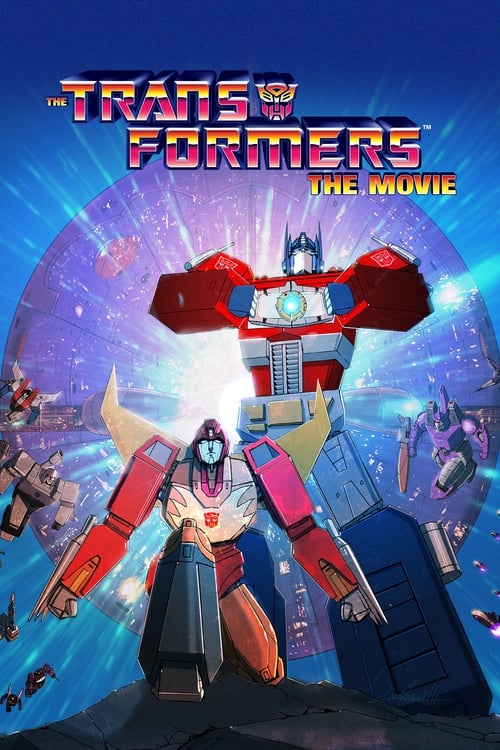
The Transformers: The Movie (1986)
Directed by Nelson Shin
The Transformers: The Movie arrives as a genuine curiosity in the annals of progressive cultural analysis: an 85-minute toy commercial that accidentally contains more thematic substance than several films that were consciously trying.
Consciousness Markers
Arcee, the franchise's first female Transformer, was deliberately introduced to broaden the audience's gender range. The gesture is undercut by her being pink, largely decorative, and surrounded by a cast of several dozen male robots, which is a ratio that would make even the most forgiving diversity auditor quietly close their spreadsheet.
The villain is a planet-eating entity of pure, insatiable consumption, and retrospective critics have noted the irony that this symbol of destructive consumerism was itself commissioned by a corporation that killed off beloved characters to sell new toy lines. The anti-capitalist reading is accidental, which somehow makes it more interesting.
Arcee's inclusion was a conscious, if modest, step toward acknowledging that girls also exist and might conceivably enjoy watching robots fight. She does not drive the plot, deliver a speech about systemic barriers, or dismantle any patriarchal structures. The feminist signal is present but arrives in a very small envelope.
The film does deliver a sincere and earnest sermon on leadership, sacrifice, and the burden of destiny, centered on the Autobot Matrix of Leadership and Hot Rod's reluctant heroism. It is not politically preachy in the modern sense, but it does want you to understand that true leadership comes from within, and it will repeat this until you do.
The film's racial consciousness manifests primarily in its absence: a predominantly white creative establishment produced a film that Casey Kasem would later leave the franchise over due to anti-Arab ethnic stereotyping in subsequent material. The film itself does not foreground race, but the surrounding context is a quiet footnote.
Arcee's origins were retroactively reimagined as a transgender narrative by IDW comic writers decades after the film's release. The film itself contains no such content. We score the artifact before us, not the fanfiction of future decades, so this registers as a faint residual signal only.
There is no climate messaging in this film. Unicron consuming planets could theoretically be read as an environmental metaphor by someone who has had a long day and is looking for one, but the film does not invite this reading and we will not extend that invitation on its behalf.
The characters are robots. They do not have bodies in any meaningful sense. Body positivity does not apply here, and we respect the film for not attempting to make it apply.
No character is coded as neurodivergent, nor does the film show any interest in exploring cognitive or psychological difference. The characters are engaged in a war. They have other priorities.
The film is set in 2005 and concerns entirely fictional robotic factions. There is no history to revise. It is not in conversation with the historical record in any way.
Why it received this score
The Transformers: The Movie arrives as a genuine curiosity in the annals of progressive cultural analysis: an 85-minute toy commercial that accidentally contains more thematic substance than several films that were consciously trying. Produced under direct corporate mandate to kill off the 1984 toy line and install the 1986 one, the film is, at its core, a product roadmap rendered in cel animation, set to a synth-rock soundtrack, and voiced by Orson Welles in what he described, with characteristic generosity, as playing "a toy that attacks other toys." That this film also manages to traumatize an entire generation with the death of Optimus Prime is either a remarkable creative accident or a warning about what happens when you give animators too much latitude within a budget meeting.
On the spectrum of social consciousness, the film occupies a position we might call "1986 aspirational." The introduction of Arcee, the franchise's first female Transformer, represents a sincere if structurally limited attempt at gender inclusion: she is pink, she is present, and she is not given very much to do. The film's more interesting progressive credential is entirely unintentional. Its central villain, a planet-devouring colossus of pure appetite, functions as a fairly pointed metaphor for the very corporate machinery that produced him, a detail that the executives at Hasbro presumably did not linger over. Casey Kasem's subsequent resignation from the franchise over anti-Arab stereotyping in the television series adds a layer of context that the film itself does not earn but cannot entirely escape.
The lecture energy here is of the old-fashioned heroic variety: the Matrix of Leadership must be passed, the chosen one must accept his destiny, and sacrifice must be honored. It is earnest to the point of being almost aggressive about it. This is not the targeted social sermonizing of a later era. It is the blunt moral instruction of a Saturday morning cartoon that has been given a theatrical budget and a death scene, and it delivers its lessons about courage and succession with the confidence of a film that has never once doubted itself. We score it accordingly, and with a certain grudging respect.
Analysis generated by our Consciousness Algorithm


Synopsis
The Autobots must stop a colossal planet-consuming robot who goes after the Autobot Matrix of Leadership. At the same time, they must defend themselves against an all-out attack from the Decepticons.