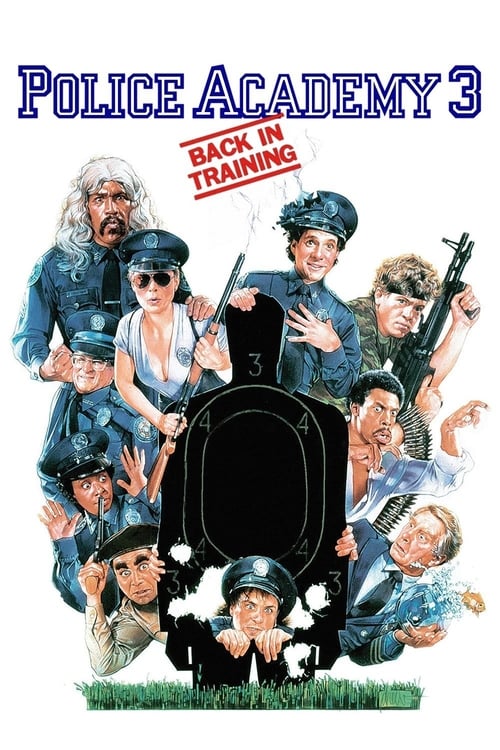
Police Academy 3: Back in Training (1986)
Directed by Jerry Paris
No · Ultra Based
How we score movies →Consciousness Markers
The cast includes performers of various ethnicities and Marion Ramsey as a female officer, but their inclusion serves purely comedic ends without any engagement with representation as a meaningful concern.
Marion Ramsey's character participates in the same physical comedy as her male counterparts, but the film contains no feminist perspective or critique of gender dynamics.
No LGBTQ+ themes, characters, or subtext are present in the film. Sexual orientation is not addressed or explored.
The film contains no examination of race, racial dynamics, or systemic racism. Performers of color are present but treated identically to white performers in service of slapstick humor.
Climate or environmental concerns are entirely absent from this comedy about police academy competitions.
Despite a plot point about budget cuts, there is no critique of capitalism, wealth inequality, or institutional economics. The premise serves purely as a comedic device.
The film's humor often derives from physical appearance and body types, but not from any body-positive framework. Bodies are treated as vehicles for comedy rather than as subjects of acceptance.
No representation or discussion of neurodivergence, disability, or cognitive difference appears in the film.
The film contains no historical content or revisionist engagement with history. It is set in a contemporary (1986) police academy.
The film is structured entirely around physical comedy and character bits. No preachy elements or instructive passages appear.


Synopsis
When police funding is cut, the Governor announces he must close one of the academies. To make it fair, the two police academies must compete against each other to stay in operation. Mauser persuades two officers in Lassard's academy to better his odds, but things don't quite turn out as expected...
Why it received this score
Police Academy 3 remains what it has always been: a cheerful, uncomplicated comedy about people in uniforms doing ridiculous things. The film's ensemble cast includes performers from various backgrounds, but this diversity serves no narrative purpose beyond providing different body types and comedic styles for the filmmakers to exploit. The humor derives primarily from slapstick, sound effects, and physical comedy rather than any engagement with social structures or institutional critique.
The film's nominal plot concerns the closing of police academies due to budget cuts, a premise that might suggest commentary on government spending or institutional failure. Instead, the story functions as mere scaffolding for set pieces and character bits. There is no examination of what such closures mean, no consideration of public safety, and certainly no interrogation of police authority or accountability. The police themselves are presented as bumbling but essentially benign figures, and the academy is treated as a sandbox for hijinks rather than an institution worthy of scrutiny.
To evaluate this film through the lens of contemporary cultural consciousness would be to impose frameworks the work never contemplates. Police Academy 3 is a product of mid-1980s mass entertainment, concerned with profit margins and audience laughter, not social awareness. It contains representation, yes, but representation that exists in service of commercial comedy, not cultural statement. The film remains innocent of progressive sensibility, which is to say it remains innocent of any sensibility at all.
Analysis generated by our Consciousness Algorithm
Critic Reviews
“The slim plot is a feeble excuse for a series of set pieces, some of which can be seen coming even before the opening credits roll, and a handful that are genuinely funny.”
“Cast of cartoon misfits is still basically intact and if Police Academy 3 has any charm it’s in the good-natured dopeyness of these people. No bones about it, these people are there to laugh at.”
“The plot, which more or less prompts the gags without interfering with them, has something to do with a competition between the two police academies to see which one will survive a state-decreed budget cut. It's perfectly serviceable.”
“At its worst, a distasteful series of homophobic, racist and sexist jokes, and otherwise little more than jollies of the most juvenile and locker room sort. [24 Mar 1986, p.5C]”