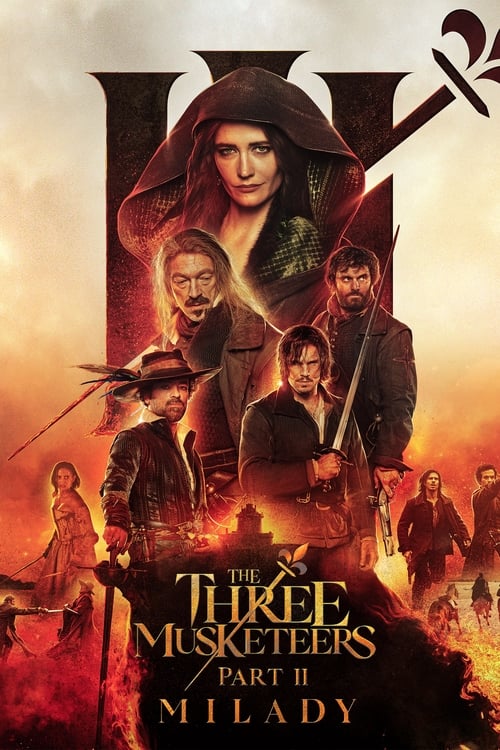
The Three Musketeers: Milady (2023)
Directed by Martin Bourboulon
No — The Three Musketeers: Milady is not especially woke, scoring 37 out of 100 on our wokeness meter.
The second half of Martin Bourboulon's Dumas diptych arrives with swords, gunpowder, and a quiet determination to improve the seventeenth century.
Consciousness Markers
By centering the story around Hannibal, the film attempts to inject a level of racial consciousness into a period where such representation was entirely absent from the source material.
The inclusion of Hannibal, based on the true story of Louis Anniaba, France's first Black musketeer, provides a significant, if historically constrained, moment of representation.
Constance Bonacieux is portrayed as a character of agency, and the film attempts to modernize the dynamic between D'Artagnan and Constance by emphasizing respect and consent.
The film explicitly identifies Porthos as bisexual, a modern sensibility applied to a character within a historical setting.
The film revisits the classic Dumas narrative by modernizing character interactions and incorporating a real historical figure (Hannibal) into the fictional framework.
The conflict is rooted in religious and political power struggles (Catholic vs. Protestant) rather than a critique of modern economic structures or wealth disparity.
While the film attempts to modernize certain tropes, it remains an action-adventure piece and does not devolve into didactic social commentary.
The film's focus on 17th-century warfare and political intrigue leaves no room for environmental commentary or climate activism.
There is no discernible focus on diverse body types or challenging traditional beauty standards within the narrative or character descriptions.
No characters are depicted with neurological differences or specific neurodivergent traits.
Why it received this score
The second half of Martin Bourboulon's Dumas diptych arrives with swords, gunpowder, and a quiet determination to improve the seventeenth century. The film's most substantial modernizing gesture is Hannibal, drawn from the true story of Louis Anniaba, France's first Black musketeer. This is representation with a historical alibi, and it gives the narrative a racial consciousness the source novel never possessed. The result is not clumsy, though it does ask us to accept a very contemporary casting logic inside a very old adventure. Porthos is now bisexual. The film notes this with the same gravity a sommelier might note a faint mineral finish. It is a small addition, applied to a character who otherwise remains a man of appetite and fists.
Constance Bonacieux receives more agency than Dumas allowed, and the romance between her and D'Artagnan has been rewritten toward respect and consent. This is feminist tinkering of a mild and practical sort. The film wants its swashbuckling to pass modern inspection without surrendering its pleasures. It mostly succeeds. The political conflict remains Catholic against Protestant, crown against rebel, which leaves the economic order untouched. There is no climate sermon, no body-positive subplot, no neurodivergent hero. The film is too busy with horses, muskets, and Eva Green's excellent coat.
This is revisionist history in the soft sense: a classic text sanded at the edges, not rebuilt from the foundation. The sermonizing is minimal. The film prefers duels to diatribes, and its social consciousness arrives as costume detail and revised flirtation. That restraint is welcome. It is a sequel, a spectacle, and a competent piece of heritage action. The cultural awareness is present, but it never overwhelms the swordplay. A weary critic can respect that.
Analysis generated by our Consciousness Algorithm


Synopsis
D'Artagnan, on a quest to rescue the abducted Constance, runs into the mysterious Milady de Winter again. The tension between the Catholics and the Protestants finally escalates, as the king declares war — forcing the now four musketeers into battle. But as the war goes on, they are tested physically, mentally and emotionally.
Questions about The Three Musketeers: Milady
Is The Three Musketeers: Milady woke?
No — The Three Musketeers: Milady is not especially woke, scoring 37 out of 100 on our wokeness meter. That earns it a verdict of Based.
Does The Three Musketeers: Milady have any woke elements?
5 of the 10 markers register at 30 or above, led by Racial Consciousness (75), Representation Casting (65) and Feminist Agenda (45). On Racial Consciousness: By centering the story around Hannibal, the film attempts to inject a level of racial consciousness into a period where such representation was entirely absent from the source material.
How does The Three Musketeers: Milady compare to other 2023 movies?
It ranks #41 of the 200 films from 2023 we've scored; their average is 24. The wokest is Origin (84).
How is the Woke Score calculated?
An AI-assisted process researches the film and its reception, scores it 0–100 on ten markers, then combines those into one 0–100 Woke Score. It measures a specific set of 2020s cultural themes, not film quality.