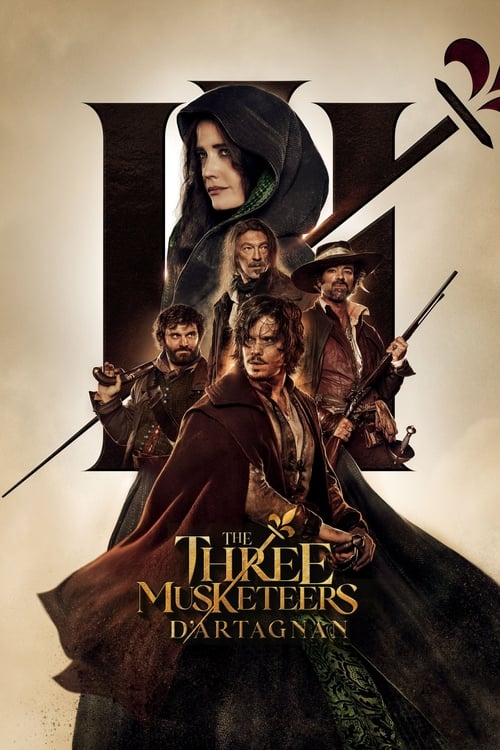
The Three Musketeers: D'Artagnan (2023)
Directed by Martin Bourboulon
No — The Three Musketeers: D'Artagnan is not especially woke, scoring 30 out of 100 on our wokeness meter.
Martin Bourboulon's The Three Musketeers: D'Artagnan arrives with the confidence of a thirty-six million euro French production that has decided the 1844 Dumas novel needs a thriller's pulse.
Consciousness Markers
The adaptation invents a new character, Hannibal, based on Aniaba, described as France's first black musketeer, and casts Lyna Khoudri as Constance, deliberately diversifying a historically white French cast.
Porthos is explicitly made bisexual in this version, a deliberate departure from Dumas's novel, though it is a background detail rather than a thematic focus.
The filmmakers explicitly sought 'strong female characters' and 'modernity,' and star François Civil had the seduction scenes rewritten to inject more respect, but the plot remains a conventional swashbuckler.
The inclusion of a black musketeer gestures at racial inclusion, but it is framed as historical curiosity rather than a sustained racial-consciousness theme.
This is a propulsive action-thriller adaptation with little overt moralizing or preaching to the audience.
The film is a straightforward adaptation of a historical adventure novel; the added black musketeer is drawn from a real figure rather than a revisionist reframing of events.
No environmental or climate themes appear in this 17th-century adventure.
The film concerns court intrigue, duels, and royal politics; there is no critique of capitalism or class economics.
No body-positivity themes or messaging are present.
No neurodivergence themes or characters are present.
Why it received this score
Martin Bourboulon's The Three Musketeers: D'Artagnan arrives with the confidence of a thirty-six million euro French production that has decided the 1844 Dumas novel needs a thriller's pulse. The duels are crisp, the mud is real, and the whole enterprise hums with the self-assurance of a franchise opener that knows a second part is already in the can. It is, by most measures, a good time at the cinema.
The cultural bookkeeping is more interesting than the swordplay. The production invents Hannibal, drawn from the real Aniaba, reputedly France's first black musketeer, and casts Lyna Khoudri as Constance, gestures that nudge a famously white historical cast toward something more contemporary. Porthos is bisexual now, a detail mentioned and then set aside. The filmmakers openly sought strong female characters and a certain modernity, and star François Civil had the seduction scenes rewritten so his D'Artagnan might flirt with more respect. These are real interventions. They are also decorative. The film never pauses to argue with us about any of them, which is a mercy.
What we do not get is a sermon. There is no climate reckoning in seventeenth-century France, no critique of the aristocracy's economics, no discourse on bodies or minds. Cardinal Richelieu remains a schemer, the king remains a nervous man in a large hat, and the camera cares only about who is holding the sword. As pieces of cultural signaling go, these are faint brushstrokes on a very large canvas. The result is a swashbuckler politely modernized at the edges and left alone at the center. Refreshing, in its way.
Analysis generated by our Consciousness Algorithm


Synopsis
D'Artagnan, a spirited young Gascon, is left for dead after trying to save a noblewoman from being kidnapped. Once in Paris, he tries by all means to find his attackers, unaware that his quest will lead him to the very heart of a war where the future of France is at stake. Aided by King's Musketeers Athos, Porthos and Aramis, he faces the machinations of villainous Cardinal Richelieu and Milady de Winter, while falling in love with Constance, the Queen's confidante.
Questions about The Three Musketeers: D'Artagnan
Is The Three Musketeers: D'Artagnan woke?
No — The Three Musketeers: D'Artagnan is not especially woke, scoring 30 out of 100 on our wokeness meter. That earns it a verdict of Based.
Does The Three Musketeers: D'Artagnan have any woke elements?
4 of the 10 markers register at 30 or above, led by Representation Casting (50), LGBTQ+ Themes (45) and Feminist Agenda (38). On Representation Casting: The adaptation invents a new character, Hannibal, based on Aniaba, described as France's first black musketeer, and casts Lyna Khoudri as Constance, deliberately diversifying a historically white French cast.
How does The Three Musketeers: D'Artagnan compare to other 2023 movies?
It ranks #54 of the 200 films from 2023 we've scored; their average is 24. The wokest is Origin (84).
How is the Woke Score calculated?
An AI-assisted process researches the film and its reception, scores it 0–100 on ten markers, then combines those into one 0–100 Woke Score. It measures a specific set of 2020s cultural themes, not film quality.