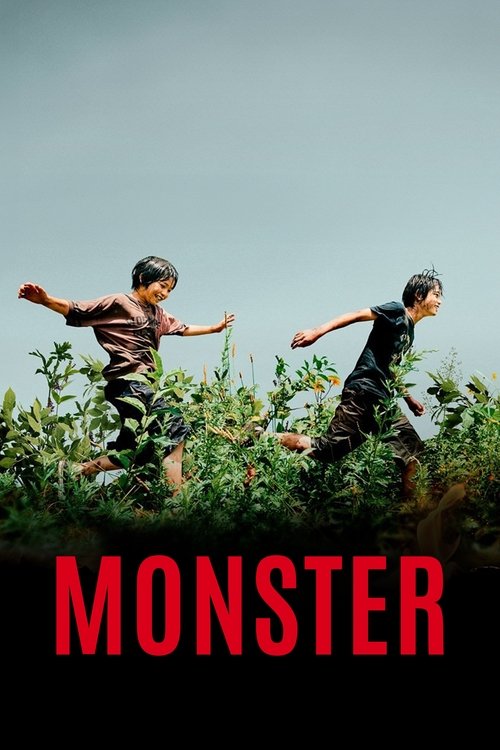
Monster (2023)
Directed by Hirokazu Kore-eda
Yes — Monster is woke, scoring 68 out of 100 on our wokeness meter.
Hirokazu Kore-eda takes a screenplay he did not write and assembles it three times over, each pass peeling back a layer of the same small catastrophe.
Consciousness Markers
The central relationship between two fifth-grade boys, Minato and Yori, is a tender same-sex romance, and the film won the Queer Palm at Cannes for its LGBTQ+ themes.
The film's multi-perspective structure encourages empathy and questions easy judgments, but it remains subtle and avoids preachy lecturing.
The cast is entirely Japanese, with no deliberate diverse or color-conscious casting choices; the film does not engage with representation casting as a marker.
While a single mother drives the first act, the film does not advance a feminist agenda or explicitly critique patriarchy as a thematic priority.
The film is set in a homogeneous Japanese community and contains no racial consciousness or commentary on race.
There is no climate change theme or environmental crusade in the narrative.
The school's reputation-protecting bureaucracy is criticized, but this is institutional, not an anti-capitalist or eat-the-rich message.
No body positivity themes or body-image commentary are present.
Yori is bullied for being asocial and effeminate, but the film does not explicitly frame this as neurodivergence or explore neurodiverse identity.
The film is a contemporary original story with no historical revisionism.
Why it received this score
Hirokazu Kore-eda takes a screenplay he did not write and assembles it three times over, each pass peeling back a layer of the same small catastrophe. A single mother sees her fifth-grade son come home with one shoe and a haircut he gave himself, and she does the reasonable thing: she demands answers from a school that would prefer the matter stay indoors. The faculty apologize without apologizing. A teacher becomes a suspect. The reputation of an institution is protected at the expense of everyone inside it. This is the first act, and it plays like a quiet procedural about bureaucratic cowardice.
Then the film turns, and turns again, and the suspicion curdles into something else. The two boys at the center, Minato and Yori, are not the victim and the bully the adults keep naming. They are in love, in the tentative and wordless manner of children who have no vocabulary for it and no safe place to say it aloud. Kore-eda films this with a tenderness that never announces itself. A shared railcar, a hand in someone's hair, a question about whether they have been reborn. The film took the Queer Palm at Cannes, a distinction its marketing had apparently been at pains to conceal, which reads now as its own small act of institutional cowardice.
Nothing here lectures. The school bureaucracy is indicted, but the film has no interest in economic systems or identity checklists. It wants us to sit with the awful fact that everyone was telling a version of the truth and every version was incomplete. The result is humane, restrained, and almost entirely free of the sermonizing that this decade tends to reward. A gentle, devastating piece of work. It earns its compassion the hard way: by refusing to hand us a villain.
A note for the ledger. The central romance between two boys supplies the only substantial marker of contemporary social consciousness, and it is handled with a delicacy that resists the usual framing. The preachy instincts of the age are largely absent. This is a film about a mother, a teacher, and two children, told from three angles, and it trusts the audience to assemble the pieces without instruction. That restraint is the rarest thing in it, and the most welcome.
{"thematic_tags": []}
Analysis generated by our Consciousness Algorithm


Synopsis
After an outburst at school involving her son, a concerned single mother demands answers, triggering a sequence of deepening suspicion and turmoil.
Questions about Monster
Is Monster woke?
Yes — Monster is woke, scoring 68 out of 100 on our wokeness meter. That earns it a verdict of Woke.
What makes Monster woke?
1 of the 10 markers register at 30 or above, led by LGBTQ+ Themes (95). On LGBTQ+ Themes: The central relationship between two fifth-grade boys, Minato and Yori, is a tender same-sex romance, and the film won the Queer Palm at Cannes for its LGBTQ+ themes.
How does Monster compare to other 2023 movies?
It ranks #6 of the 200 films from 2023 we've scored; their average is 24. The wokest is Origin (84).
How is the Woke Score calculated?
An AI-assisted process researches the film and its reception, scores it 0–100 on ten markers, then combines those into one 0–100 Woke Score. It measures a specific set of 2020s cultural themes, not film quality.