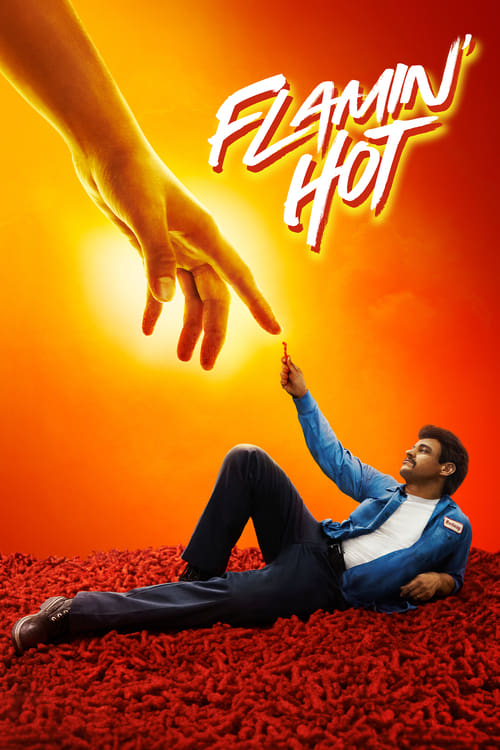
Flamin' Hot (2023)
Directed by Eva Longoria
Yes — Flamin' Hot is very woke, scoring 80 out of 100 on our wokeness meter.
Flamin' Hot arrives as a feature-length act of brand stewardship, which is a polite way of saying it turns a disputed snack origin story into a warm bath of uplift.
Consciousness Markers
Mexican American identity is the engine of the plot: Richard channels his heritage to pitch a spicy product to the Latino market, and the film repeatedly invokes 'Sí, se puede' and cultural pride as its central message.
The film is a deliberate showcase of Latino representation, with a predominantly Mexican American cast led by Jesse Garcia and Annie Gonzalez, and was promoted as the first White House screening of a movie centered on Hispanic characters.
The film markets itself as a true story while dramatizing Richard Montañez's account of inventing Flamin' Hot Cheetos, a claim thoroughly debunked by the LA Times and NPR, and it fabricates events such as the Reagan-era framing and the climactic standing ovation.
Critics noted the film is so consumed with delivering its cultural 'message' and 'Sí, se puede' mantra that the characters get little room to breathe, giving it a pronounced sermonizing streak.
Directed by Eva Longoria in her feature debut, and Judy Montañez is written as a forceful, supportive partner who pushes Richard forward, but the story remains squarely a male underdog narrative and never advances an explicit feminist thesis.
The film gestures at Reagan-era layoffs and corporate indifference, but its arc is fundamentally a celebration of entrepreneurial hustle and rising within Frito-Lay, epitomized by the 'think like a CEO' mantra.
No LGBTQ+ characters, relationships, or themes appear anywhere in the narrative.
There is no environmental or climate-related content in the film.
No body positivity themes or body-image commentary are present.
No neurodivergent characters or themes are depicted.
Why it received this score
Flamin' Hot arrives as a feature-length act of brand stewardship, which is a polite way of saying it turns a disputed snack origin story into a warm bath of uplift. Eva Longoria directs with professional smoothness, and the predominantly Mexican American cast, led by Jesse Garcia and Annie Gonzalez, gives the enterprise a genuine, lived-in charge. The film was feted at the White House as the first screening of its kind for Hispanic characters, and that context tells you much about its ambitions. It wants to be representation and product launch at the same time. The trouble is that the product is Cheetos, and the representation is delivered with a smile that never quite relaxes.
Mexican American identity powers the plot. Richard hears his grandfather, remembers his family, and pitches spice to a Latino market that corporate America has overlooked. The mantra 'Sí, se puede' is invoked until it becomes a drumbeat. This is not a subtle film about assimilation. It is a sermon with snack breaks. Judy Montañez is written as a forceful partner who pushes Richard forward, and Longoria's direction adds a welcome female gaze to a male underdog tale. Yet the story stays fixed on Richard's rise, so the feminist current remains a tributary, not the river. Meanwhile, the script gestures at Reagan-era layoffs and corporate indifference before sprinting back to celebrate entrepreneurial hustle and the wisdom of thinking like a CEO. The rich are not eaten here. They are asked for a promotion.
Then there is the matter of truth. The film sells itself as the inspiring true story of Richard Montañez, though the LA Times and NPR have thoroughly disputed his claim to inventing Flamin' Hot Cheetos. The climax, a standing ovation from coworkers, was admitted by Longoria to be invented. That is a bold choice for a movie that keeps insisting on its own sincerity. The result is less history than motivational poster with a copyright line. It has no climate crusade, no body positivity, no neurodivergence, no queer presence, and little patience for ambiguity. What it has is a message, repeated until the characters have no room left to breathe. The snack may be spicy. The sermon is mild.
Analysis generated by our Consciousness Algorithm
Part of


Synopsis
The inspiring true story of Richard Montañez, the Frito Lay janitor who channeled his Mexican American heritage and upbringing to turn the iconic Flamin' Hot Cheetos into a snack that disrupted the food industry and became a global pop culture phenomenon.
Questions about Flamin' Hot
Is Flamin' Hot woke?
Yes — Flamin' Hot is very woke, scoring 80 out of 100 on our wokeness meter. That earns it a verdict of Peak Woke.
What makes Flamin' Hot woke?
4 of the 10 markers register at 30 or above, led by Racial Consciousness (82), Representation Casting (78) and Revisionist History (75). On Racial Consciousness: Mexican American identity is the engine of the plot: Richard channels his heritage to pitch a spicy product to the Latino market, and the film repeatedly invokes 'Sí, se puede' and cultural pride as its central message.
How does Flamin' Hot compare to other 2023 movies?
It ranks #2 of the 200 films from 2023 we've scored; their average is 24. The wokest is Origin (84).
How is the Woke Score calculated?
An AI-assisted process researches the film and its reception, scores it 0–100 on ten markers, then combines those into one 0–100 Woke Score. It measures a specific set of 2020s cultural themes, not film quality.