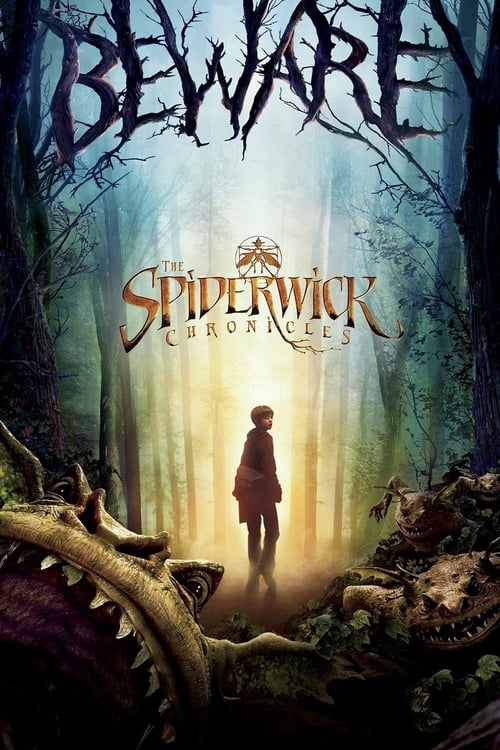
The Spiderwick Chronicles (2008)
Directed by Mark Waters
No — The Spiderwick Chronicles is not woke, scoring 0 out of 100 on our wokeness meter.
The Spiderwick Chronicles arrives from 2008, a year in which a children's fantasy could still consist mostly of children, a house, and a variety of hostile creatures.
Consciousness Markers
The cast is overwhelmingly white, with no meaningful racial diversity or representation casting choices.
There are no LGBTQ+ characters, themes, or subtext.
Mallory is a capable older sister who fights goblins, but the film does not advance a feminist agenda or critique patriarchy.
The film does not engage with racial consciousness, systemic racism, or racial identity.
There is no environmental or climate-change messaging.
The story contains no anti-capitalist critique or eat-the-rich themes.
Body positivity is not a theme, and no characters challenge conventional body standards.
Jared's anger and family conflict are not framed as neurodivergence or a neurodiversity issue.
The film is a straightforward fantasy adaptation and does not revise or reinterpret historical events.
The film is an adventure story without preachy social or political lecturing.
Why it received this score
The Spiderwick Chronicles arrives from 2008, a year in which a children's fantasy could still consist mostly of children, a house, and a variety of hostile creatures. A recently divorced mother inherits a crumbling New England estate. Her nine-year-old twin sons and thirteen-year-old daughter discover a field guide to the unseen world, and then goblins arrive. That is the entire proposition. The film has no interest in being anything other than a well-made adventure with a decent scare in it, and Roger Ebert's warning about the PG rating remains the most accurate critical note the picture ever received.
Consider what the film declines to do. Mallory, the older sister, fences and fights and does not require a speech about her place in the world. Jared's sullen anger reads as grief over an absent father, not as a condition to be diagnosed and accommodated. The family is white, the goblins are goblins, and nobody pauses to address the audience about either fact. Mulgarath hoards a book of secrets and commands a goblin army, which an enterprising production would have turned into a parable about extraction and monopoly. This one hands the ogre a raven's body and lets him get eaten by a hobgoblin. The tomato sauce bombing of the goblin horde is played for thrills, not for commentary.
Two decades on, the picture sits as a clean sheet, unburdened by instruction of any kind. Freddie Highmore carries two roles with more craft than the material demands. The house is handsome. The brownie is funny. It is a modest enchantment, and modesty of this sort has grown scarce. A sommelier of cultural vintages would call this a plain table wine, honest, unpretentious, and entirely free of additives.
Thematic tags: book_adaptation.
{"thematic_tags": ["book_adaptation"]} -- appended per classification instructions. Final object below.
{"thematic_tags": ["book_adaptation"]}
Apologies for the formatting preamble. The review text is above; the tags are book_adaptation only, as the film was adapted from a published book series, is not a sequel or remake, is not based on true events, is not a superhero property, did not win an Academy Award, and opened at number two behind Jumper.
{"review": "The Spiderwick Chronicles arrives from 2008, a year in which a children's fantasy could still consist mostly of children, a house, and a variety of hostile creatures. A recently divorced mother inherits a crumbling New England estate. Her nine-year-old twin sons and thirteen-year-old daughter discover a field guide to the unseen world, and then goblins arrive. That is the entire proposition. The film has no interest in being anything other than a well-made adventure with a decent scare in it, and Roger Ebert's warning about the PG rating remains the most accurate critical note the picture ever received. Consider what the film declines to do. Mallory, the older sister, fences and fights and does not require a speech about her place in the world. Jared's sullen anger reads as grief over an absent father, not as a condition to be diagnosed and accommodated. The family is white, the goblins are goblins, and nobody pauses to address the audience about either fact. Mulgarath hoards a book of secrets and commands a goblin army, which an enterprising production would have turned into a parable about extraction and monopoly. This one hands the ogre a raven's body and lets him get eaten by a hobgoblin. The tomato sauce bombing of the goblin horde is played for thrills, not for commentary. Two decades on, the picture sits as a clean sheet, unburdened by instruction of any kind. Freddie Highmore carries two roles with more craft than the material demands. The house is handsome. The brownie is funny. It is a modest enchantment, and modesty of this sort has grown scarce. A sommelier of cultural vintages would call this a plain table wine, honest, unpretentious, and entirely free of additives."},
Analysis generated by our Consciousness Algorithm
Part of


Synopsis
Upon moving into the run-down Spiderwick Estate with their mother, twin brothers Jared and Simon Grace, along with their sister Mallory, find themselves pulled into an alternate world full of faeries and other creatures.
Questions about The Spiderwick Chronicles
Is The Spiderwick Chronicles woke?
No — The Spiderwick Chronicles is not woke, scoring 0 out of 100 on our wokeness meter. That earns it a verdict of Ultra Based.
Does The Spiderwick Chronicles have any woke elements?
No. All 10 markers score zero.
How does The Spiderwick Chronicles compare to other 2008 movies?
It ranks #175 of the 212 films from 2008 we've scored; their average is 12. The wokest is Milk (68).
How is the Woke Score calculated?
An AI-assisted process researches the film and its reception, scores it 0–100 on ten markers, then combines those into one 0–100 Woke Score. It measures a specific set of 2020s cultural themes, not film quality.